
| Step | Reasoning |
|---|---|
| Identify the state of motion and the target variable. | The question asks for the correct free-body diagram of the rod while it is at rest. |
| Apply Newton’s First Law to the horizontal direction. \[ \sum F_x = F_{right} – F_{left} = 0 \] |
Since the rod is at rest, the acceleration is zero, meaning the net force acting on the rod must be zero. |
| Determine the relationship between the magnitudes of the forces. \[ F_{right} = F_{left} = F \] |
To satisfy the equilibrium condition, the force pulling to the right must have the same magnitude as the force pulling to the left. |
| Select the diagram that matches these physical requirements. | Diagram A shows two arrows of equal length pointing in opposite directions away from the rod, representing the outward pulls exerted by the sensors. |
Why each choice is correct or incorrect:
(A) This is the correct answer because the rod is in equilibrium, requiring equal and opposite forces.
(B) Incorrect because if only one force acted on the rod, it would accelerate to the right according to Newton’s Second Law (\( F = ma \)).
(C) Incorrect because unequal forces would result in a non-zero net force, causing the rod to accelerate, which contradicts the statement that it is at rest.
(D) Incorrect because the sensors are pulling the rod outward (tension); this diagram represents compression, where forces would be pushing inward on the rod.
A Major Upgrade To Phy Is Coming Soon — Stay Tuned
We'll help clarify entire units in one hour or less — guaranteed.
A self paced course with videos, problems sets, and everything you need to get a 5. Trusted by over 15k students and over 200 schools.

A student investigates the energy transformations that occur when a solid bouncy ball of mass \(m = 0.050 \text{ kg}\) collides with a rigid force sensor. The sensor is connected to a computer that records the force exerted on the sensor over time. The solid plate of the force sensor behaves mathematically like an ideal spring with a very large, unknown spring constant \(k\).
The student drops the ball from rest from an initial height \(h\) directly above the sensor. During the collision, the sensor’s surface compresses by a maximum distance \(d\) and records a maximum impact force \(F_{max}\). Because the sensor is extremely stiff, the compression distance \(d\) is microscopic, meaning the change in the ball’s gravitational potential energy during the compression itself is negligible.

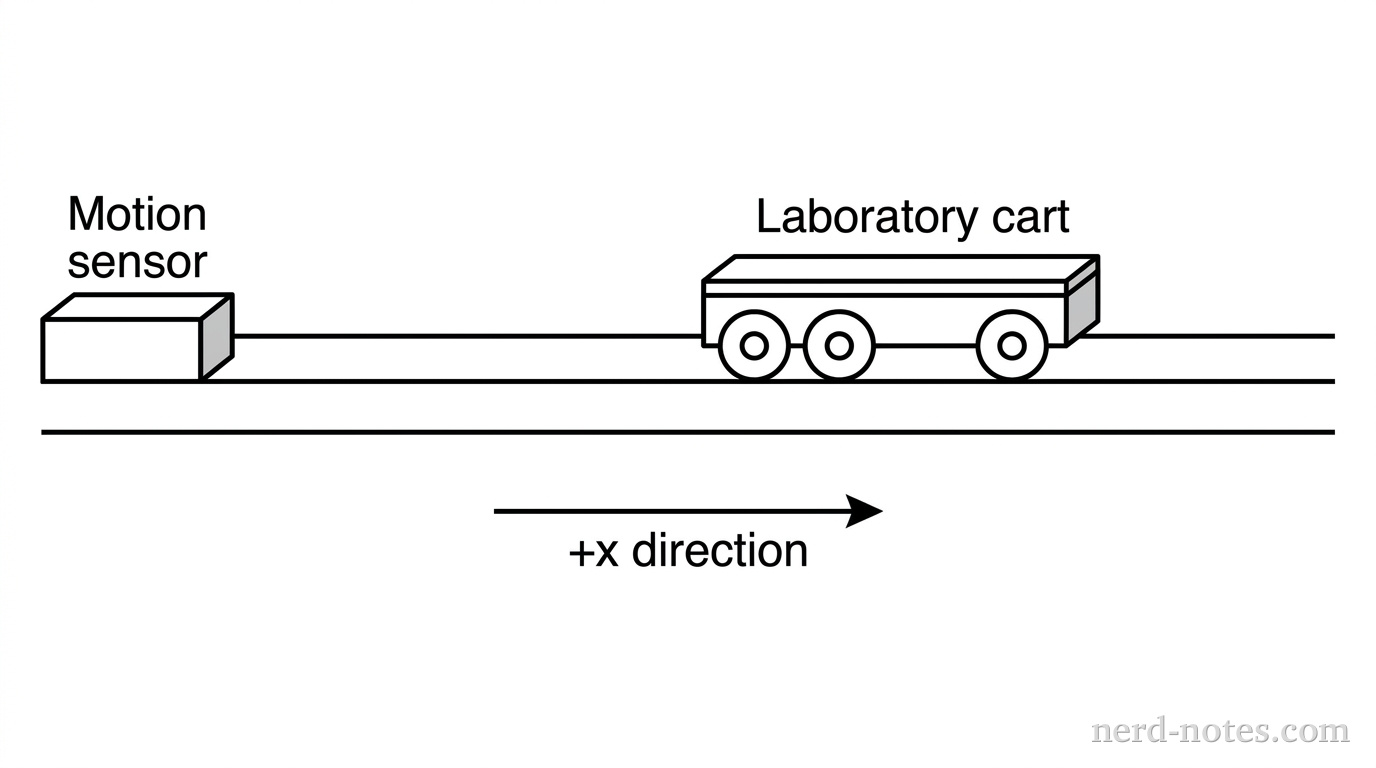
A block of mass \(m\) is attached to an ideal horizontal spring with spring constant \(k\) on a frictionless surface. The block is pulled to a displacement \(A\) from its equilibrium position and released from rest, undergoing simple harmonic motion. A student uses a motion sensor to analyze the system and intends to create an energy bar chart for the moment the block is at position \(x = \dfrac{A}{2}\).
Which of the following energy bar charts best represents the kinetic energy \(K\) of the block and the elastic potential energy \(U_s\) of the spring-block system at this position?

A block of mass \(M_1\) is connected to a block of unknown mass \(M_2\) by a light string with an ideal spring scale of negligible mass spliced into the middle. The system is pulled vertically upward by an external force of magnitude \(F\), causing the blocks to accelerate upward. The values of \(M_1\), the external force \(F\), and the spring scale reading \(F_s\) are known. Which of the following additional measurements, if any, must be made to determine the unknown mass \(M_2\)?

A small cart is released from rest at time \( t = 0 \) and moves down a straight track with constant acceleration \( a \). A motion sensor measures the speed \( v \) of the cart at different positions \( x \) along the track, where \( x = 0 \) is the starting position. The data collected is used to create the graph shown of the square of the speed \( v^2 \) as a function of position \( x \). Based on the graph, what is the acceleration of the cart?

A uniform object of mass \(M\) and radius \(R\) is released from rest at the top of a ramp inclined at an angle \(\theta\) to the horizontal. The object rolls without slipping as it moves down the ramp. The rotational inertia of the object is given by the expression \(I = cMR^2\), where \(c\) is a dimensionless constant. Which of the following expressions correctly represents the distance \(d\) the object travels along the ramp as a function of time \(t\)?

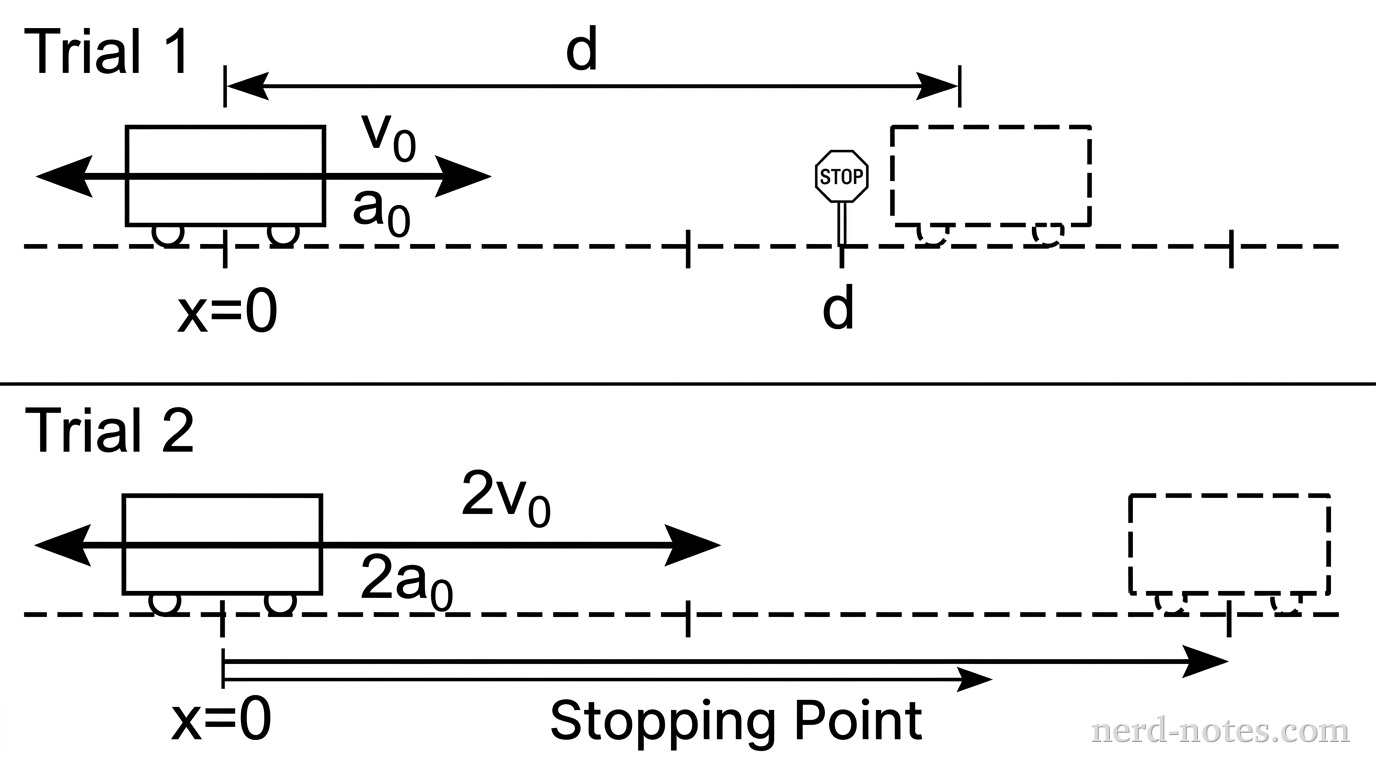
A student is calibrating a projectile launcher to be used in a laboratory experiment. The launcher is placed on the ground and set to fire a ball at an angle \( heta \) above the horizontal across a level field. In the first calibration trial, the ball is launched with an initial speed \( v_0 \) and travels a horizontal distance \( D_1 \) before hitting the ground. In the second calibration trial, the launcher is adjusted to fire the ball at the same angle \( heta \) but with an initial speed of \( 2v_0 \), resulting in a horizontal distance \( D_2 \). What is the ratio of the horizontal distance \( D_2 \) to the horizontal distance \( D_1 \)?

A block of known mass \(M\) rests on a rough horizontal table. It is attached to a lightweight, inextensible string that passes over an ideal pulley at the edge of the table. A mass hanger of negligible mass is attached to the other end of the string. The student is provided with a set of varying known masses \(m\) that can be added to the mass hanger, a ruler, and a stopwatch. The student is tasked with designing experiments to determine both the coefficient of static friction \(\mu_s\) and the coefficient of kinetic friction \(\mu_k\) between the block and the table.

A student conducts an experiment to determine the constant acceleration \(a\) of a cart that starts from rest and rolls down a long, straight track. The student uses a sensor to collect data for the distance \(d\) the cart travels as a function of time \(t\) since it was released. To determine the acceleration using the slope of a linear graph, the student should plot which of the following quantities on the vertical and horizontal axes?

A student conducts an experiment to determine the local acceleration due to gravity, g, by measuring the period T of a simple pendulum for several different string lengths L. The student intends to linearize the data so that the value of g can be calculated from the slope of a best-fit line. Which of the following combinations of quantities, when plotted on the vertical and horizontal axes, would result in a linear graph with a slope S such that g = “4\pi^2 / S”?

A uniform solid cylinder of mass \(M\) and radius \(R\) has a light string wrapped multiple times around its circumference. The free end of the string is attached to a fixed horizontal ceiling. The cylinder is held at rest and then released, falling vertically as the string unwinds without slipping. The rotational inertia of a solid cylinder about its center of mass is \(I = \dfrac{1}{2}MR^2\). After the center of mass of the cylinder has fallen a vertical distance \(h\), what is the speed of the center of mass of the cylinder?
A
By continuing you (1) agree to our Terms of Use and Terms of Sale and (2) consent to sharing your IP and browser information used by this site’s security protocols as outlined in our Privacy Policy.
| Kinematics | Forces |
|---|---|
| \(\Delta x = v_i t + \frac{1}{2} at^2\) | \(F = ma\) |
| \(v = v_i + at\) | \(F_g = \frac{G m_1 m_2}{r^2}\) |
| \(v^2 = v_i^2 + 2a \Delta x\) | \(f = \mu N\) |
| \(\Delta x = \frac{v_i + v}{2} t\) | \(F_s =-kx\) |
| \(v^2 = v_f^2 \,-\, 2a \Delta x\) |
| Circular Motion | Energy |
|---|---|
| \(F_c = \frac{mv^2}{r}\) | \(KE = \frac{1}{2} mv^2\) |
| \(a_c = \frac{v^2}{r}\) | \(PE = mgh\) |
| \(T = 2\pi \sqrt{\frac{r}{g}}\) | \(KE_i + PE_i = KE_f + PE_f\) |
| \(W = Fd \cos\theta\) |
| Momentum | Torque and Rotations |
|---|---|
| \(p = mv\) | \(\tau = r \cdot F \cdot \sin(\theta)\) |
| \(J = \Delta p\) | \(I = \sum mr^2\) |
| \(p_i = p_f\) | \(L = I \cdot \omega\) |
| Simple Harmonic Motion | Fluids |
|---|---|
| \(F = -kx\) | \(P = \frac{F}{A}\) |
| \(T = 2\pi \sqrt{\frac{l}{g}}\) | \(P_{\text{total}} = P_{\text{atm}} + \rho gh\) |
| \(T = 2\pi \sqrt{\frac{m}{k}}\) | \(Q = Av\) |
| \(x(t) = A \cos(\omega t + \phi)\) | \(F_b = \rho V g\) |
| \(a = -\omega^2 x\) | \(A_1v_1 = A_2v_2\) |
| Constant | Description |
|---|---|
| [katex]g[/katex] | Acceleration due to gravity, typically [katex]9.8 , \text{m/s}^2[/katex] on Earth’s surface |
| [katex]G[/katex] | Universal Gravitational Constant, [katex]6.674 \times 10^{-11} , \text{N} \cdot \text{m}^2/\text{kg}^2[/katex] |
| [katex]\mu_k[/katex] and [katex]\mu_s[/katex] | Coefficients of kinetic ([katex]\mu_k[/katex]) and static ([katex]\mu_s[/katex]) friction, dimensionless. Static friction ([katex]\mu_s[/katex]) is usually greater than kinetic friction ([katex]\mu_k[/katex]) as it resists the start of motion. |
| [katex]k[/katex] | Spring constant, in [katex]\text{N/m}[/katex] |
| [katex] M_E = 5.972 \times 10^{24} , \text{kg} [/katex] | Mass of the Earth |
| [katex] M_M = 7.348 \times 10^{22} , \text{kg} [/katex] | Mass of the Moon |
| [katex] M_M = 1.989 \times 10^{30} , \text{kg} [/katex] | Mass of the Sun |
| Variable | SI Unit |
|---|---|
| [katex]s[/katex] (Displacement) | [katex]\text{meters (m)}[/katex] |
| [katex]v[/katex] (Velocity) | [katex]\text{meters per second (m/s)}[/katex] |
| [katex]a[/katex] (Acceleration) | [katex]\text{meters per second squared (m/s}^2\text{)}[/katex] |
| [katex]t[/katex] (Time) | [katex]\text{seconds (s)}[/katex] |
| [katex]m[/katex] (Mass) | [katex]\text{kilograms (kg)}[/katex] |
| Variable | Derived SI Unit |
|---|---|
| [katex]F[/katex] (Force) | [katex]\text{newtons (N)}[/katex] |
| [katex]E[/katex], [katex]PE[/katex], [katex]KE[/katex] (Energy, Potential Energy, Kinetic Energy) | [katex]\text{joules (J)}[/katex] |
| [katex]P[/katex] (Power) | [katex]\text{watts (W)}[/katex] |
| [katex]p[/katex] (Momentum) | [katex]\text{kilogram meters per second (kgm/s)}[/katex] |
| [katex]\omega[/katex] (Angular Velocity) | [katex]\text{radians per second (rad/s)}[/katex] |
| [katex]\tau[/katex] (Torque) | [katex]\text{newton meters (Nm)}[/katex] |
| [katex]I[/katex] (Moment of Inertia) | [katex]\text{kilogram meter squared (kgm}^2\text{)}[/katex] |
| [katex]f[/katex] (Frequency) | [katex]\text{hertz (Hz)}[/katex] |
Metric Prefixes
Example of using unit analysis: Convert 5 kilometers to millimeters.
Start with the given measurement: [katex]\text{5 km}[/katex]
Use the conversion factors for kilometers to meters and meters to millimeters: [katex]\text{5 km} \times \frac{10^3 \, \text{m}}{1 \, \text{km}} \times \frac{10^3 \, \text{mm}}{1 \, \text{m}}[/katex]
Perform the multiplication: [katex]\text{5 km} \times \frac{10^3 \, \text{m}}{1 \, \text{km}} \times \frac{10^3 \, \text{mm}}{1 \, \text{m}} = 5 \times 10^3 \times 10^3 \, \text{mm}[/katex]
Simplify to get the final answer: [katex]\boxed{5 \times 10^6 \, \text{mm}}[/katex]
Prefix | Symbol | Power of Ten | Equivalent |
|---|---|---|---|
Pico- | p | [katex]10^{-12}[/katex] | 0.000000000001 |
Nano- | n | [katex]10^{-9}[/katex] | 0.000000001 |
Micro- | µ | [katex]10^{-6}[/katex] | 0.000001 |
Milli- | m | [katex]10^{-3}[/katex] | 0.001 |
Centi- | c | [katex]10^{-2}[/katex] | 0.01 |
Deci- | d | [katex]10^{-1}[/katex] | 0.1 |
(Base unit) | – | [katex]10^{0}[/katex] | 1 |
Deca- or Deka- | da | [katex]10^{1}[/katex] | 10 |
Hecto- | h | [katex]10^{2}[/katex] | 100 |
Kilo- | k | [katex]10^{3}[/katex] | 1,000 |
Mega- | M | [katex]10^{6}[/katex] | 1,000,000 |
Giga- | G | [katex]10^{9}[/katex] | 1,000,000,000 |
Tera- | T | [katex]10^{12}[/katex] | 1,000,000,000,000 |
One price to unlock most advanced version of Phy across all our tools.
per month
Billed Monthly. Cancel Anytime.
We crafted THE Ultimate A.P Physics 1 Program so you can learn faster and score higher.
Try our free calculator to see what you need to get a 5 on the 2026 AP Physics 1 exam.
A quick explanation
Credits are used to grade your FRQs and GQs. Pro users get unlimited credits.
Submitting counts as 1 attempt.
Viewing answers or explanations count as a failed attempts.
Phy gives partial credit if needed
MCQs and GQs are are 1 point each. FRQs will state points for each part.
Phy customizes problem explanations based on what you struggle with. Just hit the explanation button to see.
Understand you mistakes quicker.
Phy automatically provides feedback so you can improve your responses.
10 Free Credits To Get You Started
By continuing you agree to nerd-notes.com Terms of Service, Privacy Policy, and our usage of user data.
Feeling uneasy about your next physics test? We'll boost your grade in 3 lessons or less—guaranteed
NEW! PHY AI accurately solves all questions
🔥 Get up to 30% off Elite Physics Tutoring
🧠 NEW! Learn Physics From Scratch Self Paced Course
🎯 Need exam style practice questions?