
| Step | Reasoning |
|---|---|
| Identify the relationship between total speed and the velocity components. \[ v(t) = \sqrt{v_x(t)^2 + v_y(t)^2} \] |
The question asks for a graph of speed \(v\) as a function of time. |
| Analyze the horizontal component of the velocity. \[ v_x(t) = v_0 \cos \theta = \text{constant} \] |
The total speed depends on the horizontal velocity component throughout the motion. |
| Analyze the vertical component of the velocity. \[ v_y(t) = v_0 \sin \theta – gt \] |
The total speed depends on the changing vertical velocity component as the projectile rises and falls. |
| Evaluate the speed at the peak of the trajectory. \[ v_{\text{peak}} = \sqrt{(v_0 \cos \theta)^2 + 0^2} = v_0 \cos \theta \] |
To determine the shape of the graph and its minimum value, we must check the point where vertical velocity is zero. |
| Determine the qualitative shape of the graph. \[ v(t) = \sqrt{(v_0 \cos \theta)^2 + (v_0 \sin \theta – gt)^2} \] |
Since \(v_x\) is non-zero, the speed never reaches zero, and the Pythagorean combination of a constant and a linear term results in a smooth, non-linear curve. |
Why each choice is correct or incorrect:
(A) Incorrectly assumes the total speed is equal to the magnitude of the vertical velocity, which would drop to zero at the peak and create a sharp V-shape.
(B) Incorrectly assumes that speed is constant during projectile motion, perhaps by only considering the horizontal component of motion.
(C) This is the correct answer; it accounts for a non-zero minimum speed at the peak and a smooth hyperbolic change over time.
(D) Incorrectly represents the height of the projectile as a function of time instead of the speed, or assumes speed starts at zero.
A Major Upgrade To Phy Is Coming Soon — Stay Tuned
We'll help clarify entire units in one hour or less — guaranteed.
A self paced course with videos, problems sets, and everything you need to get a 5. Trusted by over 15k students and over 200 schools.

A stepped pulley consists of two rigidly connected concentric solid disks that rotate together on a frictionless horizontal axle. The outer disk has radius \(R\) and the inner disk has radius \(r\). The total rotational inertia of the pulley about the axle is \(I\).
A block of mass \(m_1\) hangs from a light string wrapped around the outer disk. A second block of mass \(m_2\) hangs from a light string wrapped around the inner disk. The strings do not slip. They are wrapped such that Block 1 exerts a counterclockwise torque and Block 2 exerts a clockwise torque on the pulley.
The system is released from rest, and Block 1 is observed to accelerate downward.
A student is tasked with designing an experiment to determine the local acceleration due to gravity, \(g\), using a simple pendulum. The student has access to the following equipment:
– A stable ring stand with a clamp
– A spool of lightweight string
– A set of small hooked spheres of various masses
– A meterstick
– A stopwatch
– A protractor

An astronaut on a space station uses a Body Mass Measurement Device (BMMD) to determine their mass in microgravity. The device consists of a seat of mass \(m_s\) attached to a spring with an unknown spring constant \(k\). To calibrate the device, the astronaut attaches several calibration blocks of known mass \(m\) to the seat and measures the period of oscillation \(T\) for each mass. To determine the spring constant \(k\) from a linear graph, which of the following quantities should be plotted on the vertical and horizontal axes, and what is the physical significance of the slope of the resulting best-fit line?

Cart A with mass \(m\) is moving with velocity \(v\) to the right on a horizontal, frictionless track toward Cart B with mass \(2m\), which is initially at rest. The carts collide, and during the collision, Cart A exerts a constant average force of magnitude \(F\) on Cart B for a time interval \(\Delta t\).
Which of the following correctly identifies the change in momentum of Cart A, \(\Delta p_A\), and the change in momentum of the two-cart system, \(\Delta p_{sys}\), during this time interval?
| | \(\Delta p_A\) | \(\Delta p_{sys}\) |
|—|—|—|
| (A) | \(-F\Delta t\) | \(0\) |
| (B) | \(+F\Delta t\) | \(0\) |
| (C) | \(-F\Delta t\) | \(-F\Delta t\) |
| (D) | \(-F\Delta t\) | \(+F\Delta t\) |

A block of mass \(m\) is placed on a frictionless horizontal surface and attached to one end of an ideal spring with spring constant \(k\). The other end of the spring is fixed to a wall. The block is pulled to a displacement of magnitude \(A\) from its equilibrium position and released from rest, causing it to oscillate in simple harmonic motion. Which of the following is a correct expression for the speed of the block when it is at a position \(x = \dfrac{A}{2}\)?

Three blocks, labeled \(X\), \(Y\), and \(Z\), have masses \(m\), \(2m\), and \(3m\), respectively. The blocks are placed on a frictionless horizontal surface in the order \(X\)-\(Y\)-\(Z\) and are pushed to the right by a constant horizontal force of magnitude \(F\) applied to block \(X\). In this configuration, the magnitude of the contact force exerted by block \(Y\) on block \(Z\) is \(F_1\). The blocks are then rearranged on the same surface in the order \(X\)-\(Z\)-\(Y\). The same force \(F\) is applied to block \(X\), and the magnitude of the contact force exerted by block \(Z\) on block \(Y\) is \(F_2\). What is the ratio \(\dfrac{F_2}{F_1}\)?

A large, sealed cylindrical tank is filled with an ideal, incompressible fluid of density \(\rho\) to a total height \(H\). The air in the space above the fluid is maintained at a constant gauge pressure of \(P_G = 4\rho g H\). A small hole is opened in the side of the tank at a depth \(d = 0.5H\) below the fluid’s surface, and the fluid exits with speed \(v_1\). If the top of the tank were instead open to the atmosphere and the hole remained at the same depth, the fluid would exit with speed \(v_2\).
What is the ratio \(v_1 / v_2\)?

An incompressible, nonviscous fluid of density \(\rho\) flows through a horizontal pipe. At a wide section of the pipe, denoted as Point 1, the cross-sectional area is \(A_1\), the fluid speed is \(v_1\), and the pressure is \(P_1\). Further downstream, the pipe narrows to a constriction at Point 2 with a cross-sectional area \(A_2\). Which of the following is a correct expression for the fluid pressure \(P_2\) at the constriction?
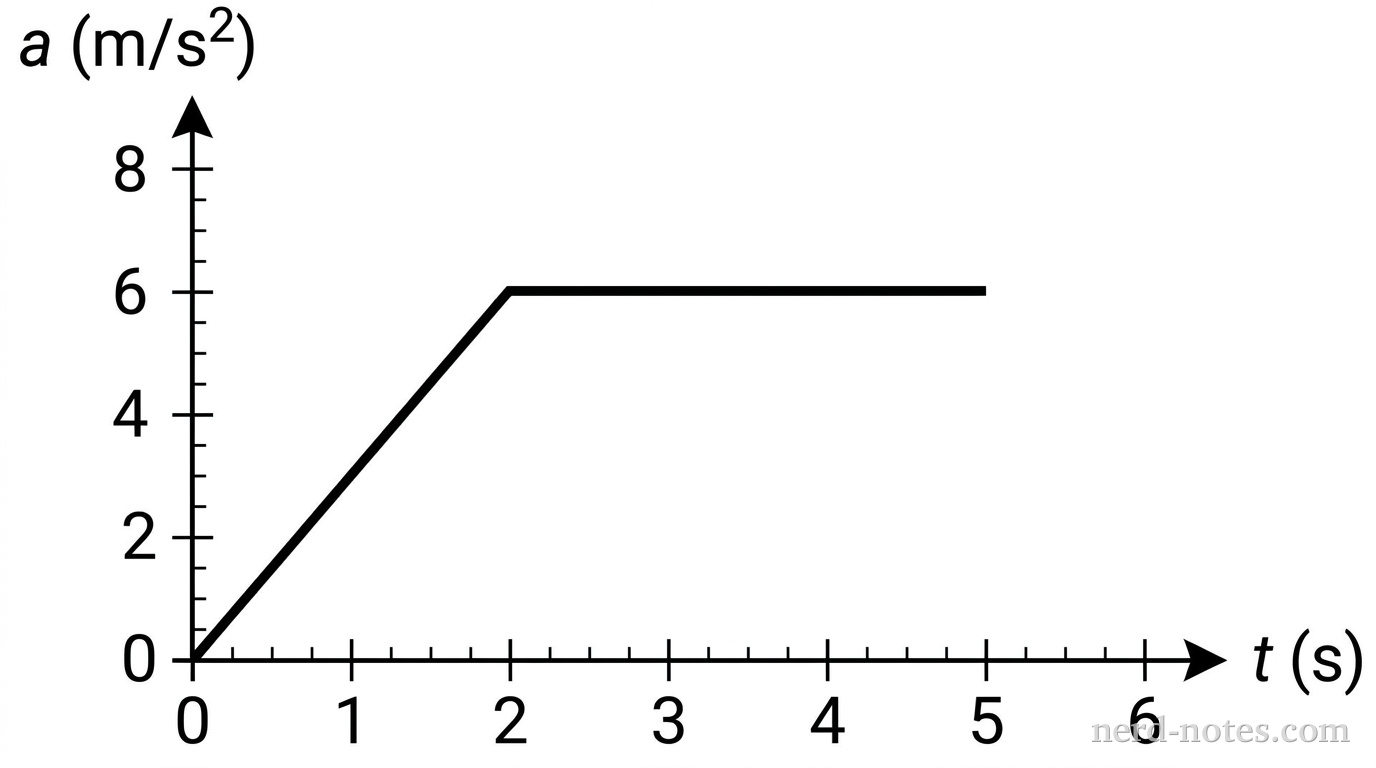
A rigid, uniform disk is mounted on a low-friction axle and is initially at rest. A motor applies a net torque to the disk that increases at a constant rate, starting from zero at time \(t = 0\). Which of the following graphs best represents the angular acceleration \(\alpha\) of the disk as a function of time \(t\)?

A student measures the absolute pressure \(P\) as a function of depth \(h\) for three different incompressible liquids (Liquid 1, Liquid 2, and Liquid 3) held in open containers. The data for each liquid are shown in the graph. All three containers are located in the same laboratory.
Based on the graph, what is the ratio of the density of Liquid 3 to the density of Liquid 1, \(\dfrac{\rho_3}{\rho_1}\)?
C
By continuing you (1) agree to our Terms of Use and Terms of Sale and (2) consent to sharing your IP and browser information used by this site’s security protocols as outlined in our Privacy Policy.
| Kinematics | Forces |
|---|---|
| \(\Delta x = v_i t + \frac{1}{2} at^2\) | \(F = ma\) |
| \(v = v_i + at\) | \(F_g = \frac{G m_1 m_2}{r^2}\) |
| \(v^2 = v_i^2 + 2a \Delta x\) | \(f = \mu N\) |
| \(\Delta x = \frac{v_i + v}{2} t\) | \(F_s =-kx\) |
| \(v^2 = v_f^2 \,-\, 2a \Delta x\) |
| Circular Motion | Energy |
|---|---|
| \(F_c = \frac{mv^2}{r}\) | \(KE = \frac{1}{2} mv^2\) |
| \(a_c = \frac{v^2}{r}\) | \(PE = mgh\) |
| \(T = 2\pi \sqrt{\frac{r}{g}}\) | \(KE_i + PE_i = KE_f + PE_f\) |
| \(W = Fd \cos\theta\) |
| Momentum | Torque and Rotations |
|---|---|
| \(p = mv\) | \(\tau = r \cdot F \cdot \sin(\theta)\) |
| \(J = \Delta p\) | \(I = \sum mr^2\) |
| \(p_i = p_f\) | \(L = I \cdot \omega\) |
| Simple Harmonic Motion | Fluids |
|---|---|
| \(F = -kx\) | \(P = \frac{F}{A}\) |
| \(T = 2\pi \sqrt{\frac{l}{g}}\) | \(P_{\text{total}} = P_{\text{atm}} + \rho gh\) |
| \(T = 2\pi \sqrt{\frac{m}{k}}\) | \(Q = Av\) |
| \(x(t) = A \cos(\omega t + \phi)\) | \(F_b = \rho V g\) |
| \(a = -\omega^2 x\) | \(A_1v_1 = A_2v_2\) |
| Constant | Description |
|---|---|
| [katex]g[/katex] | Acceleration due to gravity, typically [katex]9.8 , \text{m/s}^2[/katex] on Earth’s surface |
| [katex]G[/katex] | Universal Gravitational Constant, [katex]6.674 \times 10^{-11} , \text{N} \cdot \text{m}^2/\text{kg}^2[/katex] |
| [katex]\mu_k[/katex] and [katex]\mu_s[/katex] | Coefficients of kinetic ([katex]\mu_k[/katex]) and static ([katex]\mu_s[/katex]) friction, dimensionless. Static friction ([katex]\mu_s[/katex]) is usually greater than kinetic friction ([katex]\mu_k[/katex]) as it resists the start of motion. |
| [katex]k[/katex] | Spring constant, in [katex]\text{N/m}[/katex] |
| [katex] M_E = 5.972 \times 10^{24} , \text{kg} [/katex] | Mass of the Earth |
| [katex] M_M = 7.348 \times 10^{22} , \text{kg} [/katex] | Mass of the Moon |
| [katex] M_M = 1.989 \times 10^{30} , \text{kg} [/katex] | Mass of the Sun |
| Variable | SI Unit |
|---|---|
| [katex]s[/katex] (Displacement) | [katex]\text{meters (m)}[/katex] |
| [katex]v[/katex] (Velocity) | [katex]\text{meters per second (m/s)}[/katex] |
| [katex]a[/katex] (Acceleration) | [katex]\text{meters per second squared (m/s}^2\text{)}[/katex] |
| [katex]t[/katex] (Time) | [katex]\text{seconds (s)}[/katex] |
| [katex]m[/katex] (Mass) | [katex]\text{kilograms (kg)}[/katex] |
| Variable | Derived SI Unit |
|---|---|
| [katex]F[/katex] (Force) | [katex]\text{newtons (N)}[/katex] |
| [katex]E[/katex], [katex]PE[/katex], [katex]KE[/katex] (Energy, Potential Energy, Kinetic Energy) | [katex]\text{joules (J)}[/katex] |
| [katex]P[/katex] (Power) | [katex]\text{watts (W)}[/katex] |
| [katex]p[/katex] (Momentum) | [katex]\text{kilogram meters per second (kgm/s)}[/katex] |
| [katex]\omega[/katex] (Angular Velocity) | [katex]\text{radians per second (rad/s)}[/katex] |
| [katex]\tau[/katex] (Torque) | [katex]\text{newton meters (Nm)}[/katex] |
| [katex]I[/katex] (Moment of Inertia) | [katex]\text{kilogram meter squared (kgm}^2\text{)}[/katex] |
| [katex]f[/katex] (Frequency) | [katex]\text{hertz (Hz)}[/katex] |
Metric Prefixes
Example of using unit analysis: Convert 5 kilometers to millimeters.
Start with the given measurement: [katex]\text{5 km}[/katex]
Use the conversion factors for kilometers to meters and meters to millimeters: [katex]\text{5 km} \times \frac{10^3 \, \text{m}}{1 \, \text{km}} \times \frac{10^3 \, \text{mm}}{1 \, \text{m}}[/katex]
Perform the multiplication: [katex]\text{5 km} \times \frac{10^3 \, \text{m}}{1 \, \text{km}} \times \frac{10^3 \, \text{mm}}{1 \, \text{m}} = 5 \times 10^3 \times 10^3 \, \text{mm}[/katex]
Simplify to get the final answer: [katex]\boxed{5 \times 10^6 \, \text{mm}}[/katex]
Prefix | Symbol | Power of Ten | Equivalent |
|---|---|---|---|
Pico- | p | [katex]10^{-12}[/katex] | 0.000000000001 |
Nano- | n | [katex]10^{-9}[/katex] | 0.000000001 |
Micro- | µ | [katex]10^{-6}[/katex] | 0.000001 |
Milli- | m | [katex]10^{-3}[/katex] | 0.001 |
Centi- | c | [katex]10^{-2}[/katex] | 0.01 |
Deci- | d | [katex]10^{-1}[/katex] | 0.1 |
(Base unit) | – | [katex]10^{0}[/katex] | 1 |
Deca- or Deka- | da | [katex]10^{1}[/katex] | 10 |
Hecto- | h | [katex]10^{2}[/katex] | 100 |
Kilo- | k | [katex]10^{3}[/katex] | 1,000 |
Mega- | M | [katex]10^{6}[/katex] | 1,000,000 |
Giga- | G | [katex]10^{9}[/katex] | 1,000,000,000 |
Tera- | T | [katex]10^{12}[/katex] | 1,000,000,000,000 |
One price to unlock most advanced version of Phy across all our tools.
per month
Billed Monthly. Cancel Anytime.
We crafted THE Ultimate A.P Physics 1 Program so you can learn faster and score higher.
Try our free calculator to see what you need to get a 5 on the 2026 AP Physics 1 exam.
A quick explanation
Credits are used to grade your FRQs and GQs. Pro users get unlimited credits.
Submitting counts as 1 attempt.
Viewing answers or explanations count as a failed attempts.
Phy gives partial credit if needed
MCQs and GQs are are 1 point each. FRQs will state points for each part.
Phy customizes problem explanations based on what you struggle with. Just hit the explanation button to see.
Understand you mistakes quicker.
Phy automatically provides feedback so you can improve your responses.
10 Free Credits To Get You Started
By continuing you agree to nerd-notes.com Terms of Service, Privacy Policy, and our usage of user data.
Feeling uneasy about your next physics test? We'll boost your grade in 3 lessons or less—guaranteed
NEW! PHY AI accurately solves all questions
🔥 Get up to 30% off Elite Physics Tutoring
🧠 NEW! Learn Physics From Scratch Self Paced Course
🎯 Need exam style practice questions?