
| Step | Reasoning |
|---|---|
| Identify the equilibrium condition and define the pivot. \[ \sum \tau_{pivot} = 0 \] |
The system is in static equilibrium, so the net torque about any point must be zero. Choosing the pivot at \(L/4\) eliminates the unknown normal force from the pivot. |
| Identify the forces and their respective lever arms relative to the pivot. | Each force contributes a torque based on its distance from the pivot. The pivot is at \(L/4\) from the left end. The mass \(m_1\) is at distance \(L/4\). The rod’s weight \(Mg\) acts at its center of mass (at \(L/2\)), which is at distance \(L/2 – L/4 = L/4\) from the pivot. The submerged object at the right end is at distance \(L – L/4 = 3L/4\) from the pivot. |
| Determine the tension in the string supporting the submerged object. \[ T = m_s g – F_B = \rho_s V g – \rho_f V g = (\rho_s – \rho_f) V g \] |
The submerged object pulls the right end of the rod down with a tension \(T\). By Newton’s Second Law on the object, the tension equals the weight minus the buoyant force. |
| Set up the torque balance equation. \[ m_1 g \left( \dfrac{L}{4} \right) = Mg \left( \dfrac{L}{4} \right) + T \left( \dfrac{3L}{4} \right) \] |
The mass \(m_1\) creates a counter-clockwise torque, while the rod’s weight and the tension create clockwise torques. |
| Substitute the expression for tension and solve for \(m_1\). \[ \begin{align*} m_1 g \left( \dfrac{L}{4} \right) &= Mg \left( \dfrac{L}{4} \right) + (\rho_s – \rho_f) V g \left( \dfrac{3L}{4} \right) \\ m_1 &= M + 3V(\rho_s – \rho_f) \end{align*} \] |
Combining the physical relationships allows for the derivation of the final symbolic expression. |
Why each choice is correct or incorrect:
(A) Uses the same lever arm for the object as for the mass and rod, ignoring the fact that the right side of the rod is 3 times longer than the left side relative to the pivot.
(B) Neglects the buoyant force (the upward force of the fluid), assuming the tension in the string is simply the object’s weight.
(C) Incorrectly treats the buoyant force as an additional downward force (adding to weight) rather than an upward force (reducing tension).
(D) This is the correct answer, properly accounting for the rod’s center of mass torque, the object’s buoyancy, and the relative lever arms.
A Major Upgrade To Phy Is Coming Soon — Stay Tuned
We'll help clarify entire units in one hour or less — guaranteed.
A self paced course with videos, problems sets, and everything you need to get a 5. Trusted by over 15k students and over 200 schools.

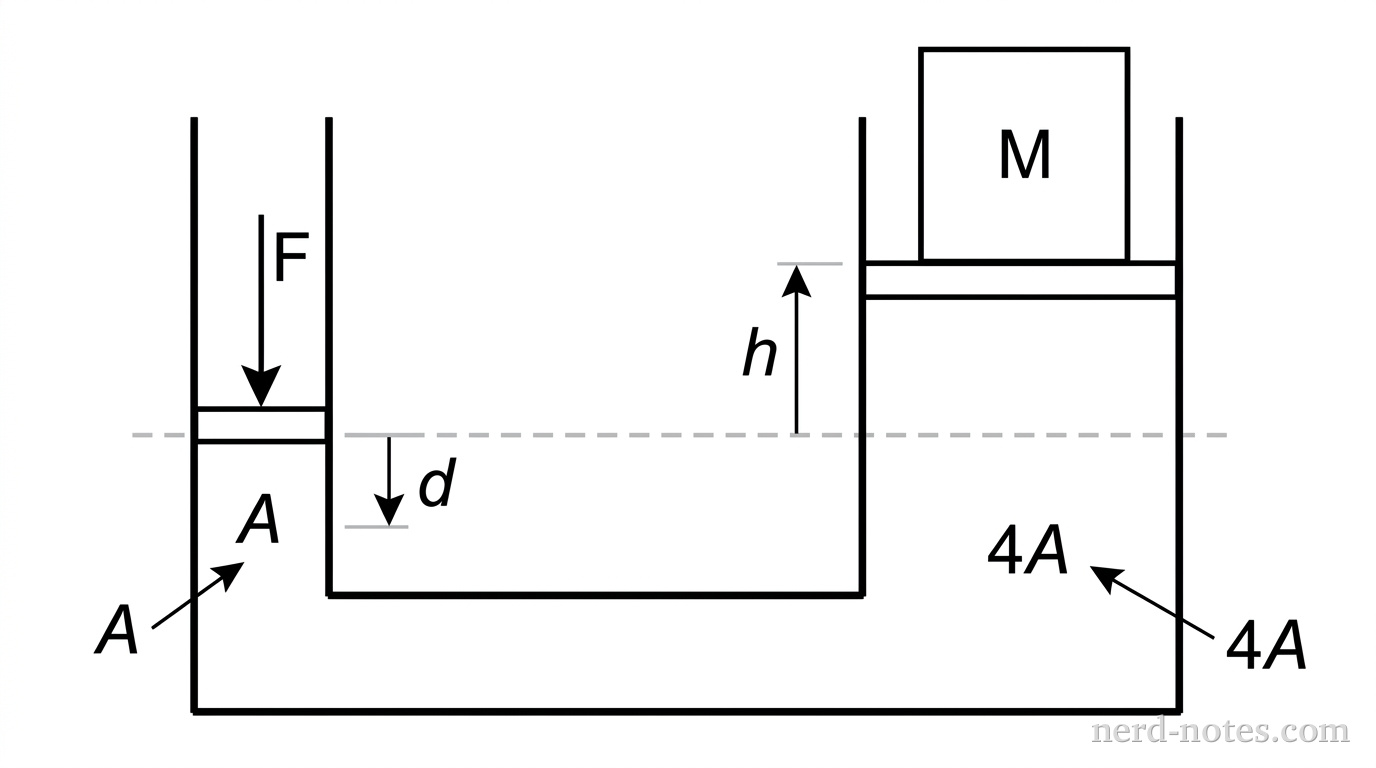
A hydraulic lift is constructed with an input cylinder of cross-sectional area \(A\) and an output cylinder of cross-sectional area \(4A\). The cylinders are filled with an incompressible fluid of density \(\rho\). Initially, the system is in equilibrium with the fluid at the same horizontal level in both cylinders. A crate of mass \(M\) is placed on the output piston, and an external force \(F\) is applied to the input piston to lift the crate. The crate is raised a vertical distance \(h\) and then held at rest. Assuming the pistons have negligible mass and the fluid is ideal, which of the following is a correct expression for the magnitude of the force \(F\) required to hold the crate in this new position?
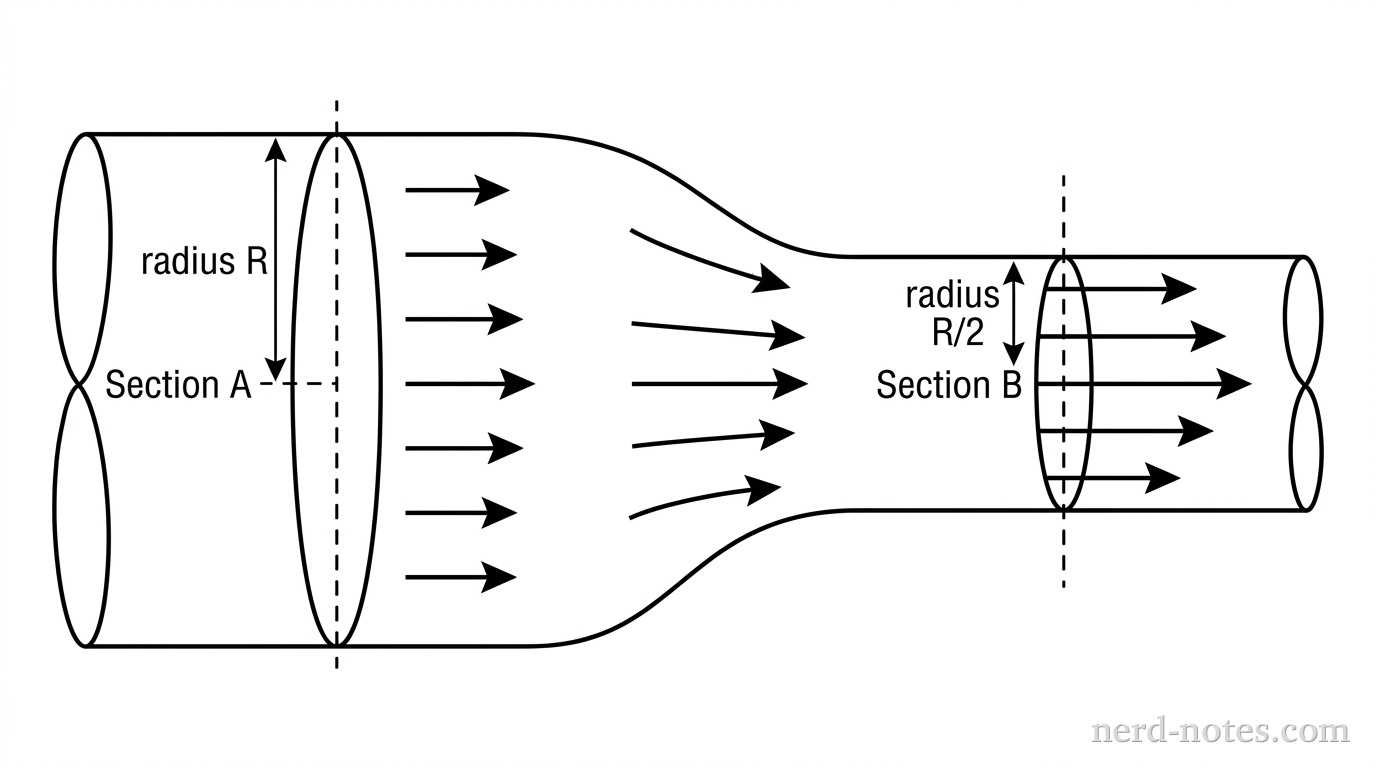
An ideal, incompressible fluid flows at a steady rate through a horizontal, cylindrical pipe. At Section A, the pipe has a radius \(R\). Further downstream, at Section B, the pipe narrows to a radius \(\frac{R}{2}\). Which of the following correctly compares the fluid speed \(v\), the volume flow rate \(Q\), and the time \(\Delta t\) required for a fixed volume of fluid to pass through a cross-sectional plane at Section B to the corresponding values at Section A?
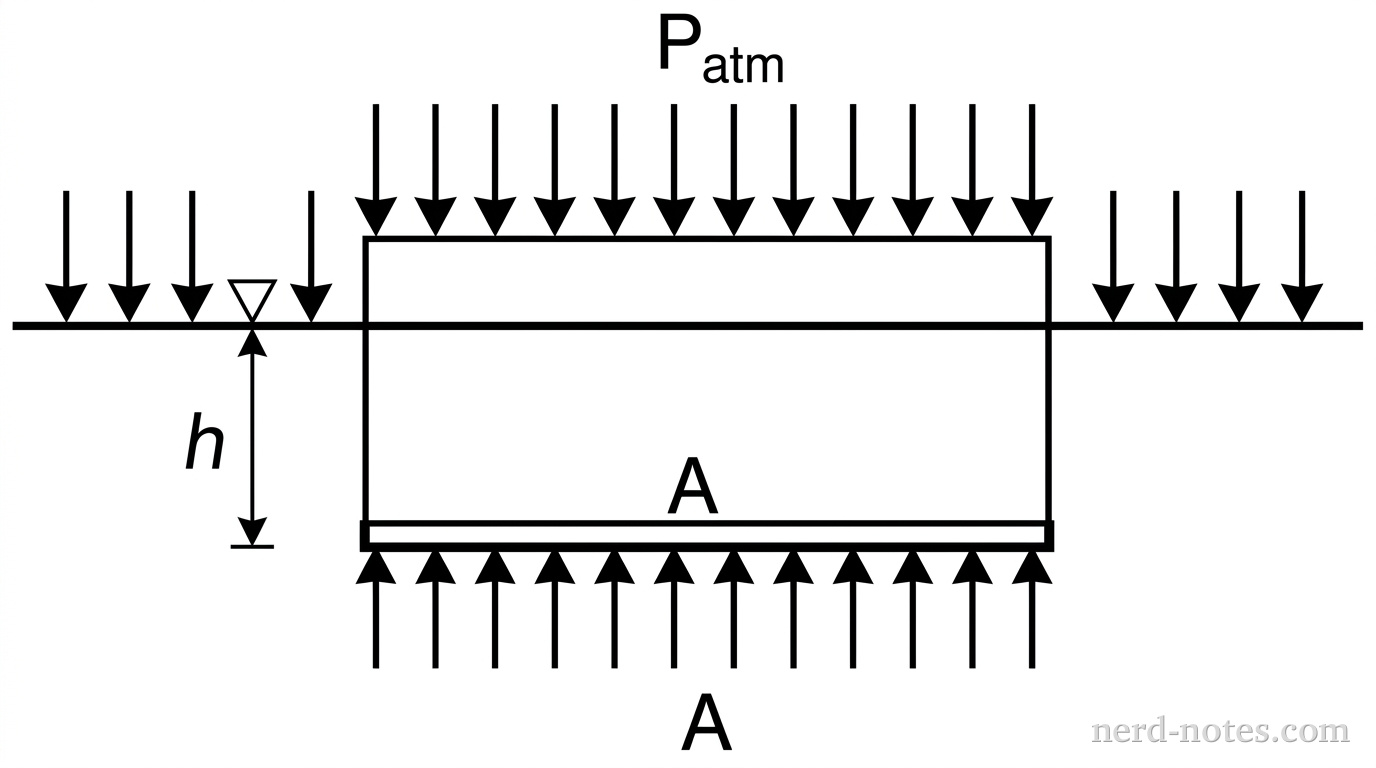
A ship of mass \(M\) floats in equilibrium in a body of water with density \(\rho_w\). The ship has a flat-bottomed hull with a constant horizontal cross-sectional area \(A\). The bottom of the hull is submerged to a depth \(h\) below the surface, and the atmospheric pressure is \(P_{atm}\). Two students make the following claims about the forces acting on the ship:
Student 1: The buoyant force exerted by the water is equal to the weight of the displaced water, \(\rho_w Ahg\), and this force must be equal to the ship’s weight, \(Mg\).
Student 2: The upward force from the water on the bottom of the hull is what supports the ship, so the water pressure at the depth of the hull’s bottom must be equal to \(\dfrac{Mg}{A}\).
Which student’s claim is correct, and what is the valid physical justification?
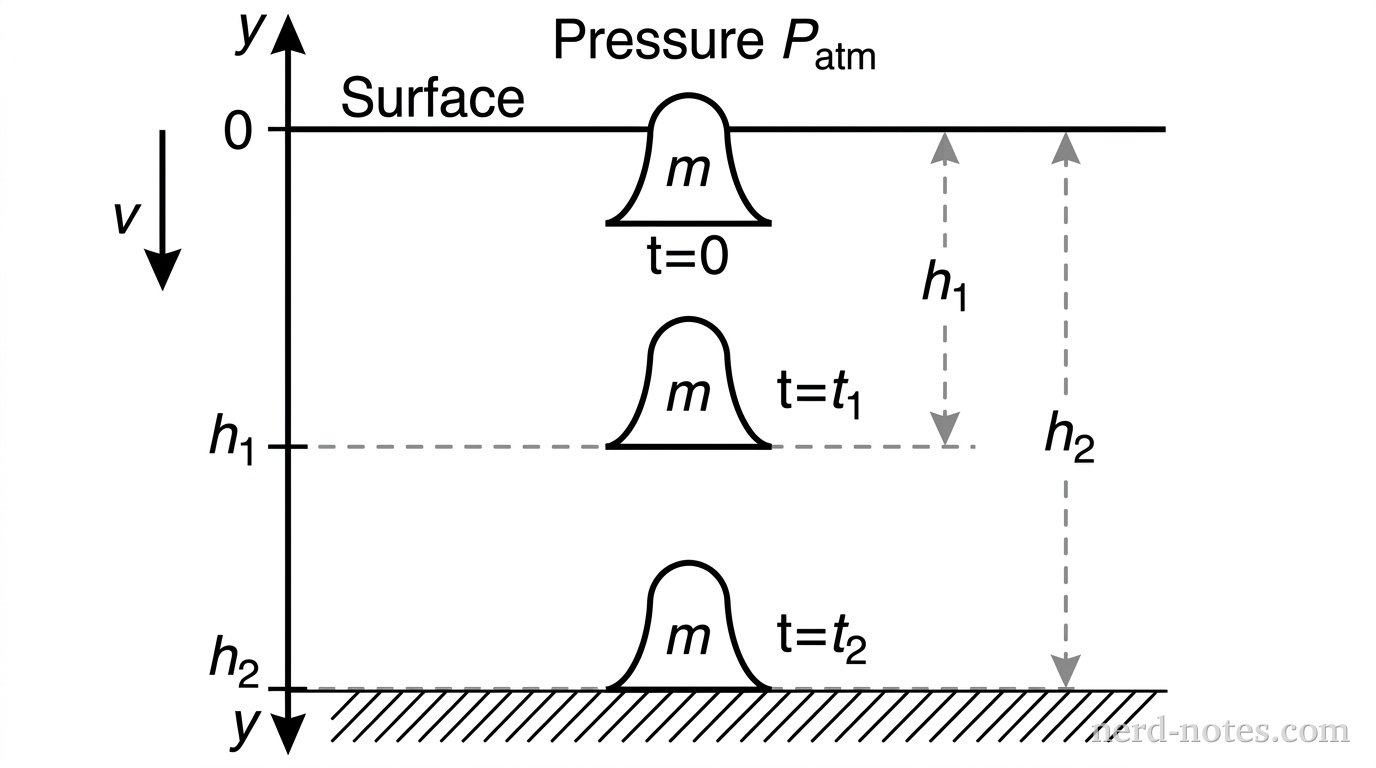
A diving bell is lowered from the surface of a deep lake into the water at a constant speed \(v\). At the surface of the lake, the absolute pressure is \(P_{atm}\). The bell is lowered until the absolute pressure exerted by the water on the bell is \(1.5 P_{atm}\), which occurs at time \(t_1\) after the bell leaves the surface. At what time \(t_2\) after leaving the surface will the absolute pressure on the bell be \(2.5 P_{atm}\)?
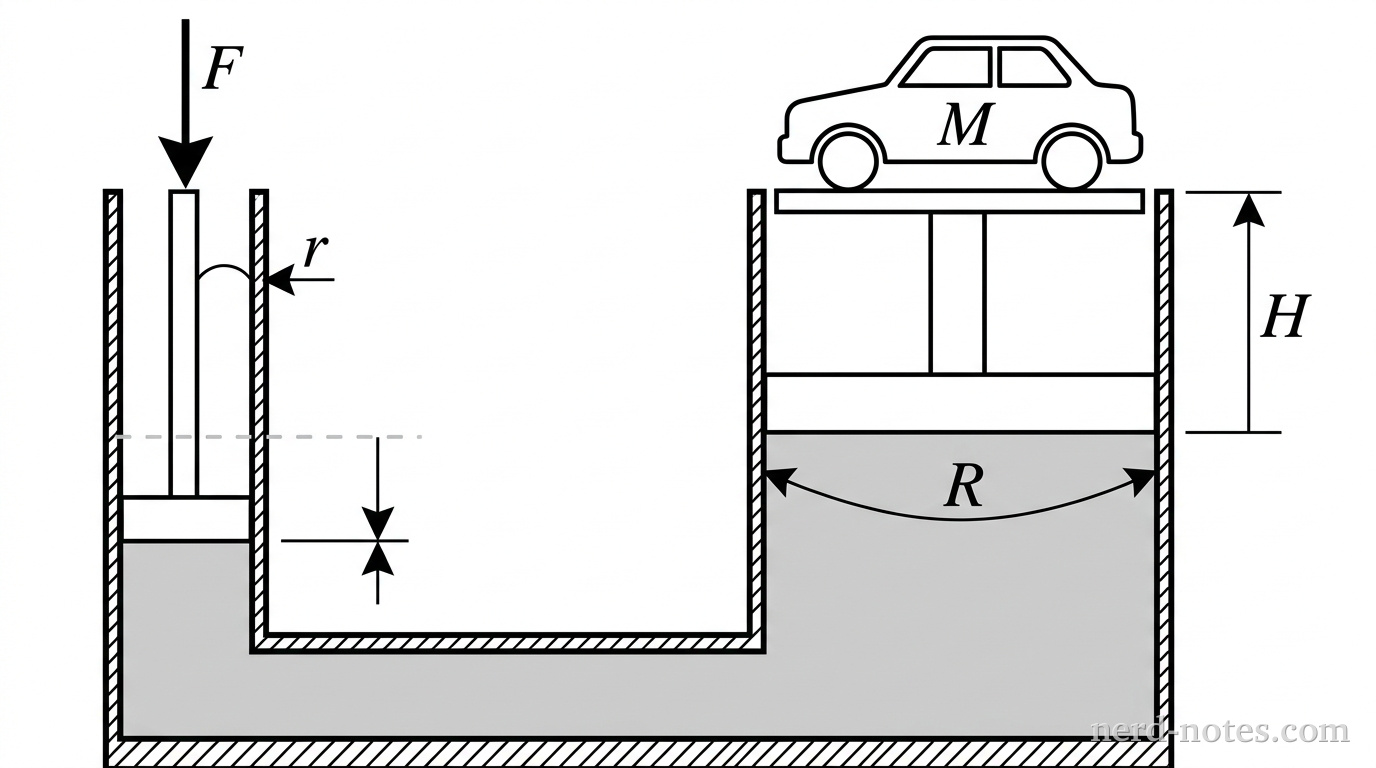
A hydraulic lift is filled with an ideal, incompressible fluid of negligible mass. A car of mass \( M \) sits on a large circular piston of radius \( R \). A mechanic applies a constant downward force \( F \) to a smaller circular piston of radius \( r \), causing the car to be lifted a vertical distance \( H \) at a constant speed. Which of the following correctly identifies the magnitude of the force \( F \) and the total work \( W \) done by the mechanic on the system?
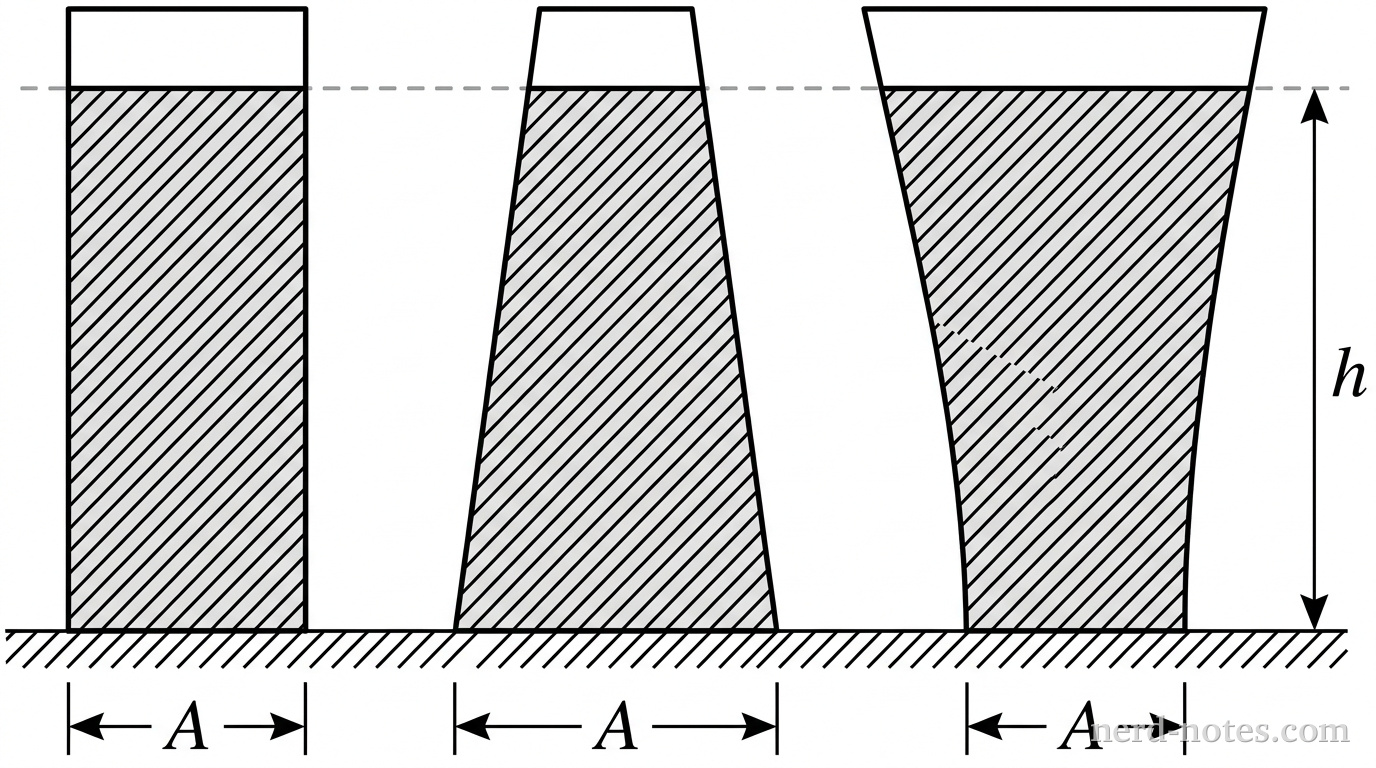
Three containers with the same base area \(A\) are filled with the same liquid of density \(\rho\) to the same height \(h\). Container 1 is a cylinder, Container 2 has walls that narrow toward the top, and Container 3 has walls that widen toward the top, as shown in the diagram. Which of the following correctly compares the magnitude of the downward force \(F_{base}\) exerted by the liquid on the base of Container 3 to the weight \(W\) of the liquid in Container 3, and provides a correct justification?
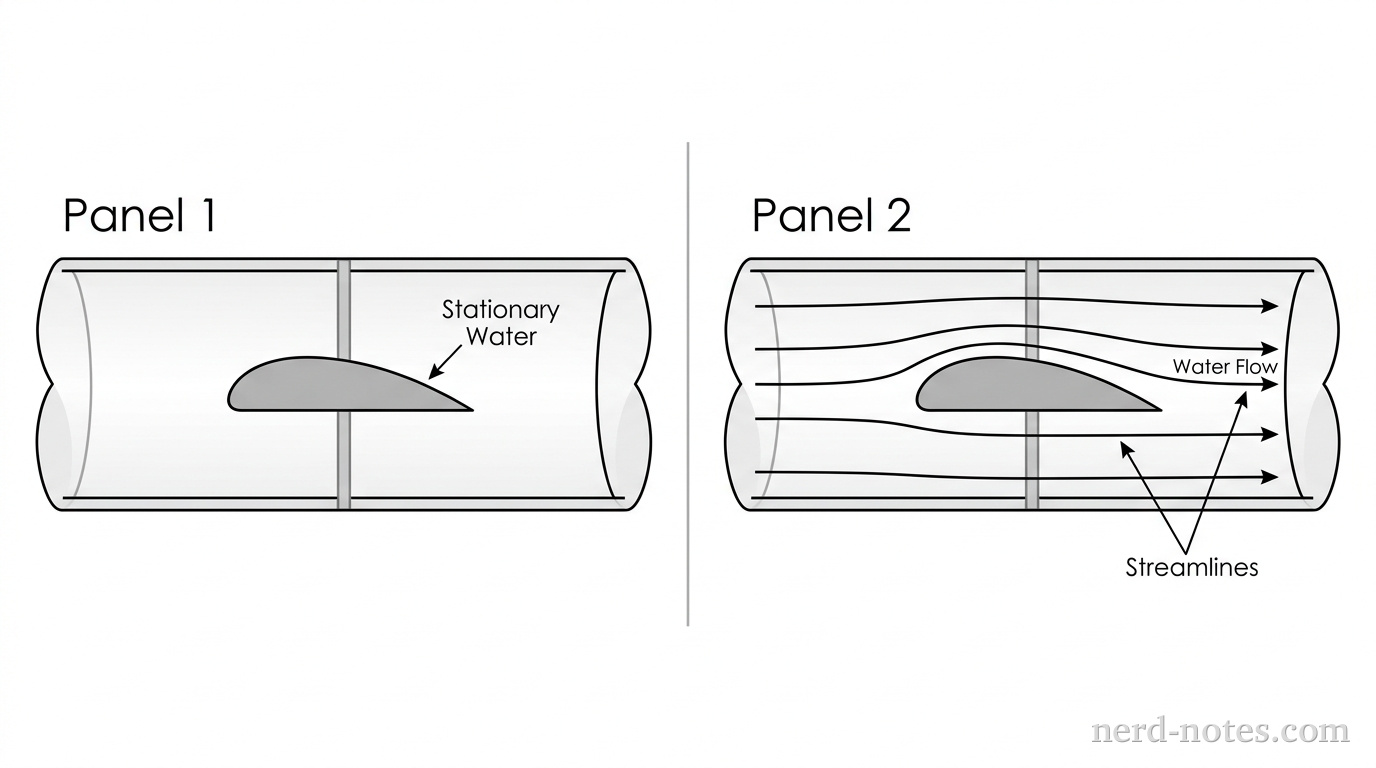
A rigid object with a volume \(V\) is fully submerged and held at a fixed position in a horizontal pipe. The object has an asymmetrical cross-section that is flat on the bottom and curved on the top. In Situation 1, the water in the pipe is stationary. In Situation 2, water of density \(\rho\) flows through the pipe at a high constant velocity. In both situations, the object is completely surrounded by water and remains at the same depth. Which of the following correctly compares the magnitude of the net vertical force \(F_{\text{water}}\) exerted by the water on the object in the two situations and provides a correct physical justification?
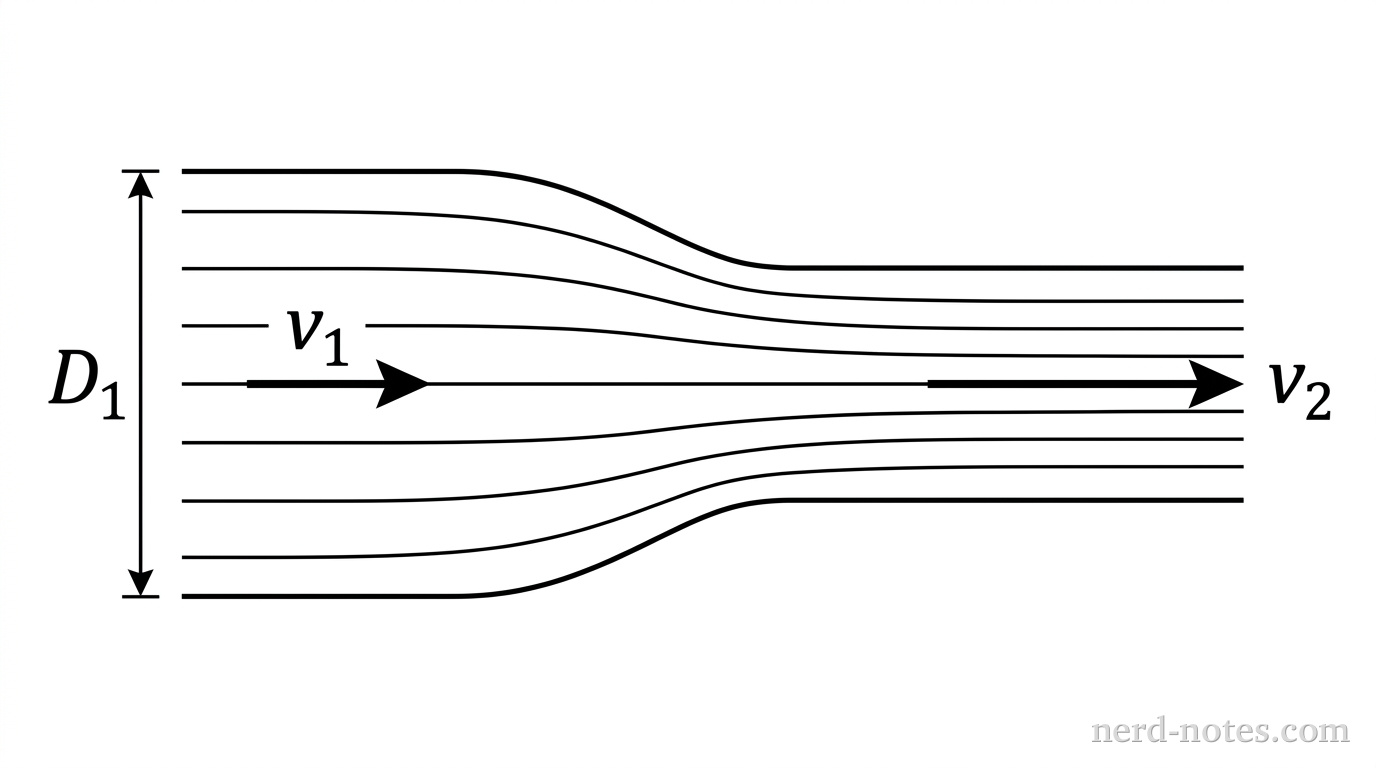
In a water filtration system, water flows through a main horizontal pipe of diameter \(D_1\) with a constant speed \(v_1\). To increase the speed for the filtration process, the pipe tapers to a smaller diameter \(D_2\). Assuming the water behaves as an ideal, incompressible fluid, which of the following expressions correctly represents the speed \(v_2\) of the water in the narrower section of the pipe?
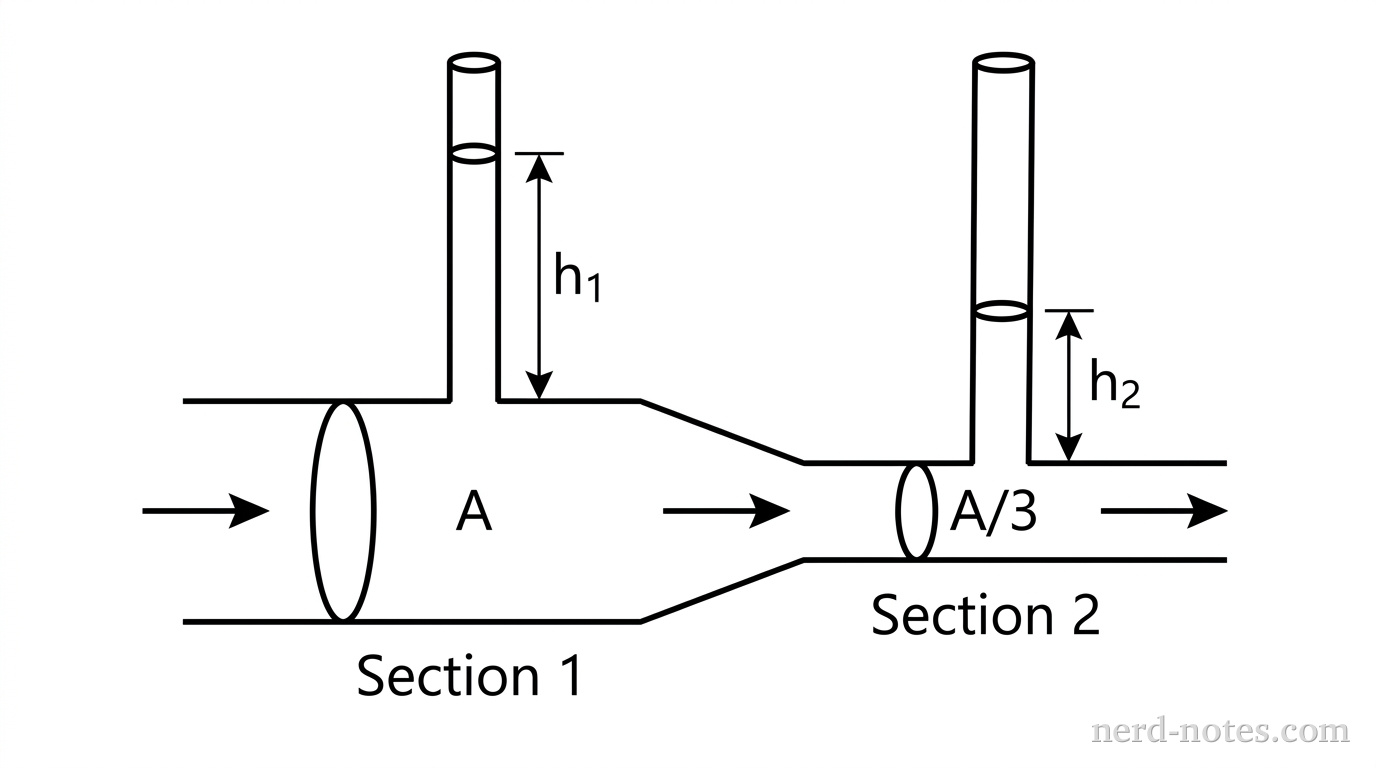
An ideal, incompressible liquid of density \(\rho\) flows through a horizontal pipe. The pipe consists of two sections: Section 1 has a cross-sectional area \(A\), and Section 2 has a cross-sectional area \(\dfrac{A}{3}\). The speed of the liquid in Section 1 is \(v\). Two vertical tubes, both open to the atmosphere, are attached to the pipe—one at Section 1 and one at Section 2—allowing the liquid to rise to heights \(h_1\) and \(h_2\), respectively. If \(g\) is the acceleration due to gravity, which of the following is a correct expression for the difference in the heights \(\Delta h = h_1 – h_2\)?
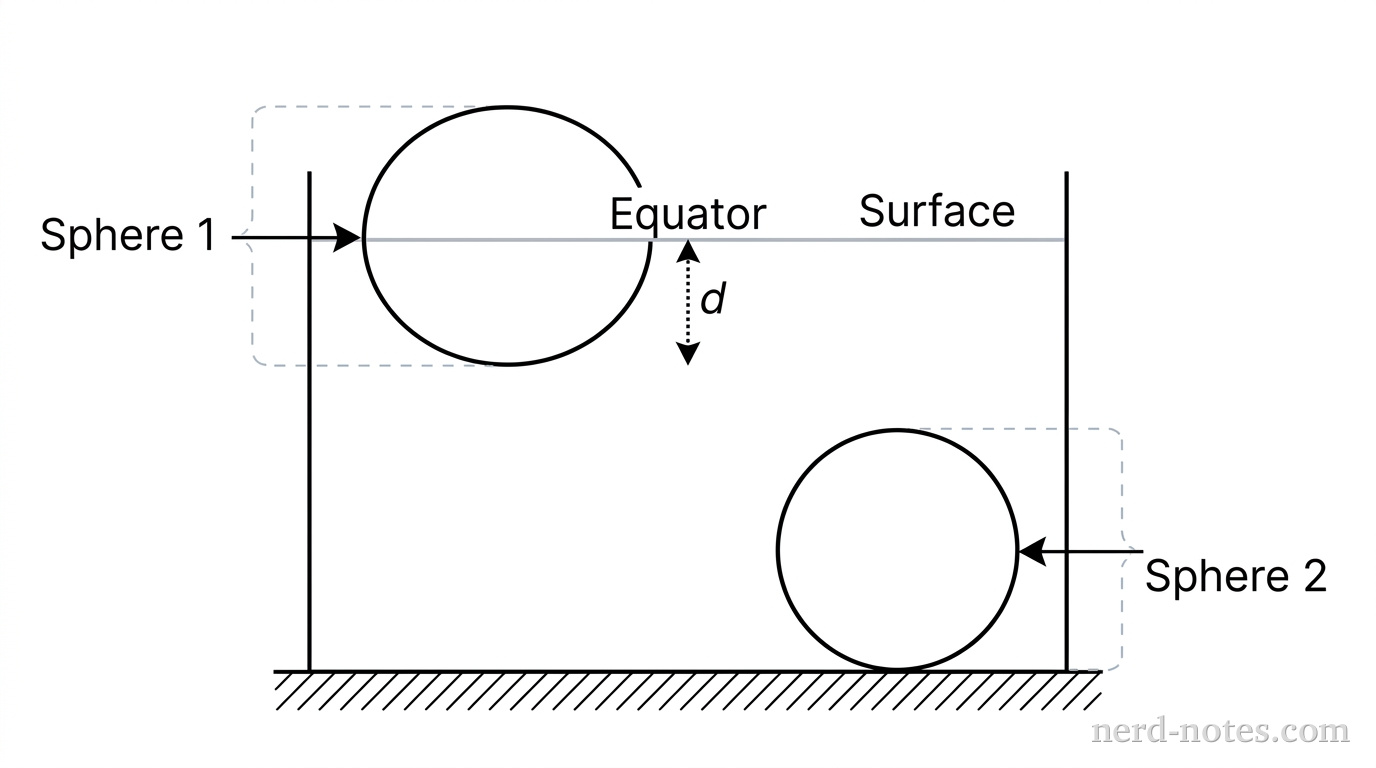
Sphere 1 has mass \(M\) and volume \(V\). When placed in a large tank of water, it floats at rest with exactly half of its volume submerged. Sphere 2 has mass \(3M\) and the same volume \(V\). When Sphere 2 is placed in the same tank, it sinks to the bottom and remains at rest. Which of the following correctly compares the magnitude of the buoyant force \(F_{B1}\) on Sphere 1 and the magnitude of the buoyant force \(F_{B2}\) on Sphere 2?
D
By continuing you (1) agree to our Terms of Use and Terms of Sale and (2) consent to sharing your IP and browser information used by this site’s security protocols as outlined in our Privacy Policy.
| Kinematics | Forces |
|---|---|
| \(\Delta x = v_i t + \frac{1}{2} at^2\) | \(F = ma\) |
| \(v = v_i + at\) | \(F_g = \frac{G m_1 m_2}{r^2}\) |
| \(v^2 = v_i^2 + 2a \Delta x\) | \(f = \mu N\) |
| \(\Delta x = \frac{v_i + v}{2} t\) | \(F_s =-kx\) |
| \(v^2 = v_f^2 \,-\, 2a \Delta x\) |
| Circular Motion | Energy |
|---|---|
| \(F_c = \frac{mv^2}{r}\) | \(KE = \frac{1}{2} mv^2\) |
| \(a_c = \frac{v^2}{r}\) | \(PE = mgh\) |
| \(T = 2\pi \sqrt{\frac{r}{g}}\) | \(KE_i + PE_i = KE_f + PE_f\) |
| \(W = Fd \cos\theta\) |
| Momentum | Torque and Rotations |
|---|---|
| \(p = mv\) | \(\tau = r \cdot F \cdot \sin(\theta)\) |
| \(J = \Delta p\) | \(I = \sum mr^2\) |
| \(p_i = p_f\) | \(L = I \cdot \omega\) |
| Simple Harmonic Motion | Fluids |
|---|---|
| \(F = -kx\) | \(P = \frac{F}{A}\) |
| \(T = 2\pi \sqrt{\frac{l}{g}}\) | \(P_{\text{total}} = P_{\text{atm}} + \rho gh\) |
| \(T = 2\pi \sqrt{\frac{m}{k}}\) | \(Q = Av\) |
| \(x(t) = A \cos(\omega t + \phi)\) | \(F_b = \rho V g\) |
| \(a = -\omega^2 x\) | \(A_1v_1 = A_2v_2\) |
| Constant | Description |
|---|---|
| [katex]g[/katex] | Acceleration due to gravity, typically [katex]9.8 , \text{m/s}^2[/katex] on Earth’s surface |
| [katex]G[/katex] | Universal Gravitational Constant, [katex]6.674 \times 10^{-11} , \text{N} \cdot \text{m}^2/\text{kg}^2[/katex] |
| [katex]\mu_k[/katex] and [katex]\mu_s[/katex] | Coefficients of kinetic ([katex]\mu_k[/katex]) and static ([katex]\mu_s[/katex]) friction, dimensionless. Static friction ([katex]\mu_s[/katex]) is usually greater than kinetic friction ([katex]\mu_k[/katex]) as it resists the start of motion. |
| [katex]k[/katex] | Spring constant, in [katex]\text{N/m}[/katex] |
| [katex] M_E = 5.972 \times 10^{24} , \text{kg} [/katex] | Mass of the Earth |
| [katex] M_M = 7.348 \times 10^{22} , \text{kg} [/katex] | Mass of the Moon |
| [katex] M_M = 1.989 \times 10^{30} , \text{kg} [/katex] | Mass of the Sun |
| Variable | SI Unit |
|---|---|
| [katex]s[/katex] (Displacement) | [katex]\text{meters (m)}[/katex] |
| [katex]v[/katex] (Velocity) | [katex]\text{meters per second (m/s)}[/katex] |
| [katex]a[/katex] (Acceleration) | [katex]\text{meters per second squared (m/s}^2\text{)}[/katex] |
| [katex]t[/katex] (Time) | [katex]\text{seconds (s)}[/katex] |
| [katex]m[/katex] (Mass) | [katex]\text{kilograms (kg)}[/katex] |
| Variable | Derived SI Unit |
|---|---|
| [katex]F[/katex] (Force) | [katex]\text{newtons (N)}[/katex] |
| [katex]E[/katex], [katex]PE[/katex], [katex]KE[/katex] (Energy, Potential Energy, Kinetic Energy) | [katex]\text{joules (J)}[/katex] |
| [katex]P[/katex] (Power) | [katex]\text{watts (W)}[/katex] |
| [katex]p[/katex] (Momentum) | [katex]\text{kilogram meters per second (kgm/s)}[/katex] |
| [katex]\omega[/katex] (Angular Velocity) | [katex]\text{radians per second (rad/s)}[/katex] |
| [katex]\tau[/katex] (Torque) | [katex]\text{newton meters (Nm)}[/katex] |
| [katex]I[/katex] (Moment of Inertia) | [katex]\text{kilogram meter squared (kgm}^2\text{)}[/katex] |
| [katex]f[/katex] (Frequency) | [katex]\text{hertz (Hz)}[/katex] |
Metric Prefixes
Example of using unit analysis: Convert 5 kilometers to millimeters.
Start with the given measurement: [katex]\text{5 km}[/katex]
Use the conversion factors for kilometers to meters and meters to millimeters: [katex]\text{5 km} \times \frac{10^3 \, \text{m}}{1 \, \text{km}} \times \frac{10^3 \, \text{mm}}{1 \, \text{m}}[/katex]
Perform the multiplication: [katex]\text{5 km} \times \frac{10^3 \, \text{m}}{1 \, \text{km}} \times \frac{10^3 \, \text{mm}}{1 \, \text{m}} = 5 \times 10^3 \times 10^3 \, \text{mm}[/katex]
Simplify to get the final answer: [katex]\boxed{5 \times 10^6 \, \text{mm}}[/katex]
Prefix | Symbol | Power of Ten | Equivalent |
|---|---|---|---|
Pico- | p | [katex]10^{-12}[/katex] | 0.000000000001 |
Nano- | n | [katex]10^{-9}[/katex] | 0.000000001 |
Micro- | µ | [katex]10^{-6}[/katex] | 0.000001 |
Milli- | m | [katex]10^{-3}[/katex] | 0.001 |
Centi- | c | [katex]10^{-2}[/katex] | 0.01 |
Deci- | d | [katex]10^{-1}[/katex] | 0.1 |
(Base unit) | – | [katex]10^{0}[/katex] | 1 |
Deca- or Deka- | da | [katex]10^{1}[/katex] | 10 |
Hecto- | h | [katex]10^{2}[/katex] | 100 |
Kilo- | k | [katex]10^{3}[/katex] | 1,000 |
Mega- | M | [katex]10^{6}[/katex] | 1,000,000 |
Giga- | G | [katex]10^{9}[/katex] | 1,000,000,000 |
Tera- | T | [katex]10^{12}[/katex] | 1,000,000,000,000 |
One price to unlock most advanced version of Phy across all our tools.
per month
Billed Monthly. Cancel Anytime.
We crafted THE Ultimate A.P Physics 1 Program so you can learn faster and score higher.
Try our free calculator to see what you need to get a 5 on the 2026 AP Physics 1 exam.
A quick explanation
Credits are used to grade your FRQs and GQs. Pro users get unlimited credits.
Submitting counts as 1 attempt.
Viewing answers or explanations count as a failed attempts.
Phy gives partial credit if needed
MCQs and GQs are are 1 point each. FRQs will state points for each part.
Phy customizes problem explanations based on what you struggle with. Just hit the explanation button to see.
Understand you mistakes quicker.
Phy automatically provides feedback so you can improve your responses.
10 Free Credits To Get You Started
By continuing you agree to nerd-notes.com Terms of Service, Privacy Policy, and our usage of user data.
Feeling uneasy about your next physics test? We'll boost your grade in 3 lessons or less—guaranteed
NEW! PHY AI accurately solves all questions
🔥 Get up to 30% off Elite Physics Tutoring
🧠 NEW! Learn Physics From Scratch Self Paced Course
🎯 Need exam style practice questions?