
AP Physics 2
9.5 Specific Heat and Thermal Conductivity
9.3 Thermal Energy Transfer and Equilibrium
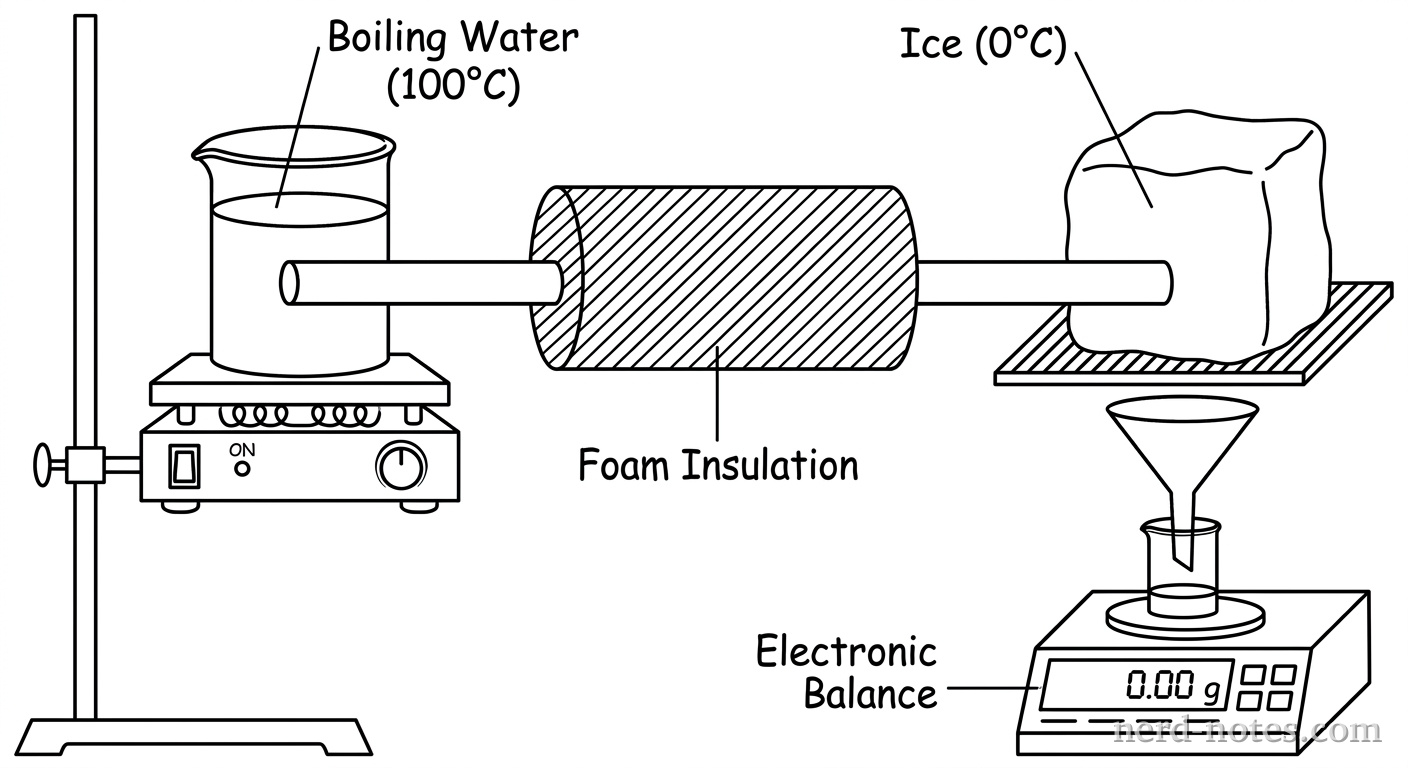
- The solid cylindrical alloy rod
- A boiling water bath maintained at \(100^\circ\text{C}\)
- A large block of ice at \(0^\circ\text{C}\) resting on a stand with a funnel beneath it
- An electronic balance
- Empty beakers
- A stopwatch
- Calipers and a metric ruler
- A foam insulation sleeve that perfectly fits around the rod
The students set up the equipment so that one end of the rod is submerged in the boiling water and the other end is pressed firmly into the ice block. Water from the melting ice drips through the funnel into a beaker resting on the electronic balance. The foam insulation sleeve covers the entire exposed length of the rod between the water bath and the ice.
Similar Questions
Tools for a 5
 AP aligned mock tests to help you get a 5.
With grading, adaptive explanations, and more.
Find a Quiz
Find, solve, and grade every AP FRQ ever.
Find an FRQ
Stuck on AP Physics 2? Get unstuck with an AP specialist.1 to 1 tutors who know the exam inside out. Understand weeks of material in a single session.Find a Tutor
Learn AP Physics from scratch, quickly. This is the only course you'll need for the year.
A self-paced course with everything you need to get a 5. Trusted by over 15,000 students and 200+ schools. Learn fast, or we'll refund your purchase, backed by our 100% satisfaction guarantee.
Explore the Course
AP aligned mock tests to help you get a 5.
With grading, adaptive explanations, and more.
Find a Quiz
Find, solve, and grade every AP FRQ ever.
Find an FRQ
Stuck on AP Physics 2? Get unstuck with an AP specialist.1 to 1 tutors who know the exam inside out. Understand weeks of material in a single session.Find a Tutor
Learn AP Physics from scratch, quickly. This is the only course you'll need for the year.
A self-paced course with everything you need to get a 5. Trusted by over 15,000 students and 200+ schools. Learn fast, or we'll refund your purchase, backed by our 100% satisfaction guarantee.
Explore the Course