
AP Chemistry
4.6 Introduction to Titration
4.5 Stoichiometry
A student uses a volumetric pipet to transfer a \(25.00\text{ mL}\) sample of an unknown monoprotic acid, \(\text{HA(aq)}\), into a flask. The student titrates the sample with standardized \(0.1000\text{ M}\) \(\text{NaOH(aq)}\), using phenolphthalein as the indicator. The neutralization reaction has a \(1:1\) mole ratio.
Near the endpoint, the student adds too much titrant, producing a persistent deep-pink solution rather than the first persistent pale-pink color. The student records \(28.64\text{ mL}\) as the volume of titrant delivered and uses this volume to calculate the initial concentration of the acid. All other measurements are made correctly.
Which statement correctly describes how the error affects the calculated concentration of \(\text{HA(aq)}\)?
Near the endpoint, the student adds too much titrant, producing a persistent deep-pink solution rather than the first persistent pale-pink color. The student records \(28.64\text{ mL}\) as the volume of titrant delivered and uses this volume to calculate the initial concentration of the acid. All other measurements are made correctly.
Which statement correctly describes how the error affects the calculated concentration of \(\text{HA(aq)}\)?
Similar Questions
Tools for a 5
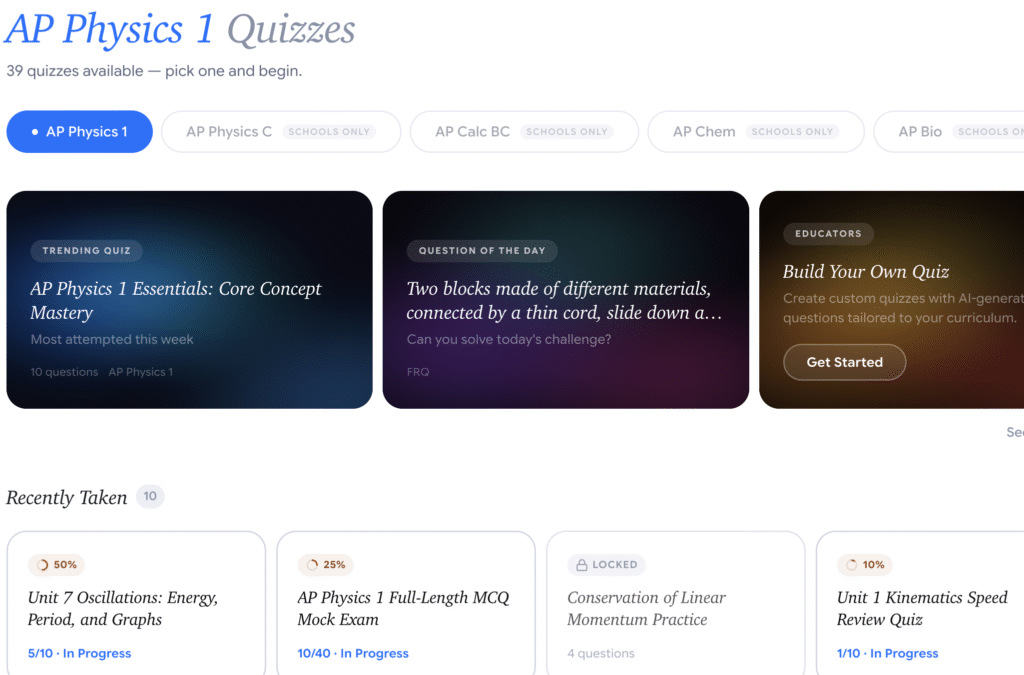 AP aligned mock tests to help you get a 5.
With grading, adaptive explanations, and more.
Find a Quiz
Find, solve, and grade every AP FRQ ever.
Find an FRQ
AP aligned mock tests to help you get a 5.
With grading, adaptive explanations, and more.
Find a Quiz
Find, solve, and grade every AP FRQ ever.
Find an FRQ
Stuck on AP Chemistry? Get unstuck with an AP specialist.1 to 1 tutors who know the exam inside out. Understand weeks of material in a single session.Book a SessionSee all our elite tutors
Learn AP Physics from scratch, quickly. This is the only course you'll need for the year.
A self-paced course with everything you need to get a 5. Trusted by over 15,000 students and 200+ schools. Learn fast, or we'll refund your purchase, backed by our 100% satisfaction guarantee.
Explore the Course