
AP Physics C: Mechanics
5.6 Newton’s Second Law in Rotational Form
5.3 Torque
5.2 Connecting Linear and Rotational Motion
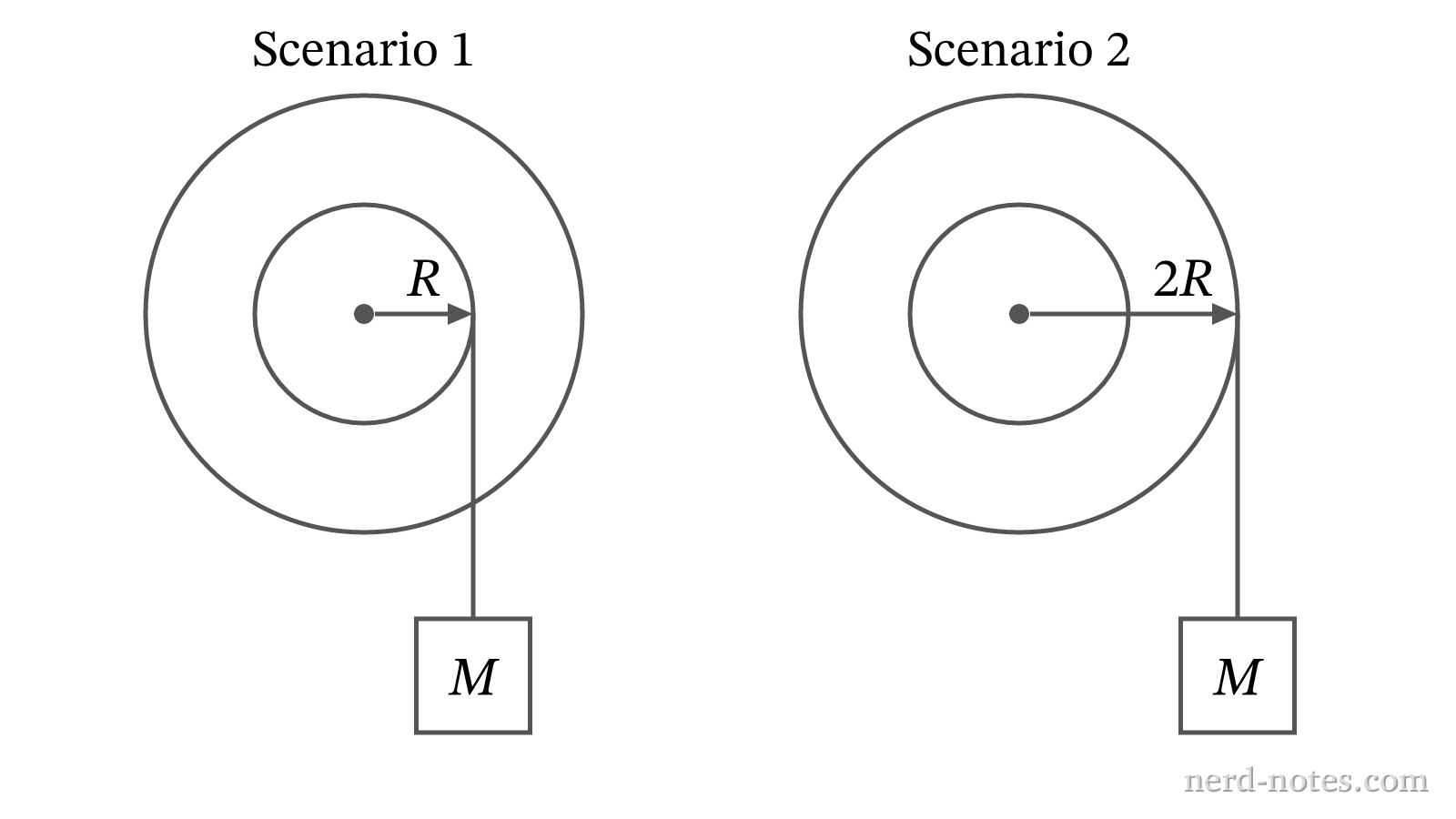
In Scenario 1, a light cord is wrapped around the inner spool of radius \(R\) and attached to a hanging block of mass \(M\).
In Scenario 2, the cord is instead wrapped around the outer spool of radius \(2R\) and attached to the same block of mass \(M\), leaving the inner spool empty.
If both systems are released from rest, what is the ratio of the vertical displacement of the block in Scenario 2 to that in Scenario 1 after an identical time interval \(\Delta t\)?
Similar Questions
Tools for a 5
 AP aligned mock tests to help you get a 5.
With grading, adaptive explanations, and more.
Find a Quiz
Find, solve, and grade every AP FRQ ever.
Find an FRQ
Stuck on AP Physics C: Mechanics? Get unstuck with an AP specialist.1 to 1 tutors who know the exam inside out. Understand weeks of material in a single session.Find a Tutor
Learn AP Physics from scratch, quickly. This is the only course you'll need for the year.
A self-paced course with everything you need to get a 5. Trusted by over 15,000 students and 200+ schools. Learn fast, or we'll refund your purchase, backed by our 100% satisfaction guarantee.
Explore the Course
AP aligned mock tests to help you get a 5.
With grading, adaptive explanations, and more.
Find a Quiz
Find, solve, and grade every AP FRQ ever.
Find an FRQ
Stuck on AP Physics C: Mechanics? Get unstuck with an AP specialist.1 to 1 tutors who know the exam inside out. Understand weeks of material in a single session.Find a Tutor
Learn AP Physics from scratch, quickly. This is the only course you'll need for the year.
A self-paced course with everything you need to get a 5. Trusted by over 15,000 students and 200+ schools. Learn fast, or we'll refund your purchase, backed by our 100% satisfaction guarantee.
Explore the Course