All questions
AP Chemistry
2.6 Resonance and Formal Charge
2.5 Lewis Diagrams
2.2 Intramolecular Force and Potential Energy
IntermediateMCQDrawing RepresentationsConceptual17.8k
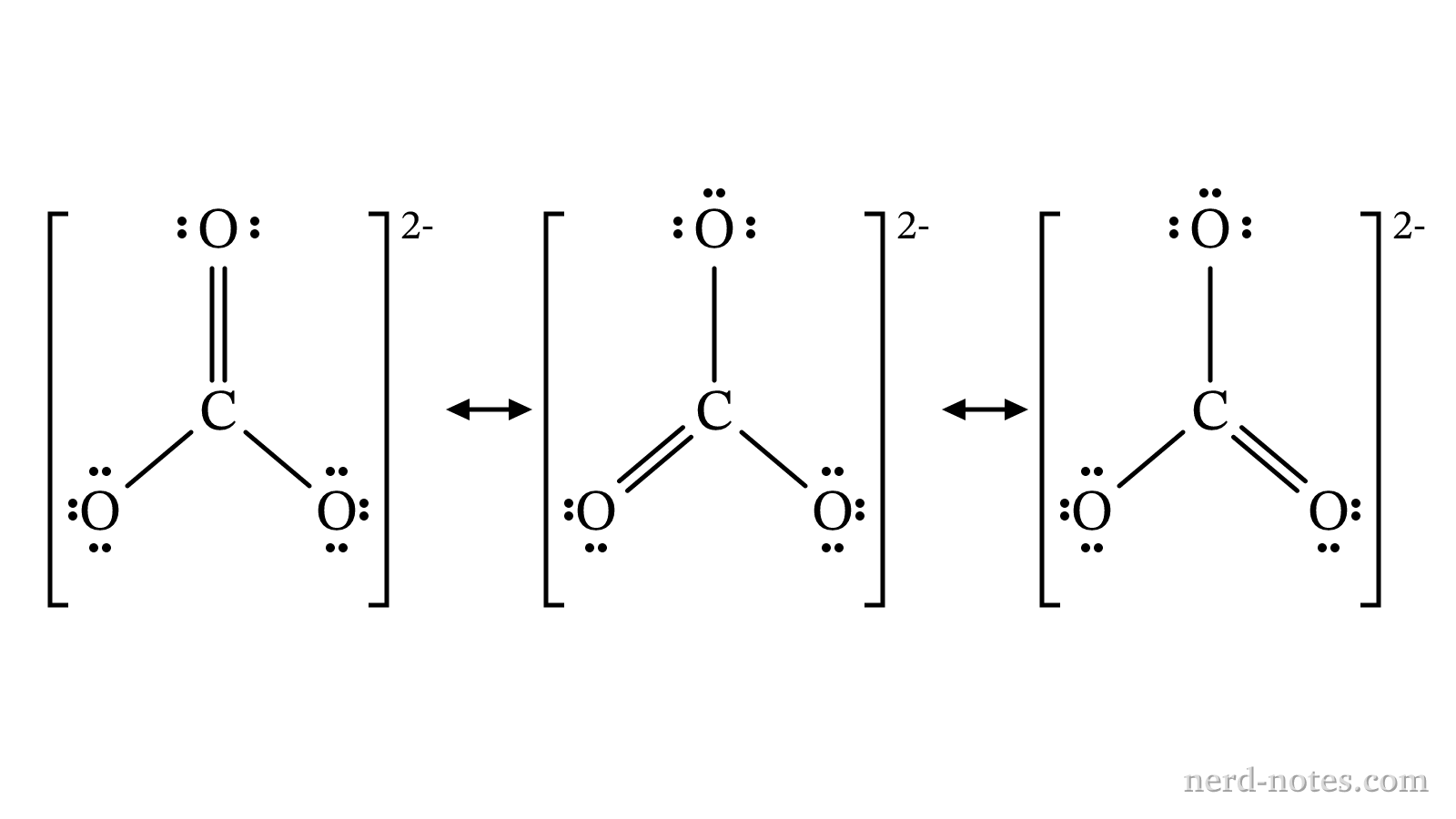
Three resonance Lewis structures of the carbonate ion arranged horizontally from left to right, separated by double-headed horizontal arrows. Each structure is enclosed in large square brackets with a 2- superscript at the top right. Each structure contains exactly 24 valence electrons and a central carbon atom with zero lone pairs. In the leftmost structure, the central C atom forms a double bond (two parallel line segments) to a top oxygen atom which has two lone pairs (four dots), a single bond (one line segment) to a lower-left oxygen atom with three lone pairs (six dots), and a single bond to a lower-right oxygen atom with three lone pairs (six dots). In the middle structure, the central C forms a single bond to the top oxygen (three lone pairs), a double bond to the lower-left oxygen (two lone pairs), and a single bond to the lower-right oxygen (three lone pairs). In the rightmost structure, the central C forms a single bond to the top oxygen (three lone pairs), a single bond to the lower-left oxygen (three lone pairs), and a double bond to the lower-right oxygen (two lone pairs). No lone pairs exist on any carbon atom. All elements and lines are rendered in black on a solid white background. No other particles, labels, text, or annotations appear.
Three resonance Lewis diagrams for \(\text{CO}_3^{2-}\).
Experimental analysis of solid \(\text{CaCO}_3\) indicates that all three carbon-oxygen bonds in the carbonate ion, \(\text{CO}_3^{2-}\), are identical in length at \(128 \text{ pm}\). For comparison, typical \(\text{C}-\text{O}\) single bonds average \(143 \text{ pm}\) and typical \(\text{C}=\text{O}\) double bonds average \(122 \text{ pm}\). Three Lewis diagrams for the carbonate ion are shown below. Which of the following claims is best supported by these representations and the experimental bond length data?

Log In to Continue

Accounts are free! Log in to try this question, see explanations, save progress, and more!

Tools for a 5