
AP Chemistry
4.8 Introduction to Acid-Base Reactions
4.6 Introduction to Titration
4.5 Stoichiometry
A student standardizes an aqueous solution of sodium hydroxide, \(\text{NaOH(aq)}\), by titrating it against potassium hydrogen phthalate, \(\text{KHC}_8\text{H}_4\text{O}_4\) (molar mass \(204.2 \text{ g/mol}\), abbreviated as \(\text{KHP}\)). The student massed a sample of pure solid \(\text{KHP}\) on an analytical balance, transferred it completely to an Erlenmeyer flask, and dissolved it in approximately \(50 \text{ mL}\) of distilled water. Before titrating with \(\text{NaOH(aq)}\) from a buret, the student rinsed the inner walls of the Erlenmeyer flask with an additional \(15 \text{ mL}\) of distilled water to ensure all solid was in the solution. Which of the following best explains the effect of adding this additional distilled water on the calculated molarity of the \(\text{NaOH(aq)}\) solution?
Similar Questions
Tools for a 5
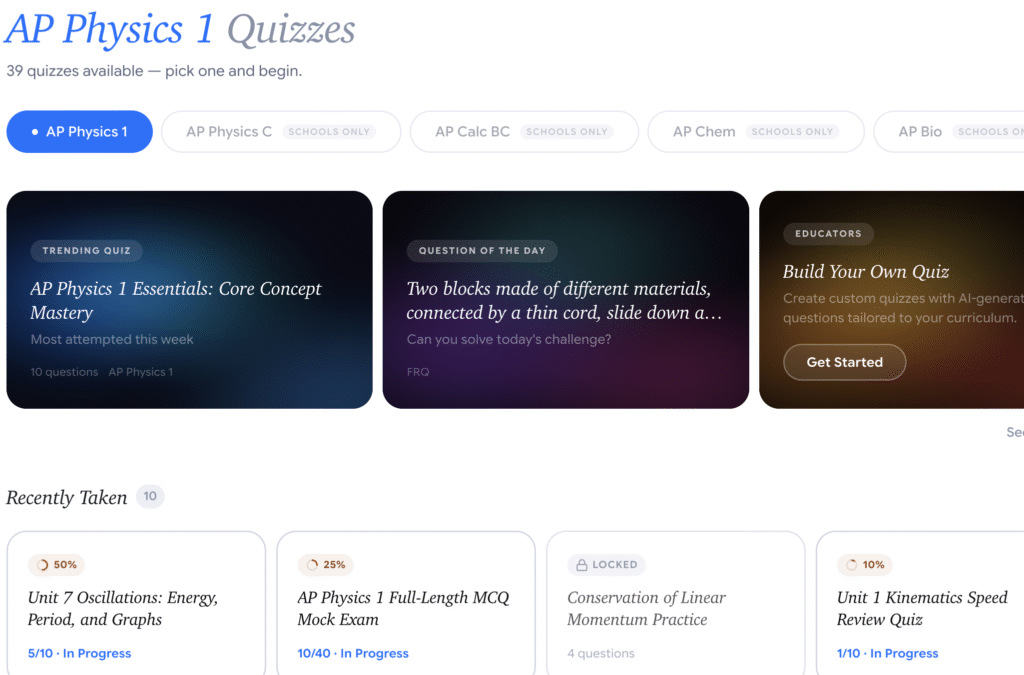 AP aligned mock tests to help you get a 5.
With grading, adaptive explanations, and more.
Find a Quiz
Find, solve, and grade every AP FRQ ever.
Find an FRQ
Stuck on AP Chemistry? Get unstuck with an AP specialist.1 to 1 tutors who know the exam inside out. Understand weeks of material in a single session.Find a Tutor
Learn AP Physics from scratch, quickly. This is the only course you'll need for the year.
A self-paced course with everything you need to get a 5. Trusted by over 15,000 students and 200+ schools. Learn fast, or we'll refund your purchase, backed by our 100% satisfaction guarantee.
Explore the Course
AP aligned mock tests to help you get a 5.
With grading, adaptive explanations, and more.
Find a Quiz
Find, solve, and grade every AP FRQ ever.
Find an FRQ
Stuck on AP Chemistry? Get unstuck with an AP specialist.1 to 1 tutors who know the exam inside out. Understand weeks of material in a single session.Find a Tutor
Learn AP Physics from scratch, quickly. This is the only course you'll need for the year.
A self-paced course with everything you need to get a 5. Trusted by over 15,000 students and 200+ schools. Learn fast, or we'll refund your purchase, backed by our 100% satisfaction guarantee.
Explore the Course