
AP Chemistry
5.3 Concentration Changes Over Time
5.2 Introduction to Rate Law
\[ 2\,\text{X}(g) \rightarrow \text{Y}(g) + \text{Z}(g) \]
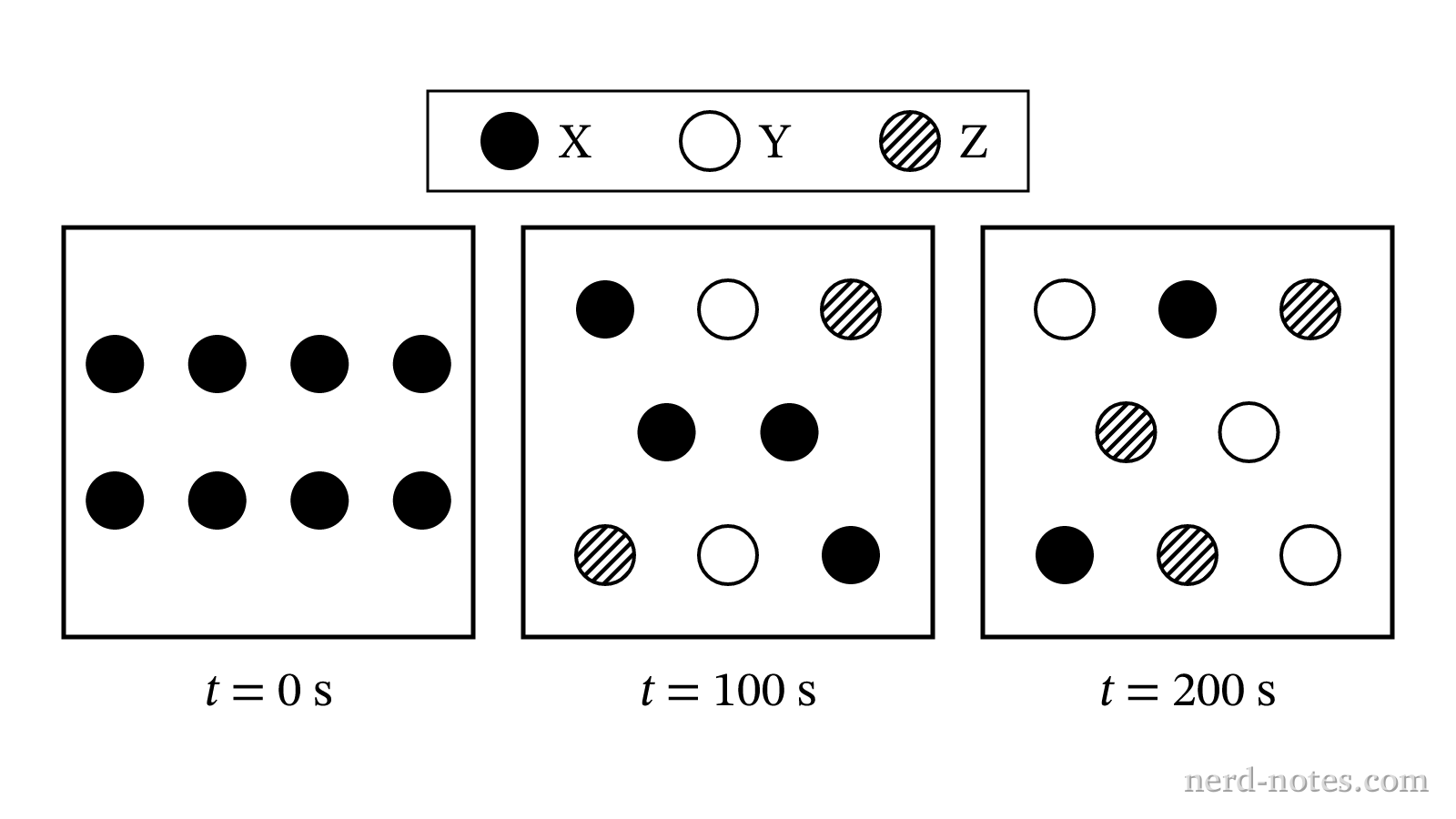
A sample of pure \(\text{X}(g)\) is placed into a rigid \(1.0\text{ L}\) vessel at a constant temperature. The particulate diagrams below represent the contents of the vessel at three successive times: \(t = 0\text{ s}\), \(t = 100\text{ s}\), and \(t = 200\text{ s}\). Each particle represents \(1.0 \times 10^{-3}\text{ mol}\) of the indicated substance.
Based on the representations, what is the order of the reaction with respect to \(\text{X}\), and what is the value of the rate constant \(k\)?
Similar Questions
Tools for a 5
 AP aligned mock tests to help you get a 5.
With grading, adaptive explanations, and more.
Find a Quiz
Find, solve, and grade every AP FRQ ever.
Find an FRQ
AP aligned mock tests to help you get a 5.
With grading, adaptive explanations, and more.
Find a Quiz
Find, solve, and grade every AP FRQ ever.
Find an FRQ
Stuck on AP Chemistry? Get unstuck with an AP specialist.1 to 1 tutors who know the exam inside out. Understand weeks of material in a single session.Book a SessionSee all our elite tutors
Learn AP Physics from scratch, quickly. This is the only course you'll need for the year.
A self-paced course with everything you need to get a 5. Trusted by over 15,000 students and 200+ schools. Learn fast, or we'll refund your purchase, backed by our 100% satisfaction guarantee.
Explore the Course