
AP Chemistry
8.3 Weak Acid and Base Equilibria
A student prepares two aqueous solutions of ammonia, \(\text{NH}_3\text{(aq)}\), at \(25^\circ\text{C}\). Solution 1 has an initial concentration of \(0.010\text{ M}\), and Solution 2 has an initial concentration of \(0.10\text{ M}\). The equilibrium reaction is represented by the equation below.
\[ \text{NH}_3\text{(aq)} + \text{H}_2\text{O(l)} \rightleftharpoons \text{NH}_4^+\text{(aq)} + \text{OH}^-\text{(aq)} \]
The student determines that Solution 2 has a higher \(\text{pH}\) than Solution 1, even though the percent ionization of \(\text{NH}_3\) is lower in Solution 2. Which of the following statements correctly explains why Solution 2 has a higher \(\text{pH}\)?
\[ \text{NH}_3\text{(aq)} + \text{H}_2\text{O(l)} \rightleftharpoons \text{NH}_4^+\text{(aq)} + \text{OH}^-\text{(aq)} \]
The student determines that Solution 2 has a higher \(\text{pH}\) than Solution 1, even though the percent ionization of \(\text{NH}_3\) is lower in Solution 2. Which of the following statements correctly explains why Solution 2 has a higher \(\text{pH}\)?
Similar Questions
Tools for a 5
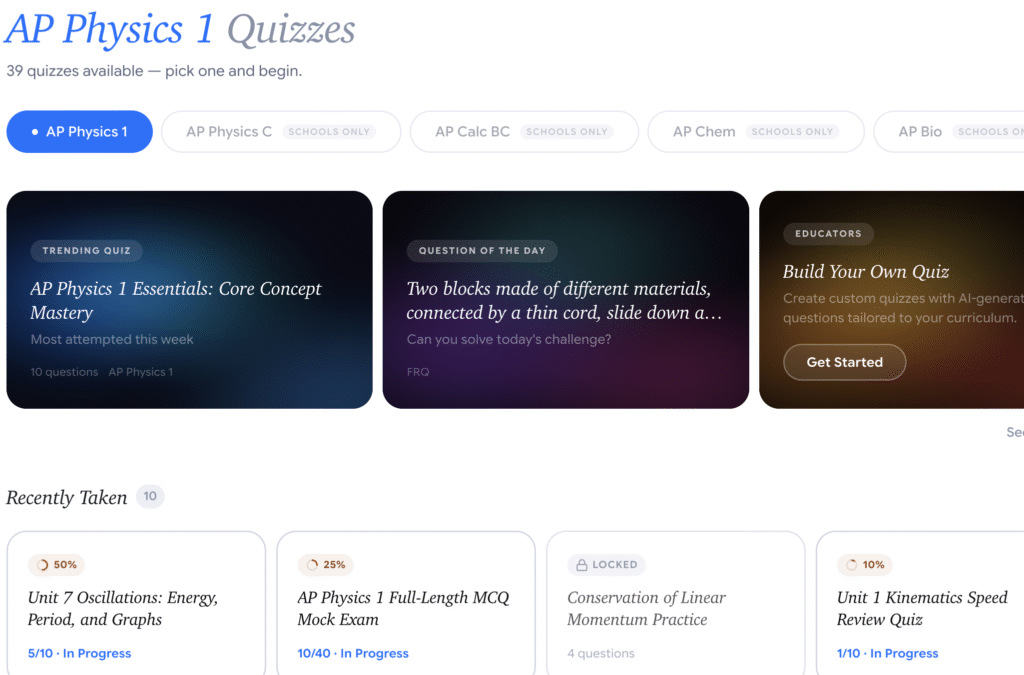 AP aligned mock tests to help you get a 5.
With grading, adaptive explanations, and more.
Find a Quiz
Find, solve, and grade every AP FRQ ever.
Find an FRQ
Stuck on AP Chemistry? Get unstuck with an AP specialist.1 to 1 tutors who know the exam inside out. Understand weeks of material in a single session.Find a Tutor
Learn AP Physics from scratch, quickly. This is the only course you'll need for the year.
A self-paced course with everything you need to get a 5. Trusted by over 15,000 students and 200+ schools. Learn fast, or we'll refund your purchase, backed by our 100% satisfaction guarantee.
Explore the Course
AP aligned mock tests to help you get a 5.
With grading, adaptive explanations, and more.
Find a Quiz
Find, solve, and grade every AP FRQ ever.
Find an FRQ
Stuck on AP Chemistry? Get unstuck with an AP specialist.1 to 1 tutors who know the exam inside out. Understand weeks of material in a single session.Find a Tutor
Learn AP Physics from scratch, quickly. This is the only course you'll need for the year.
A self-paced course with everything you need to get a 5. Trusted by over 15,000 students and 200+ schools. Learn fast, or we'll refund your purchase, backed by our 100% satisfaction guarantee.
Explore the Course