
AP Physics C: Mechanics
7.4 Energy of Simple Harmonic Oscillators
7.1 Defining Simple Harmonic Motion (SHM)
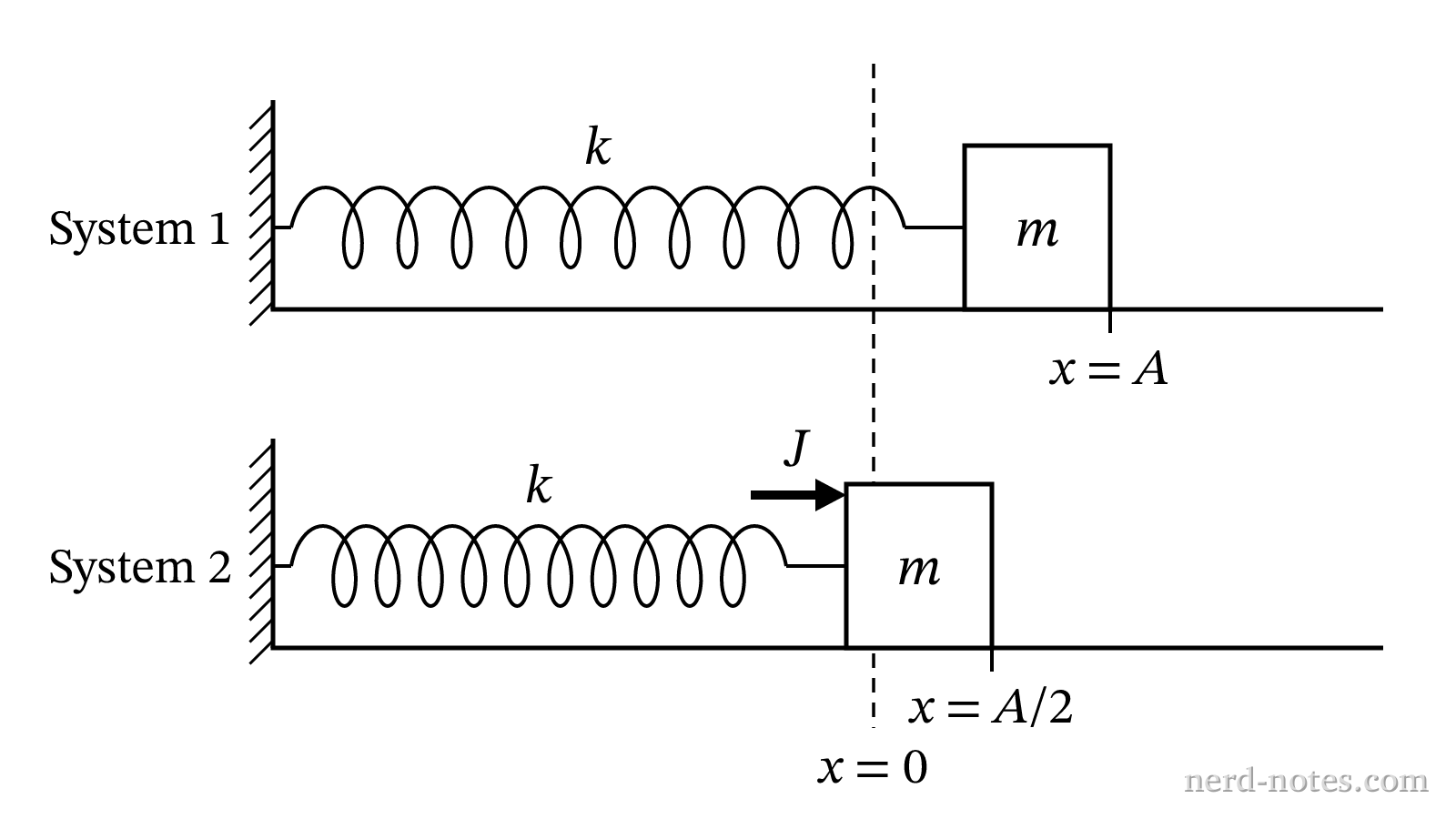
System 1 is displaced to position \(x = A\) and released from rest at time \(t = 0\), oscillating with total mechanical energy \(E\) and maximum speed \(v_{1,\max}\).
System 2 is initially held at rest at position \(x = \dfrac{1}{2}A\), and at time \(t = 0\) receives an instantaneous horizontal impulse that sets it into oscillation with total mechanical energy \(2E\).
What is the ratio of the speed of the block in System 2 immediately after the impulse to the maximum speed of the block in System 1?
Similar Questions
Tools for a 5
 AP aligned mock tests to help you get a 5.
With grading, adaptive explanations, and more.
Find a Quiz
Find, solve, and grade every AP FRQ ever.
Find an FRQ
Stuck on AP Physics C: Mechanics? Get unstuck with an AP specialist.1 to 1 tutors who know the exam inside out. Understand weeks of material in a single session.Find a Tutor
Learn AP Physics from scratch, quickly. This is the only course you'll need for the year.
A self-paced course with everything you need to get a 5. Trusted by over 15,000 students and 200+ schools. Learn fast, or we'll refund your purchase, backed by our 100% satisfaction guarantee.
Explore the Course
AP aligned mock tests to help you get a 5.
With grading, adaptive explanations, and more.
Find a Quiz
Find, solve, and grade every AP FRQ ever.
Find an FRQ
Stuck on AP Physics C: Mechanics? Get unstuck with an AP specialist.1 to 1 tutors who know the exam inside out. Understand weeks of material in a single session.Find a Tutor
Learn AP Physics from scratch, quickly. This is the only course you'll need for the year.
A self-paced course with everything you need to get a 5. Trusted by over 15,000 students and 200+ schools. Learn fast, or we'll refund your purchase, backed by our 100% satisfaction guarantee.
Explore the Course