
AP Physics 1
6.4 Conservation of Angular Momentum
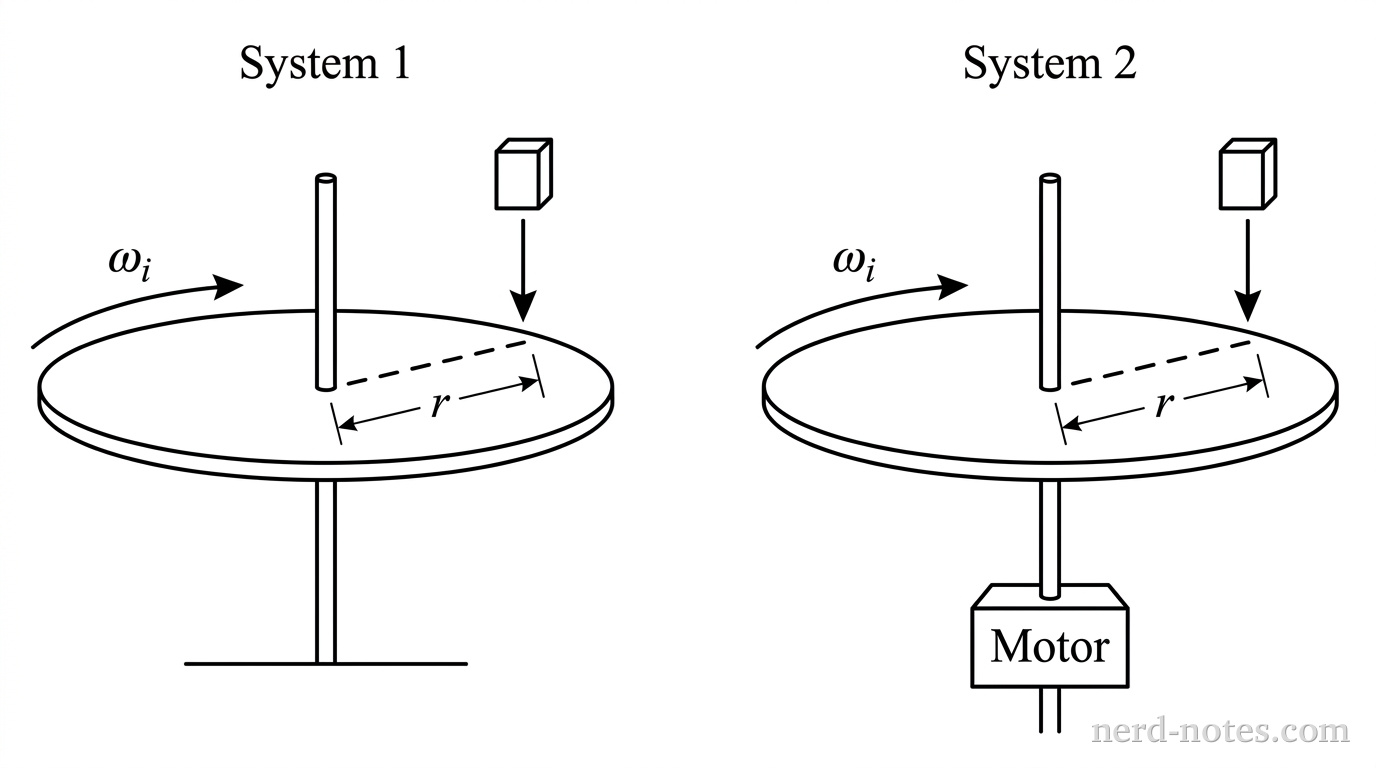
System 1: The disk is on a free-spinning axle. A small block of mass \(m\) is dropped vertically onto the disk at a distance \(r\) from the center and sticks to it.
System 2: The disk is attached to a motor that maintains the constant angular velocity \(\omega_i\) throughout the process. An identical small block is dropped vertically onto the disk at the same distance \(r\) and sticks to it.
Which of the following correctly describes the change in the angular momentum \(L\) and the angular velocity \(\omega\) for each disk-block system immediately after the block sticks?
Similar Questions
Tools for a 5
 AP aligned mock tests to help you get a 5.
With grading, adaptive explanations, and more.
Find a Quiz
Find, solve, and grade every AP FRQ ever.
Find an FRQ
AP aligned mock tests to help you get a 5.
With grading, adaptive explanations, and more.
Find a Quiz
Find, solve, and grade every AP FRQ ever.
Find an FRQ
Elite Physics Tutoring with Jason.Fast, 1 to 1 help on AP Physics 1. Understand weeks of complex concepts in just one session.Book a SessionSee all our elite tutors
Learn AP Physics from scratch, quickly. This is the only course you'll need for the year.
A self-paced course with everything you need to get a 5. Trusted by over 15,000 students and 200+ schools. Learn fast, or we'll refund your purchase, backed by our 100% satisfaction guarantee.
Explore the Course