
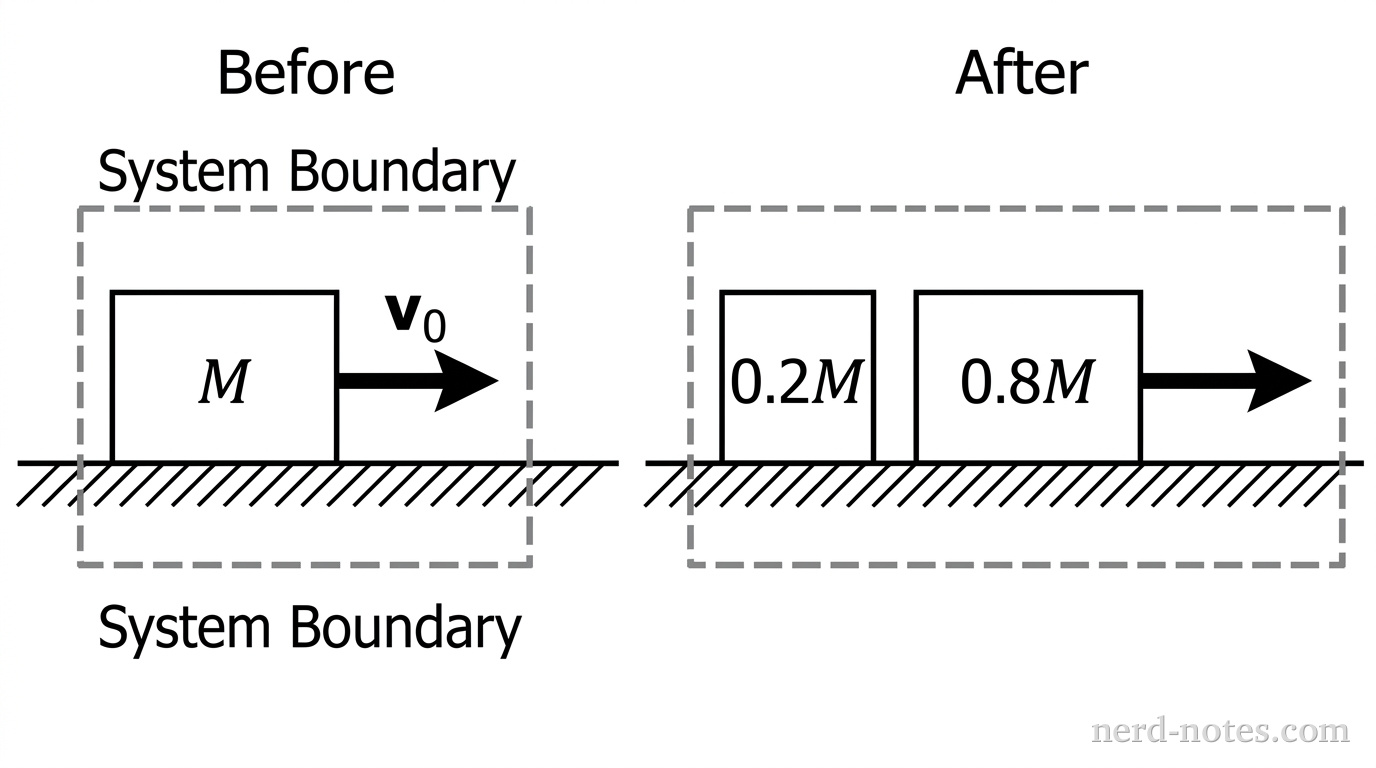
A space probe of mass \(M\) is traveling at a constant velocity \(v_{0}\) through deep space. The probe consists of two modules: a scientific instrument of mass \(0.2M\) and a propulsion unit of mass \(0.8M\). An internal mechanism separates the two modules by pushing them apart with a constant force. After the separation, the scientific instrument is observed to be at rest relative to its original inertial frame of reference. Which of the following correctly describes the velocity of the center of mass of the two-module system after the separation, and provides a correct justification?
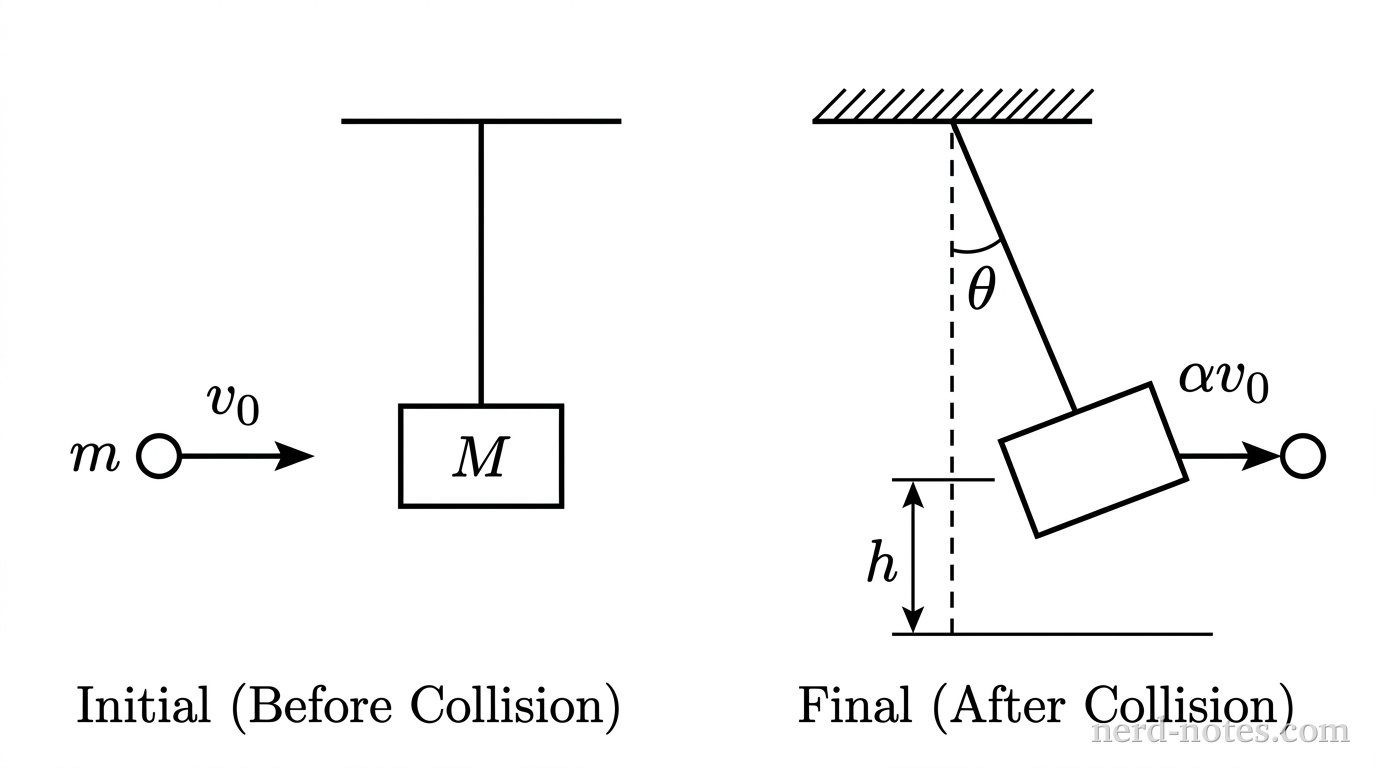
A projectile of mass \(m\) is fired horizontally with speed \(v_0\) toward a stationary block of mass \(M\) that is suspended from a rigid support by a light string of length \(L\). The projectile passes through the block and emerges from the other side traveling in the same direction with a speed of \(\alpha v_0\), where \(0 < \alpha < 1\). If the block subsequently swings upward, which of the following expressions represents the maximum height \(h\) reached by the block in terms of the given quantities and fundamental constants?
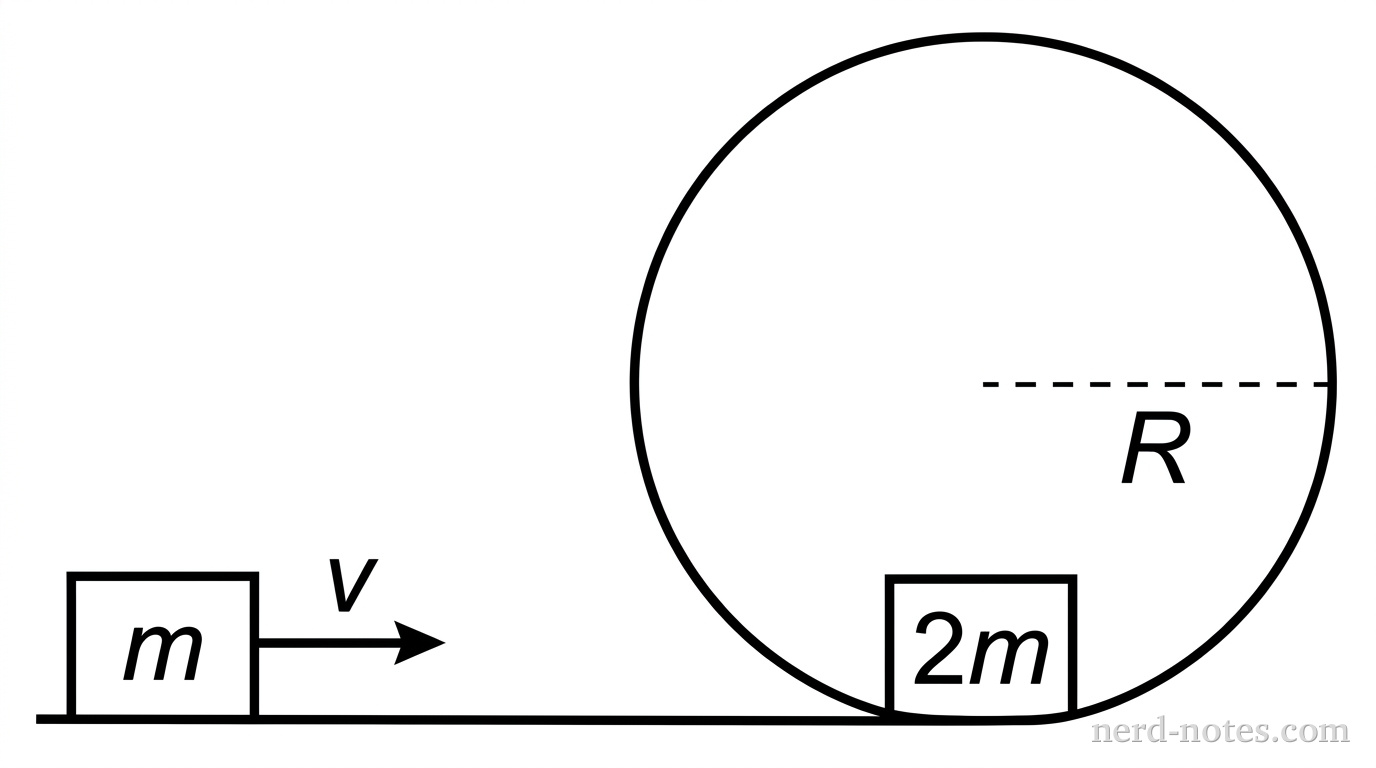
A block of mass \(m\) moves with speed \(v\) on a horizontal frictionless surface toward a stationary block of mass \(2m\). The stationary block is located at the lowest point of a vertical circular track of radius \(R\). The blocks collide and stick together, then immediately begin to move along the circular track. What is the magnitude of the normal force exerted by the track on the combined blocks immediately after the collision?
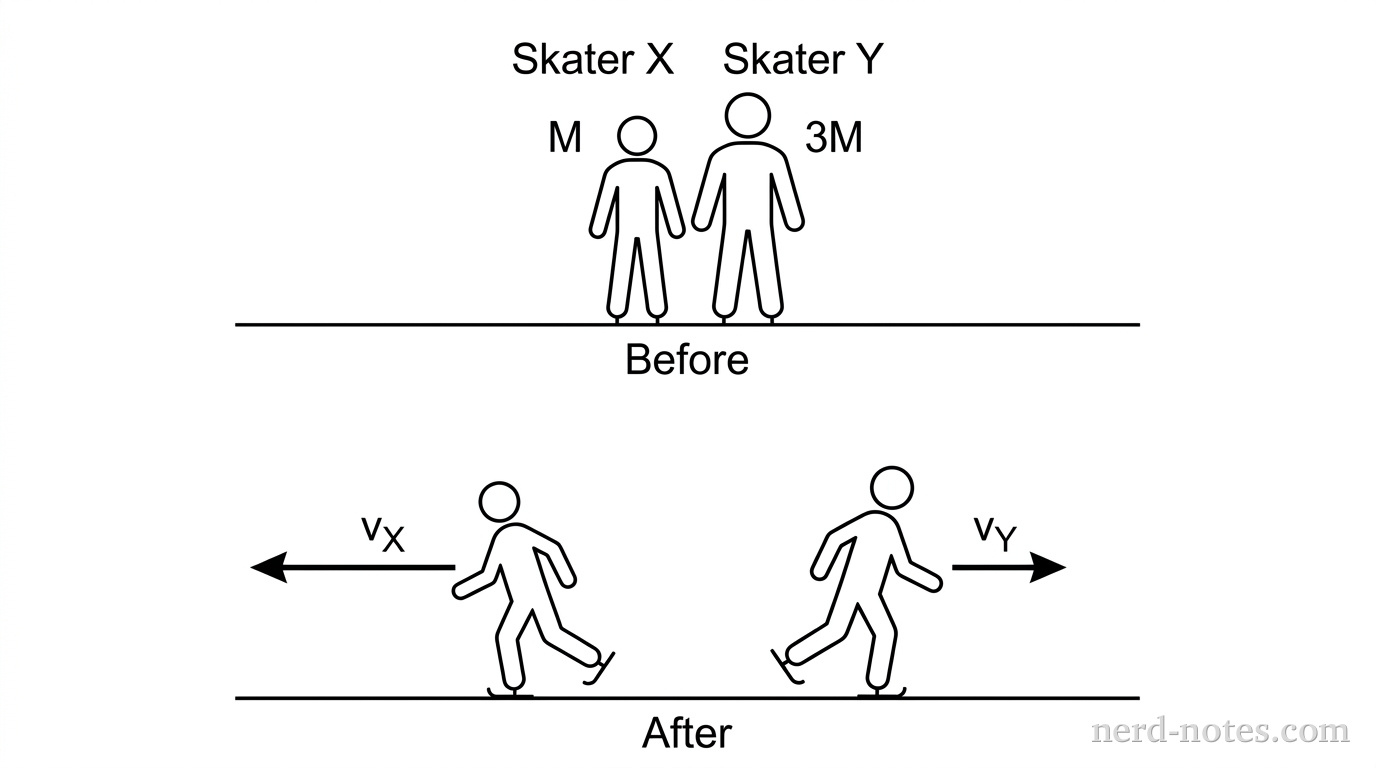
Two skaters, Skater X of mass \(M\) and Skater Y of mass \(3M\), are initially at rest on a horizontal, frictionless ice surface. The skaters push off from each other and move in opposite directions. Which of the following correctly compares the final kinetic energy \(K_X\) of Skater X and the final kinetic energy \(K_Y\) of Skater Y after they have separated?
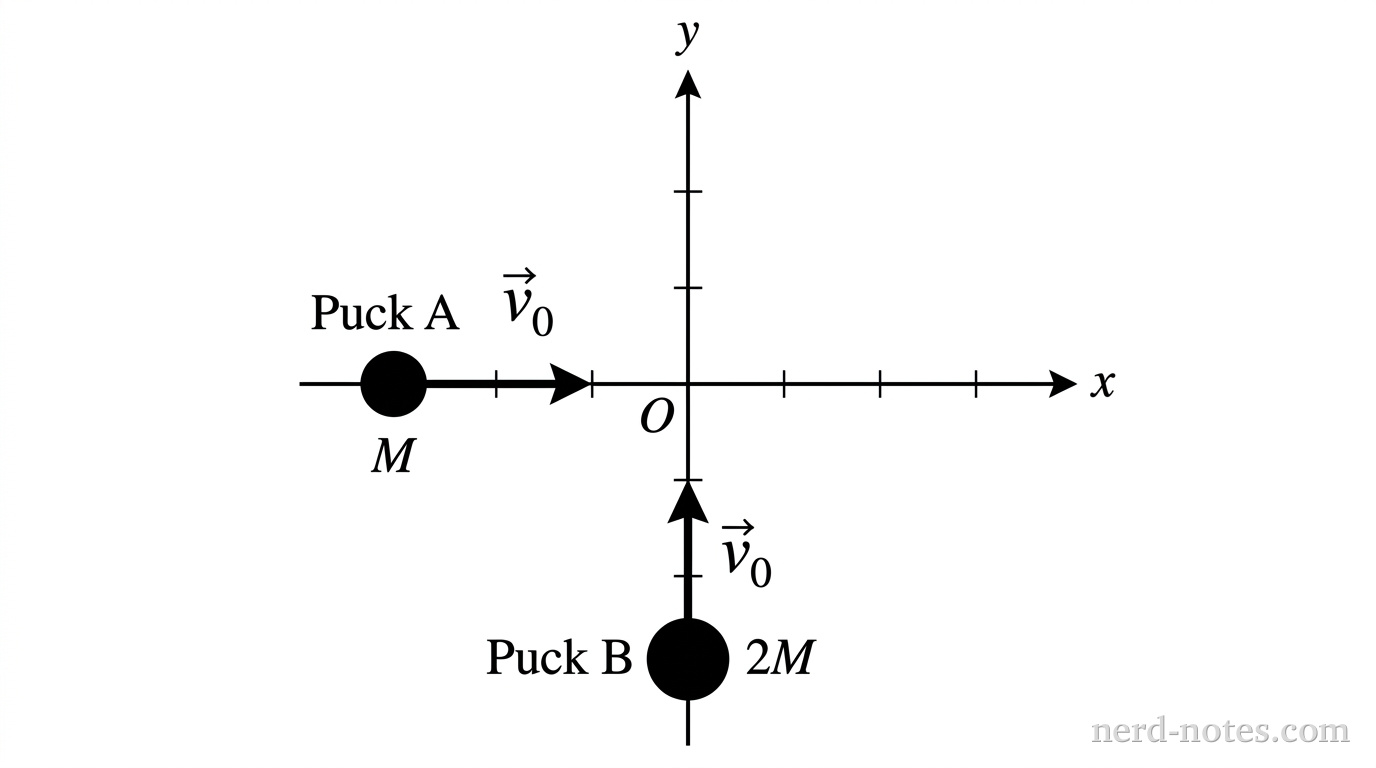
Puck A with mass \(M\) is moving with speed \(v_0\) in the positive \(x\)-direction across a horizontal, frictionless surface. Puck B with mass \(2M\) is moving with speed \(v_0\) in the positive \(y\)-direction. The pucks collide at the origin and stick together, moving as a single object after the collision. What is the ratio of the total kinetic energy of the combined system after the collision to the total kinetic energy of the two-puck system before the collision?
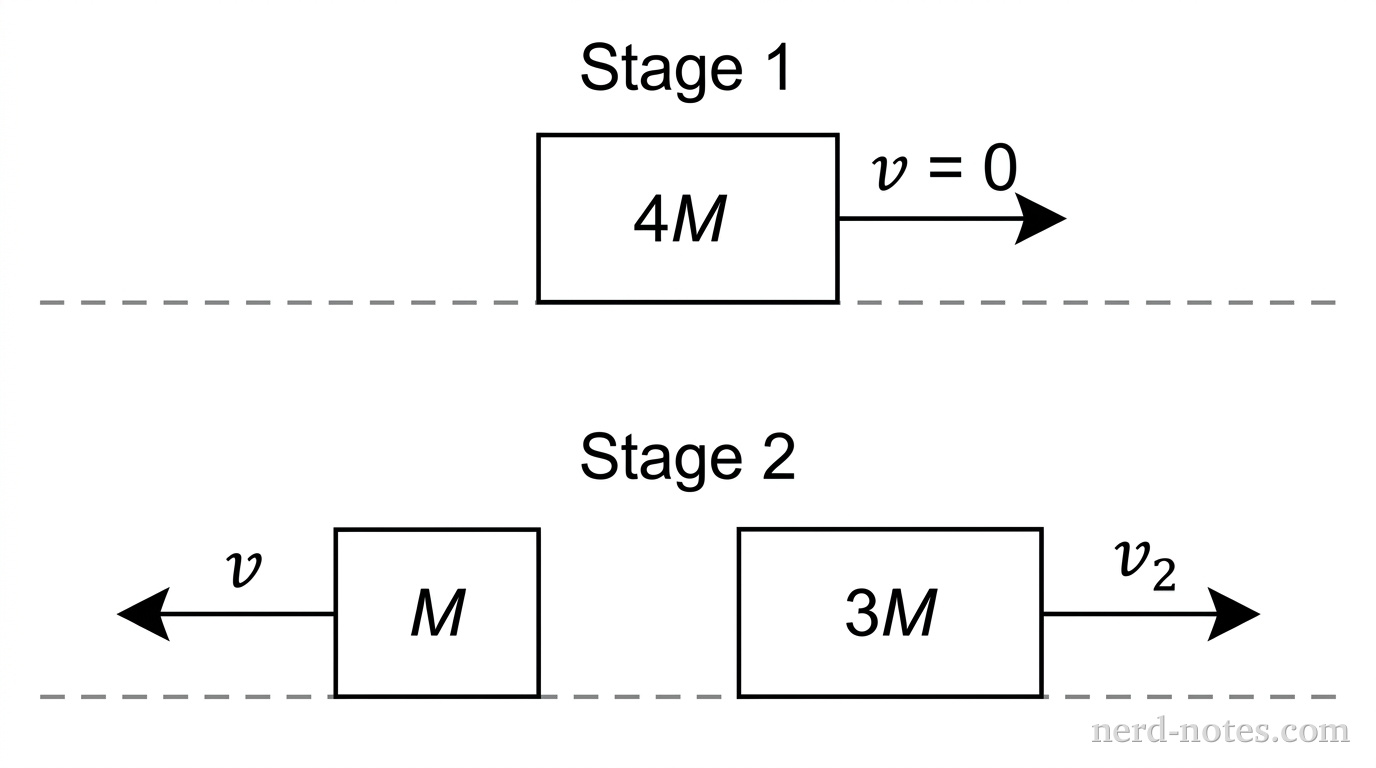
An object of mass \(4M\) is at rest on a horizontal, frictionless surface. An internal explosion splits the object into two fragments of masses \(M\) and \(3M\). Immediately after the explosion, the fragment of mass \(M\) is observed to move to the left with speed \(v\). Which of the following expressions represents the total mechanical energy released during the explosion?
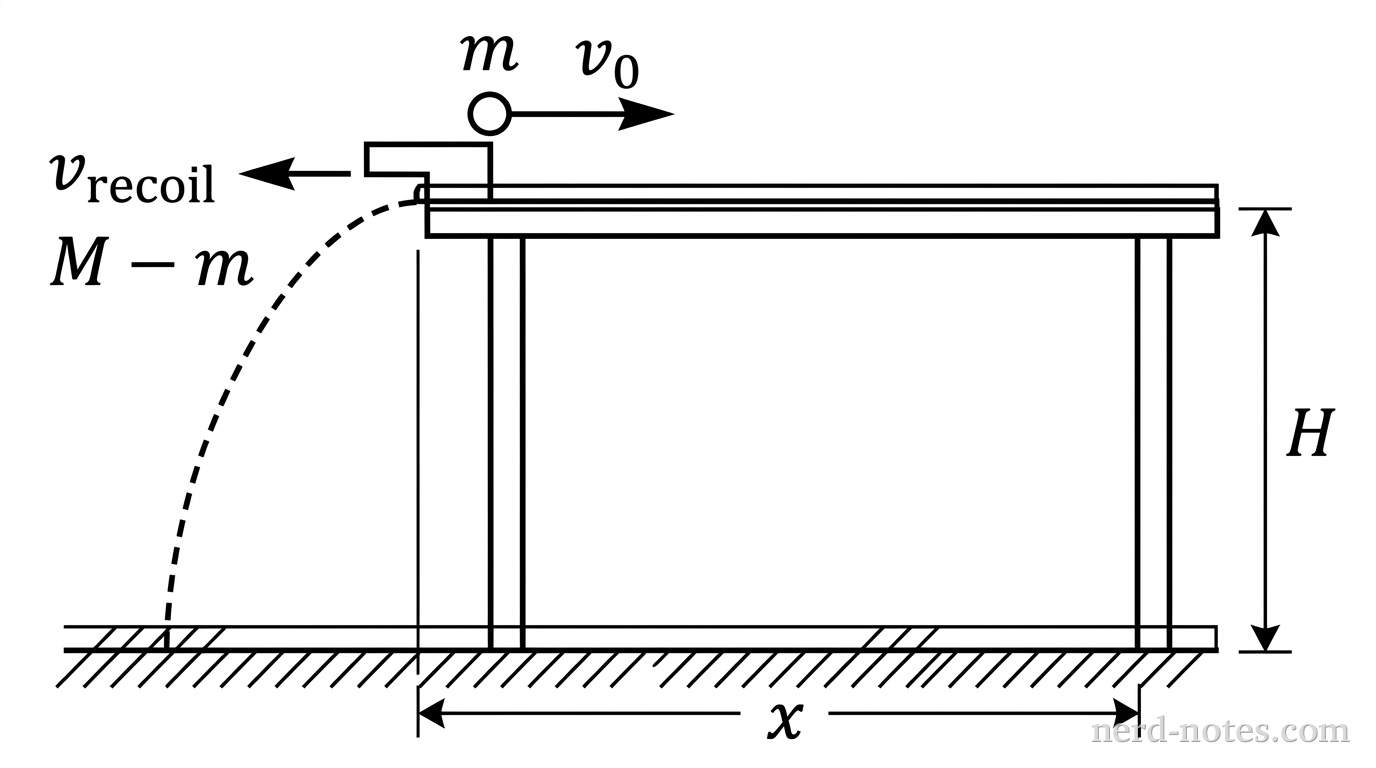
A launcher of total mass M, which includes a projectile of mass m, is initially at rest on a frictionless horizontal table at a height H above the floor. The launcher is positioned at the left edge of the table. The launcher fires the projectile horizontally to the right with a speed v_0 relative to the floor. The launcher recoils to the left, immediately leaves the table, and hits the floor. Which of the following is a correct expression for the horizontal distance x from the left edge of the table to the point where the launcher lands?
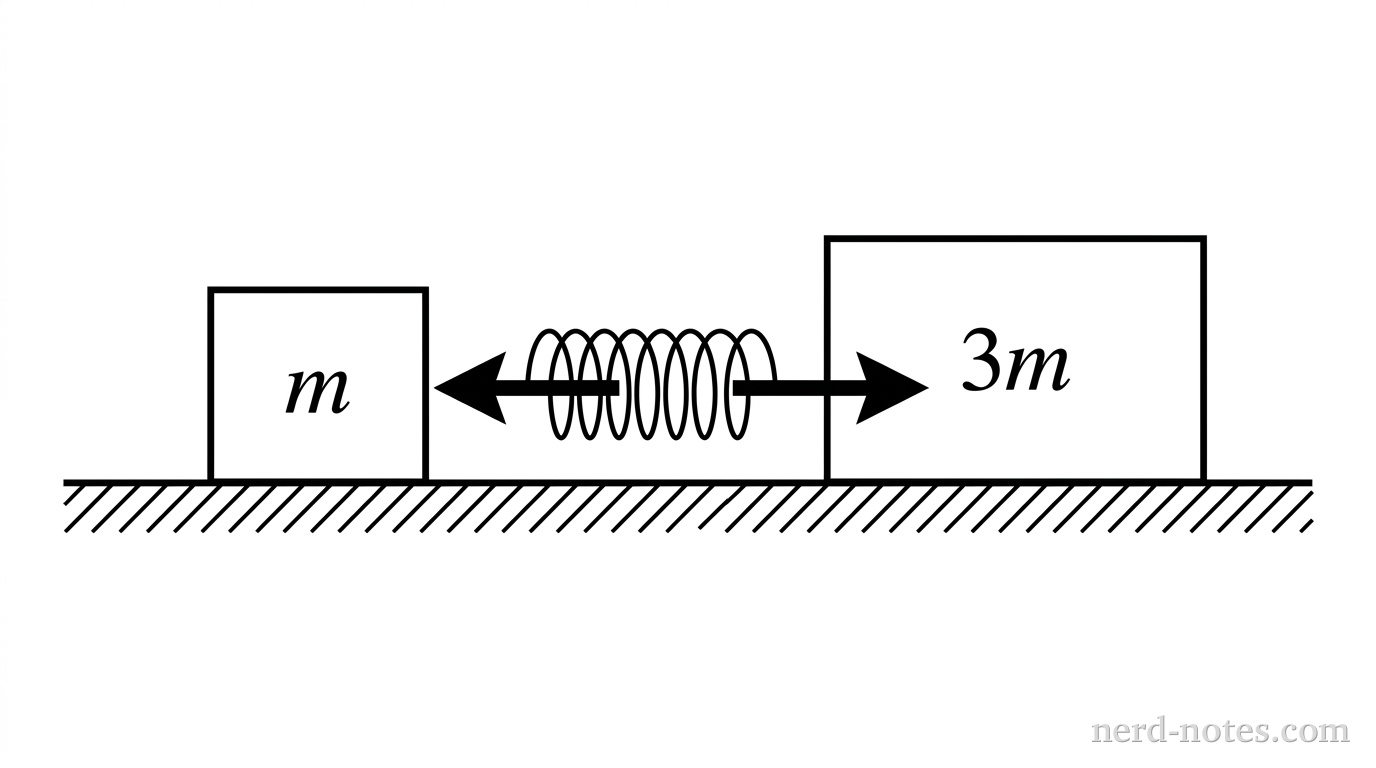
Two blocks of mass \(m\) and \(3m\) are held at rest on a horizontal, frictionless surface with a compressed spring of negligible mass between them. The blocks are released and move in opposite directions. Which of the following statements correctly describes the total momentum \(\vec{p}_{sys}\) and total kinetic energy \(K_{sys}\) of the two-block system after the blocks have lost contact with the spring?
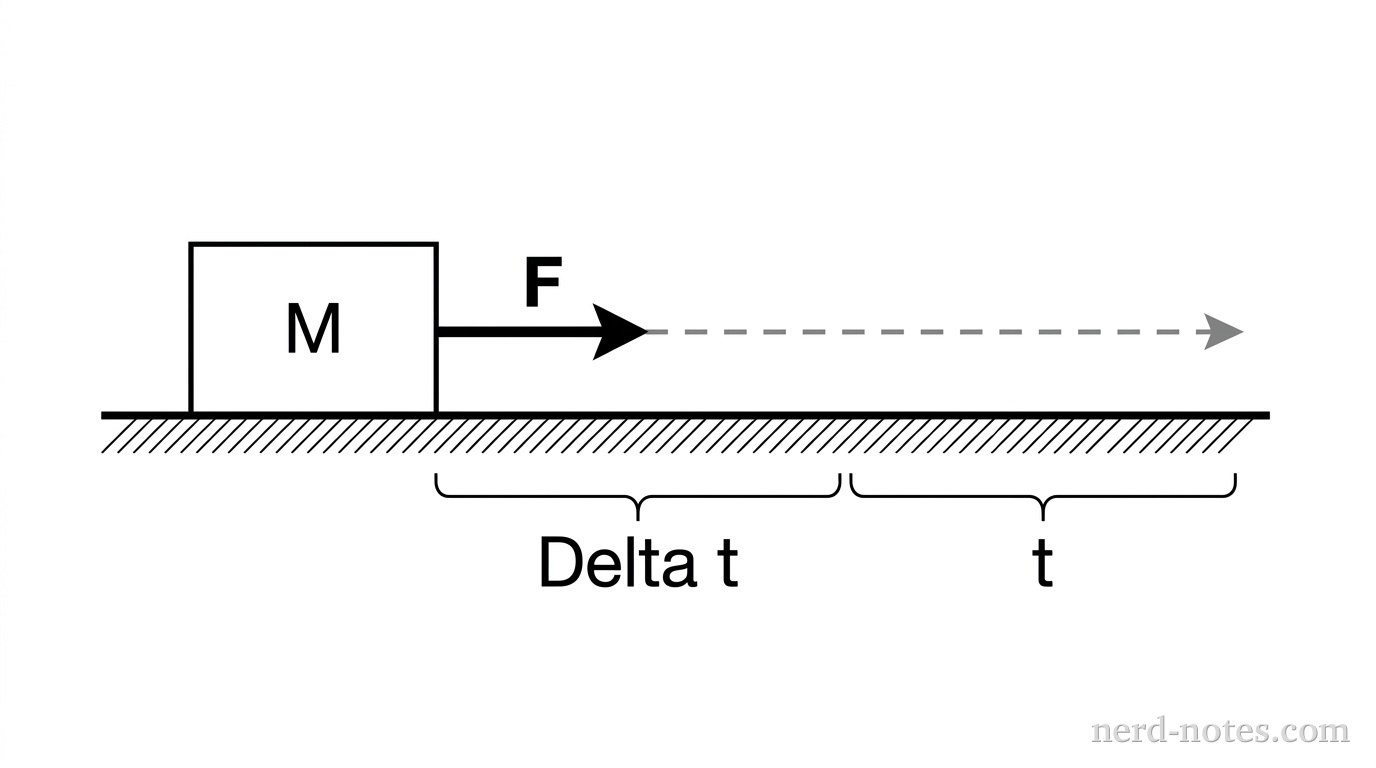
A block of mass \(M\) is initially at rest on a horizontal, frictionless surface. A constant horizontal force of magnitude \(F\) is applied to the block for a time interval \(\Delta t\). Immediately after the force is removed, the block slides for an additional time interval \(t\). Which of the following expressions represents the distance \(d\) traveled by the block during the second time interval \(t\)?
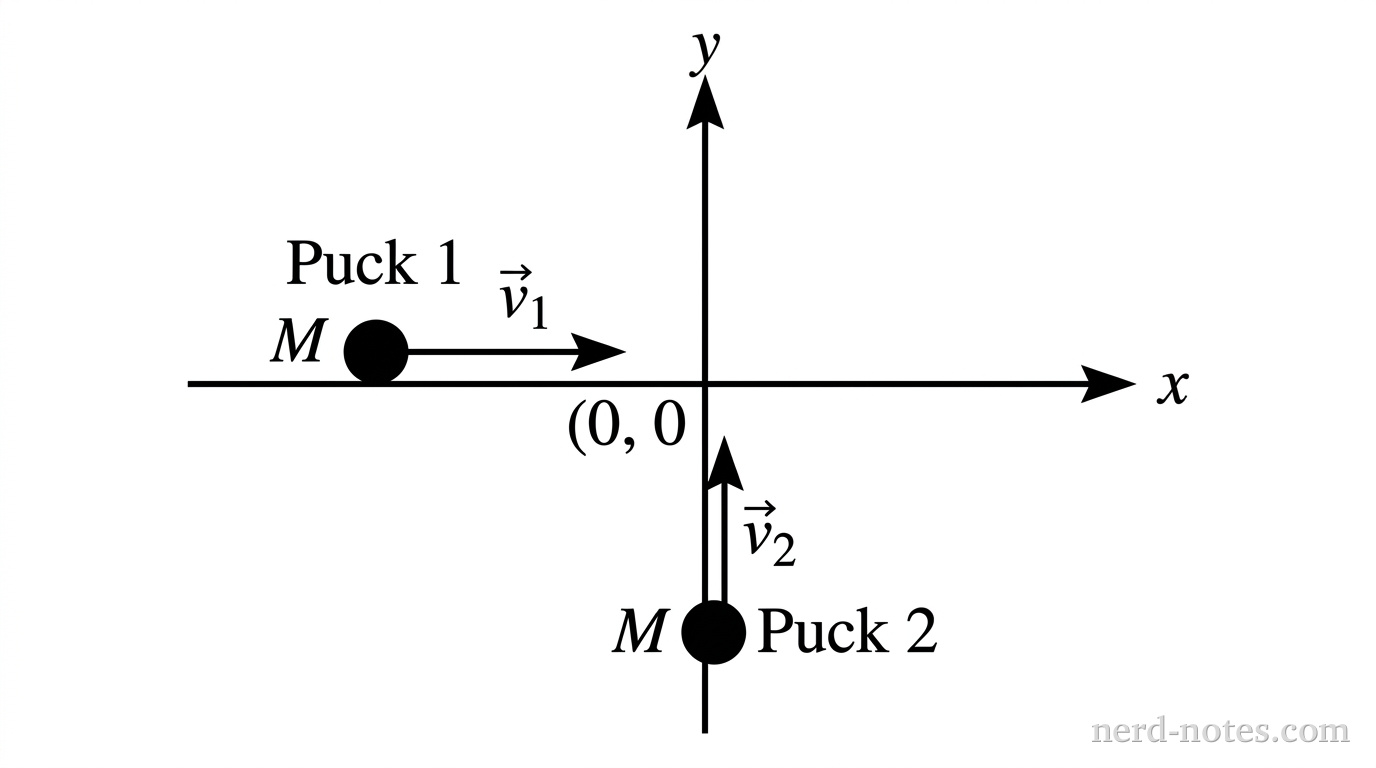
Two pucks, each of mass \(M\), slide on a horizontal frictionless surface. Puck 1 moves with speed \(v_1\) in the \(+x\)-direction, and Puck 2 moves with speed \(v_2\) in the \(+y\)-direction. The pucks collide and stick together, moving with a final speed \(v_f\) at an angle \(\theta\) relative to the \(x\)-axis. If \(\tan \theta = \dfrac{3}{4}\), what is the ratio \(\dfrac{v_f}{v_1}\)?