
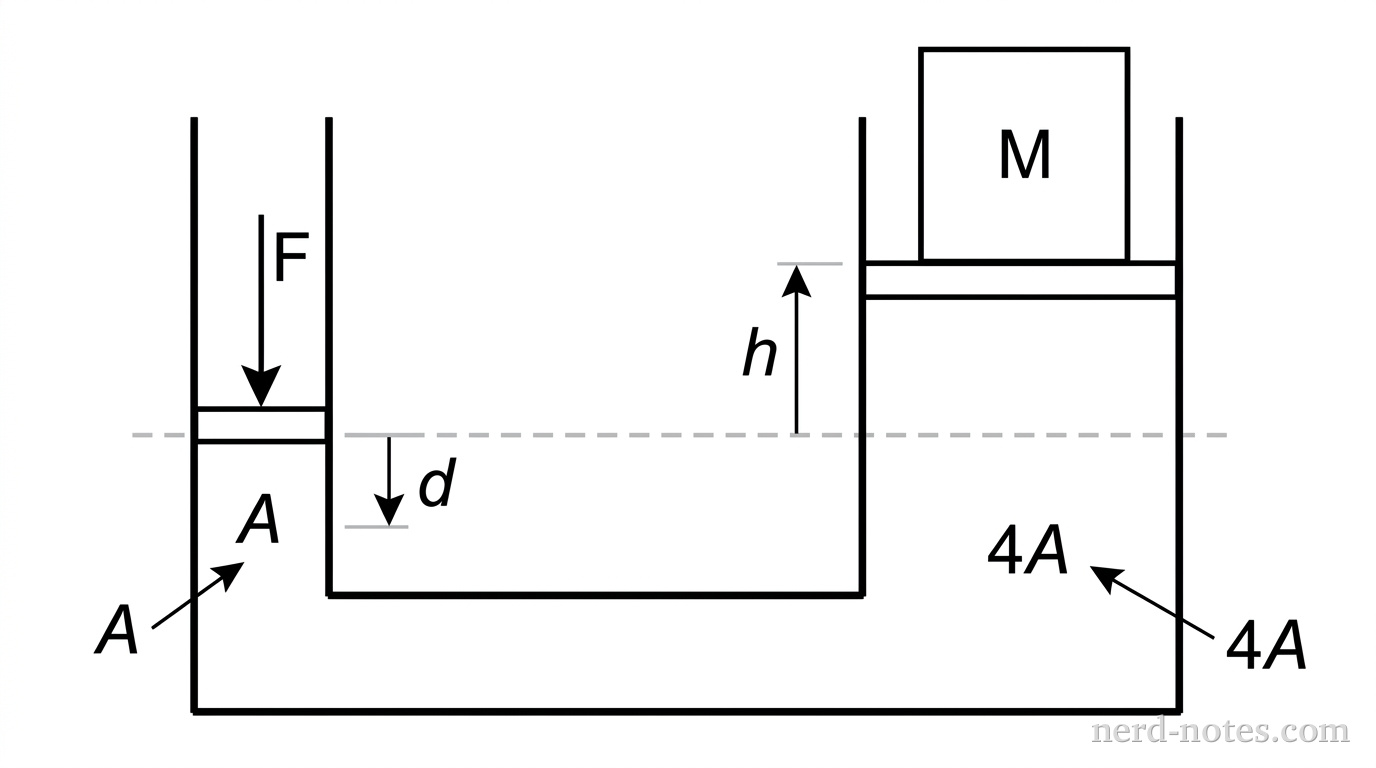
A hydraulic lift is constructed with an input cylinder of cross-sectional area \(A\) and an output cylinder of cross-sectional area \(4A\). The cylinders are filled with an incompressible fluid of density \(\rho\). Initially, the system is in equilibrium with the fluid at the same horizontal level in both cylinders. A crate of mass \(M\) is placed on the output piston, and an external force \(F\) is applied to the input piston to lift the crate. The crate is raised a vertical distance \(h\) and then held at rest. Assuming the pistons have negligible mass and the fluid is ideal, which of the following is a correct expression for the magnitude of the force \(F\) required to hold the crate in this new position?
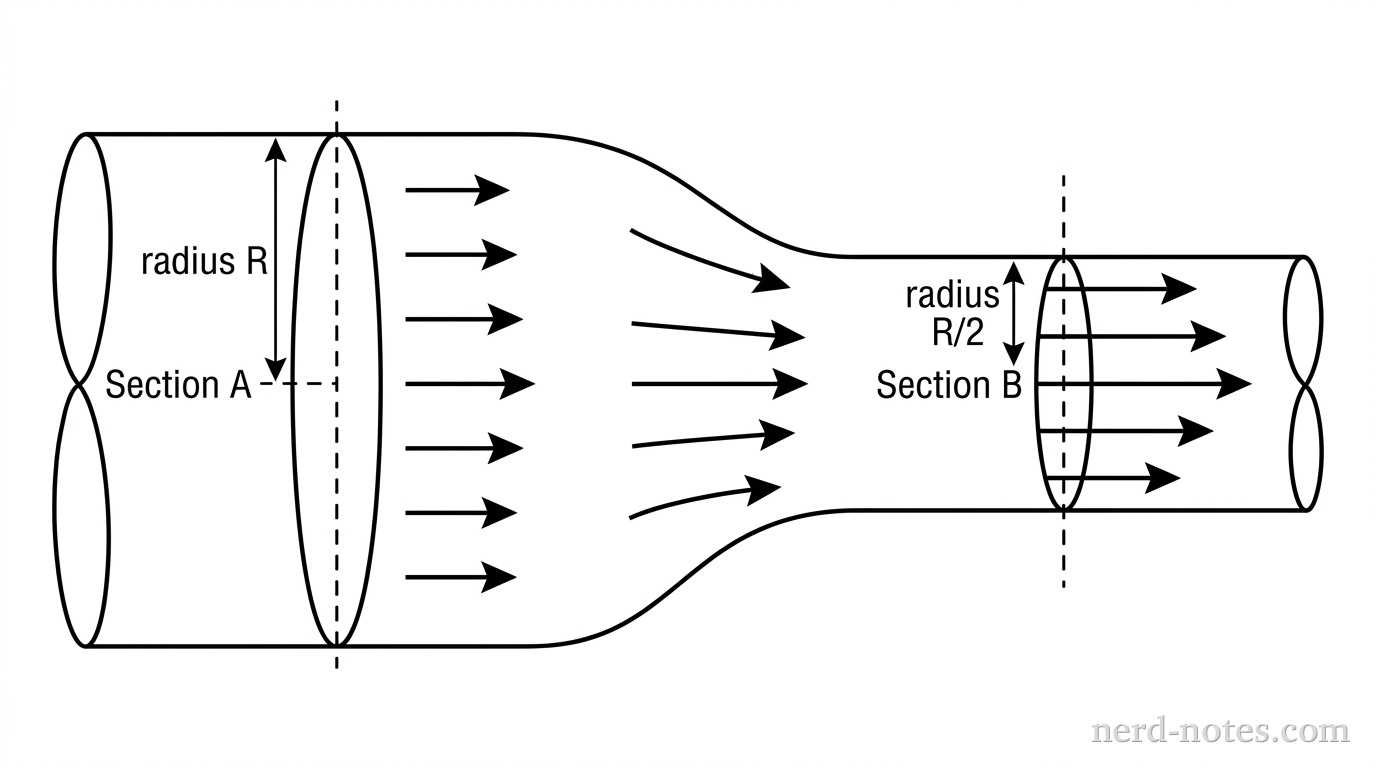
An ideal, incompressible fluid flows at a steady rate through a horizontal, cylindrical pipe. At Section A, the pipe has a radius \(R\). Further downstream, at Section B, the pipe narrows to a radius \(\frac{R}{2}\). Which of the following correctly compares the fluid speed \(v\), the volume flow rate \(Q\), and the time \(\Delta t\) required for a fixed volume of fluid to pass through a cross-sectional plane at Section B to the corresponding values at Section A?
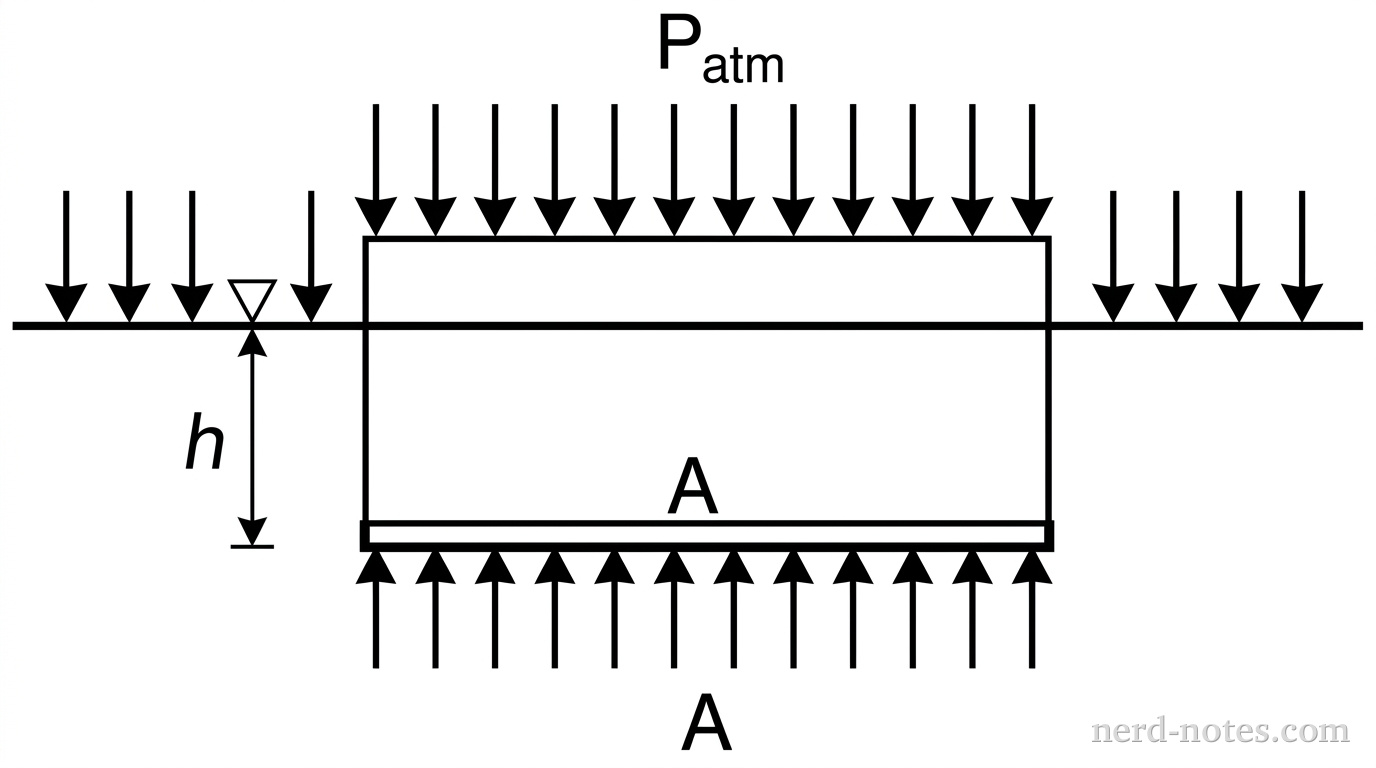
A ship of mass \(M\) floats in equilibrium in a body of water with density \(\rho_w\). The ship has a flat-bottomed hull with a constant horizontal cross-sectional area \(A\). The bottom of the hull is submerged to a depth \(h\) below the surface, and the atmospheric pressure is \(P_{atm}\). Two students make the following claims about the forces acting on the ship:
Student 1: The buoyant force exerted by the water is equal to the weight of the displaced water, \(\rho_w Ahg\), and this force must be equal to the ship’s weight, \(Mg\).
Student 2: The upward force from the water on the bottom of the hull is what supports the ship, so the water pressure at the depth of the hull’s bottom must be equal to \(\dfrac{Mg}{A}\).
Which student’s claim is correct, and what is the valid physical justification?
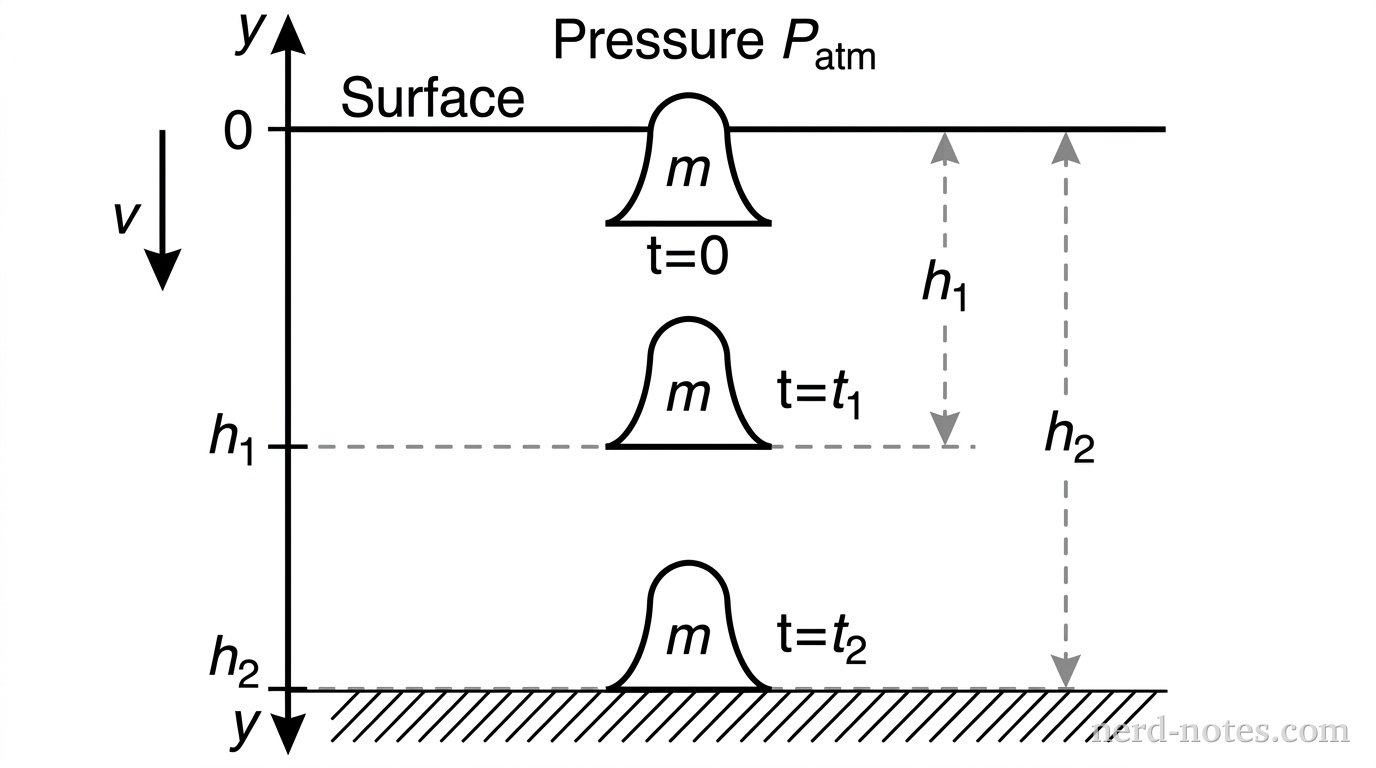
A diving bell is lowered from the surface of a deep lake into the water at a constant speed \(v\). At the surface of the lake, the absolute pressure is \(P_{atm}\). The bell is lowered until the absolute pressure exerted by the water on the bell is \(1.5 P_{atm}\), which occurs at time \(t_1\) after the bell leaves the surface. At what time \(t_2\) after leaving the surface will the absolute pressure on the bell be \(2.5 P_{atm}\)?
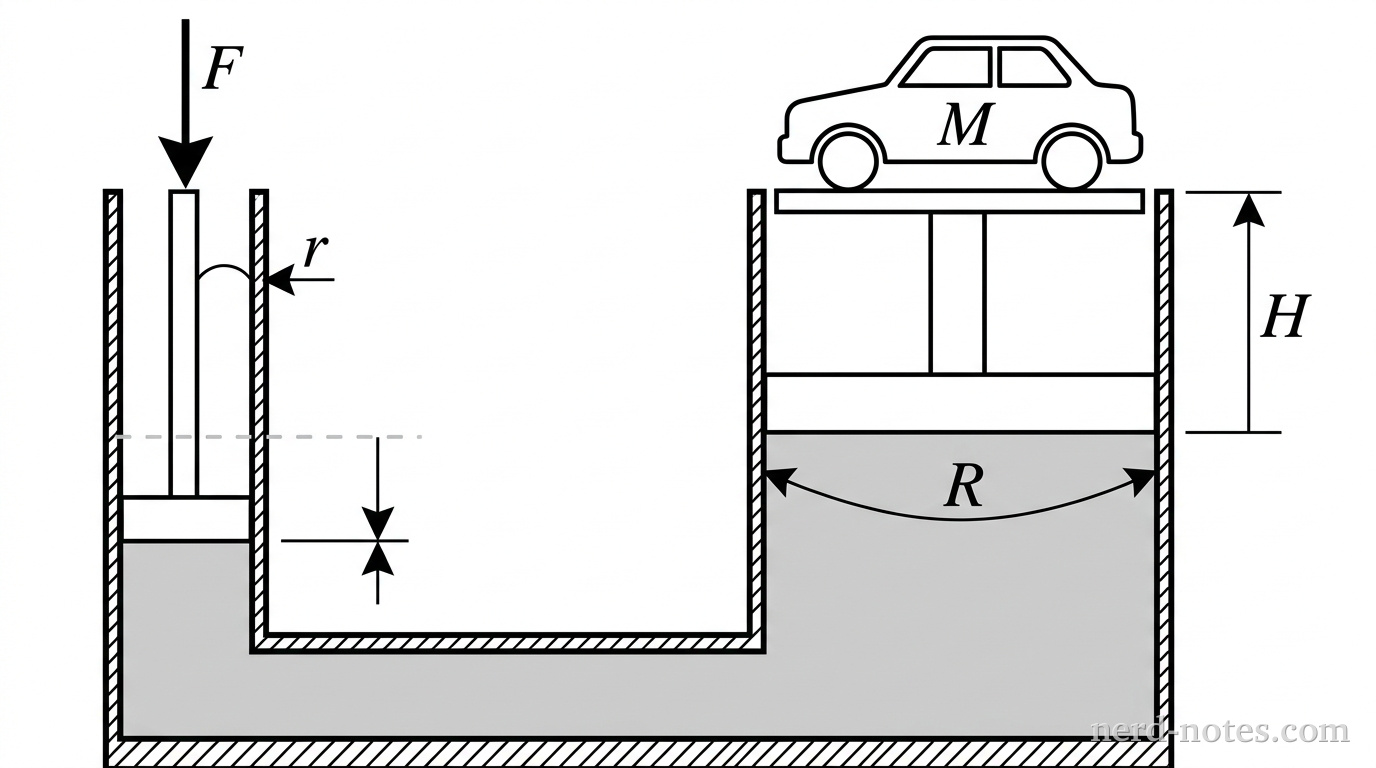
A hydraulic lift is filled with an ideal, incompressible fluid of negligible mass. A car of mass \( M \) sits on a large circular piston of radius \( R \). A mechanic applies a constant downward force \( F \) to a smaller circular piston of radius \( r \), causing the car to be lifted a vertical distance \( H \) at a constant speed. Which of the following correctly identifies the magnitude of the force \( F \) and the total work \( W \) done by the mechanic on the system?
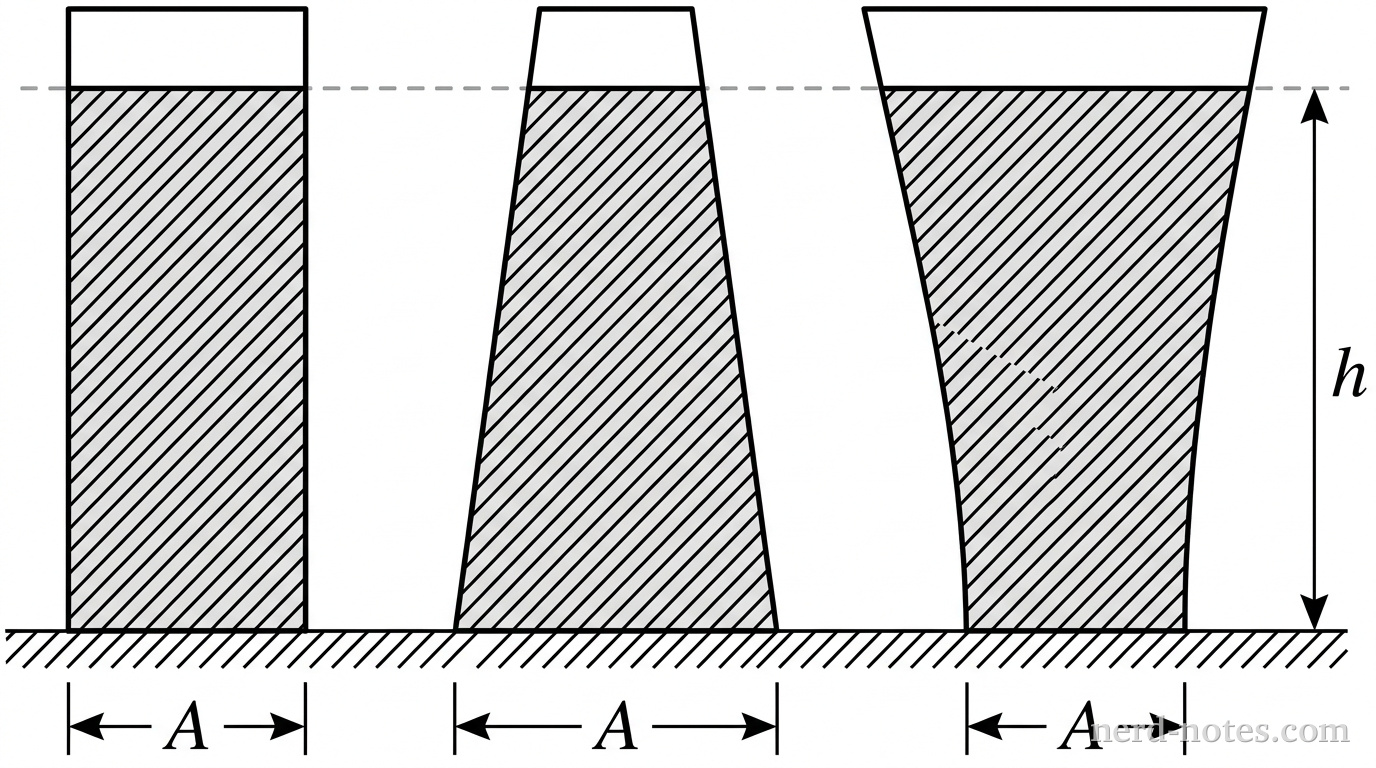
Three containers with the same base area \(A\) are filled with the same liquid of density \(\rho\) to the same height \(h\). Container 1 is a cylinder, Container 2 has walls that narrow toward the top, and Container 3 has walls that widen toward the top, as shown in the diagram. Which of the following correctly compares the magnitude of the downward force \(F_{base}\) exerted by the liquid on the base of Container 3 to the weight \(W\) of the liquid in Container 3, and provides a correct justification?
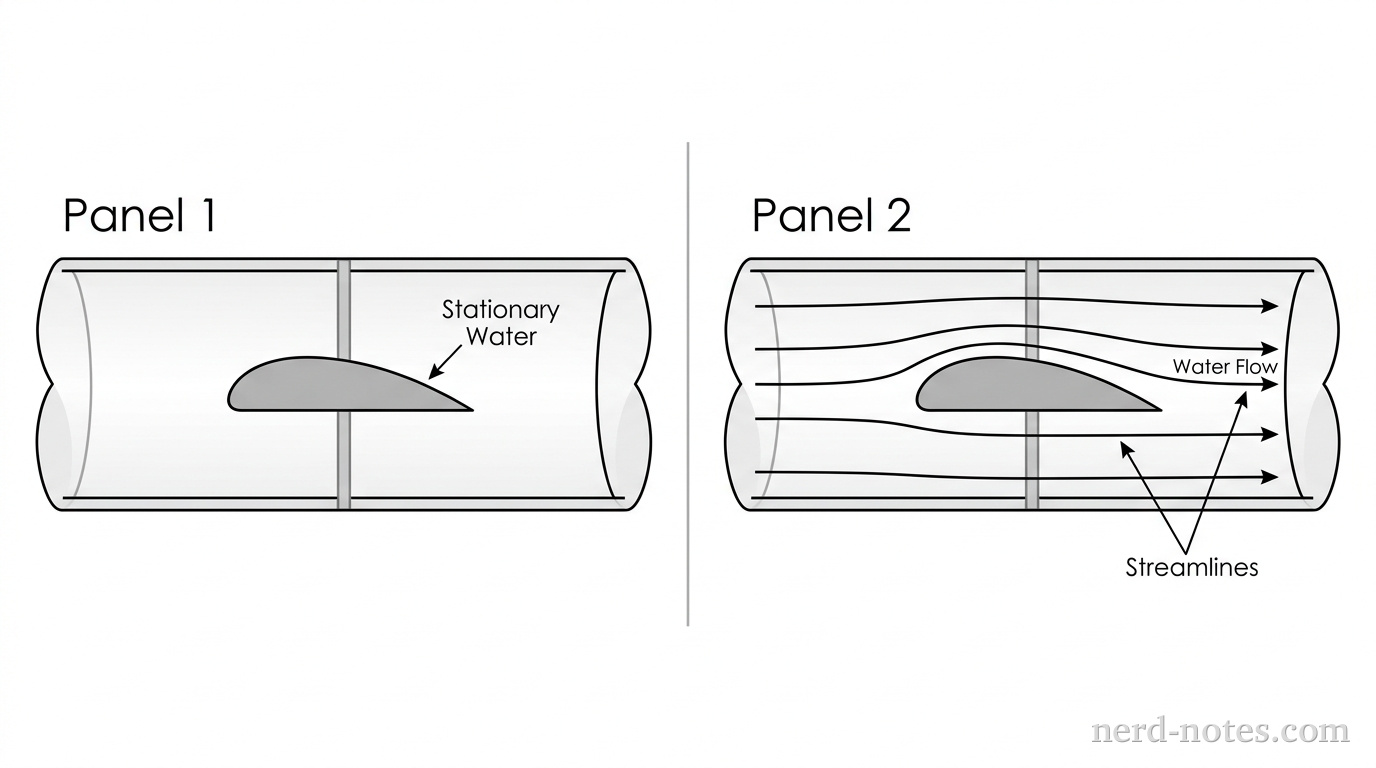
A rigid object with a volume \(V\) is fully submerged and held at a fixed position in a horizontal pipe. The object has an asymmetrical cross-section that is flat on the bottom and curved on the top. In Situation 1, the water in the pipe is stationary. In Situation 2, water of density \(\rho\) flows through the pipe at a high constant velocity. In both situations, the object is completely surrounded by water and remains at the same depth. Which of the following correctly compares the magnitude of the net vertical force \(F_{\text{water}}\) exerted by the water on the object in the two situations and provides a correct physical justification?
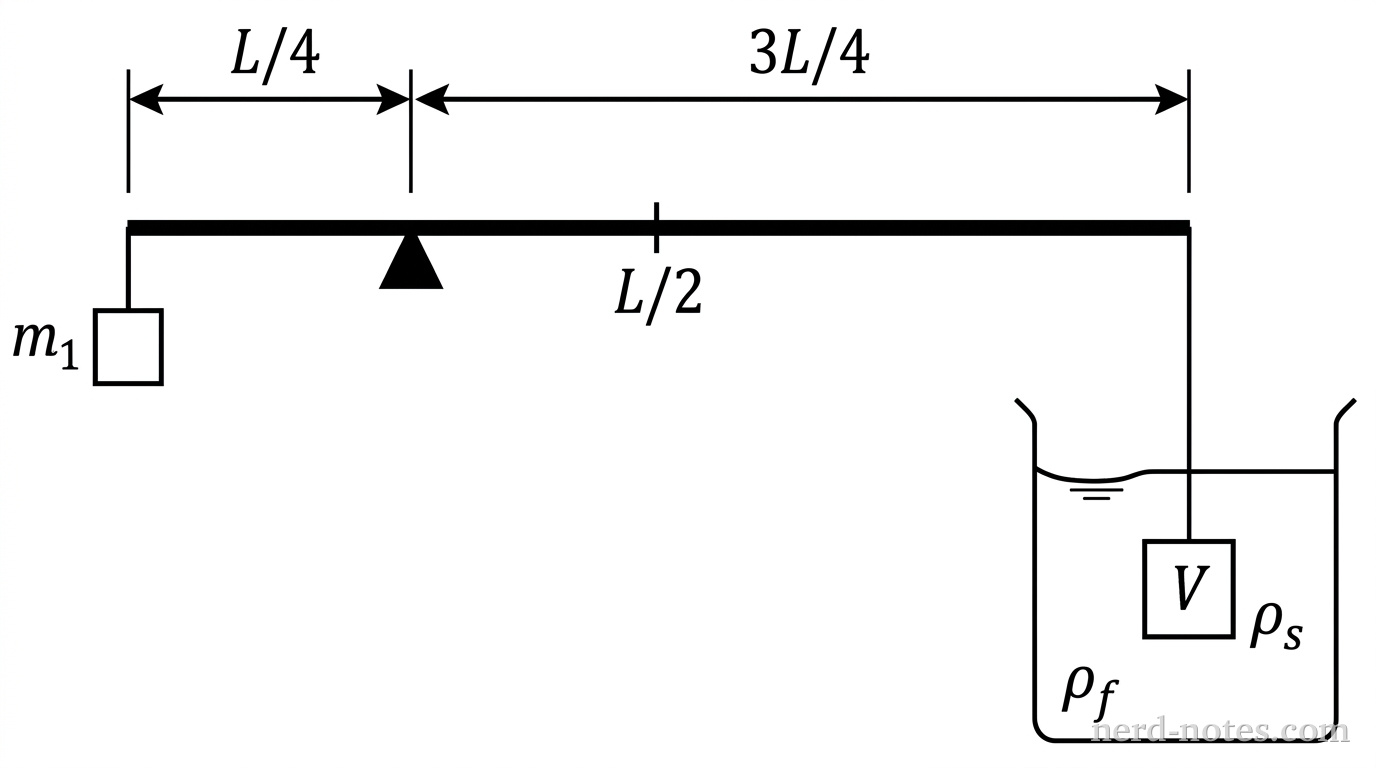
A uniform horizontal rod of mass \(M\) and length \(L\) is supported by a pivot located at a distance \(L/4\) from its left end. A small block of mass \(m_1\) is suspended from the left end of the rod. At the right end of the rod, a string is attached to a solid object of volume \(V\) and density \(\rho_s\). The object is fully submerged in a container of liquid with density \(\rho_f\), where \(\rho_s > \rho_f\). If the system is in static equilibrium with the rod remaining horizontal, which of the following is a correct expression for the mass \(m_1\)?
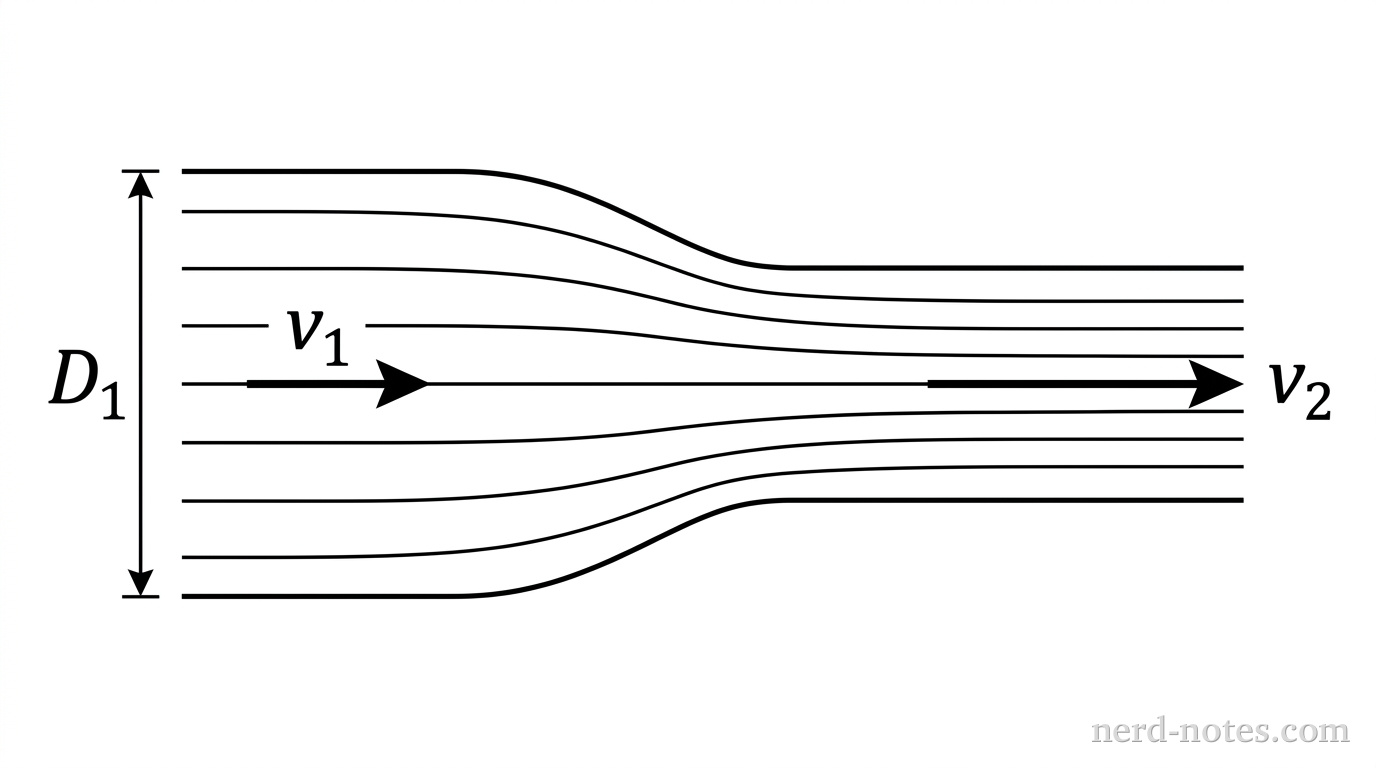
In a water filtration system, water flows through a main horizontal pipe of diameter \(D_1\) with a constant speed \(v_1\). To increase the speed for the filtration process, the pipe tapers to a smaller diameter \(D_2\). Assuming the water behaves as an ideal, incompressible fluid, which of the following expressions correctly represents the speed \(v_2\) of the water in the narrower section of the pipe?
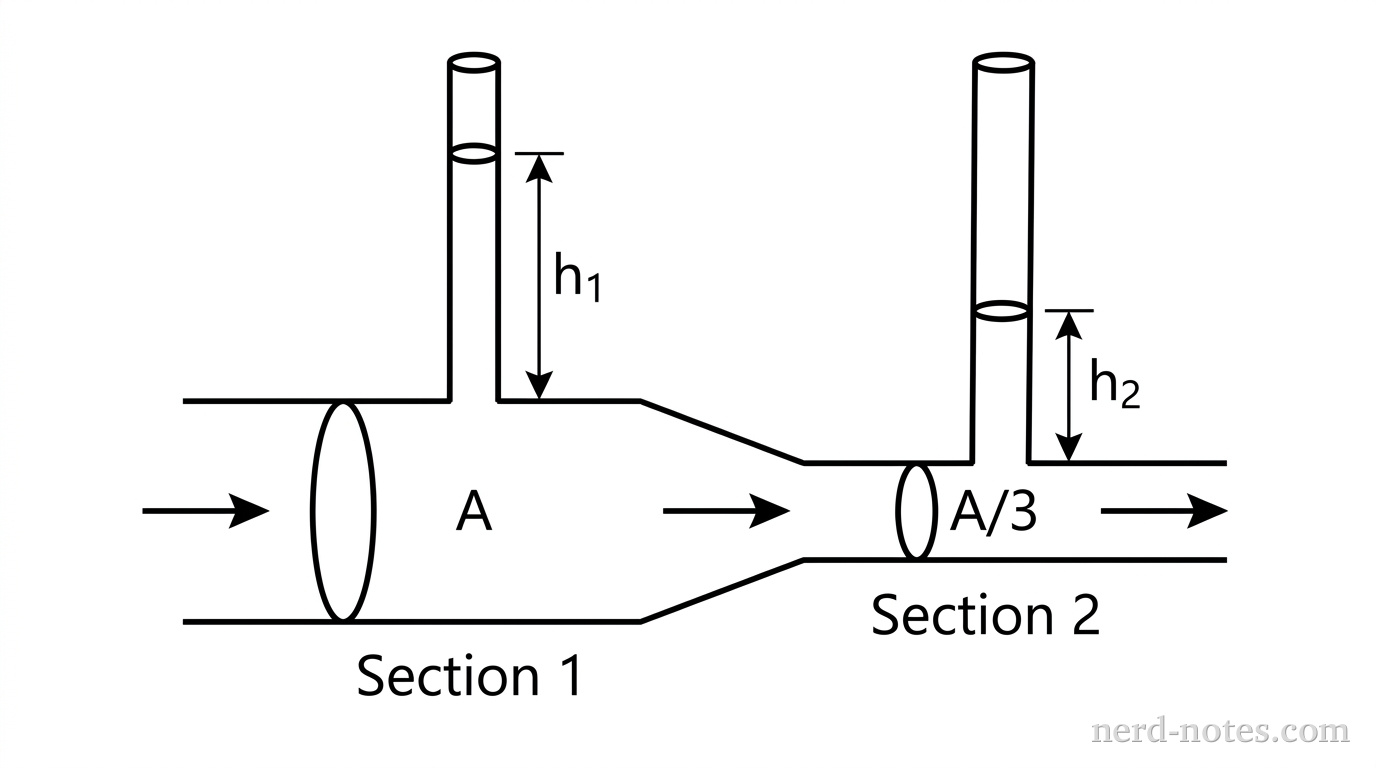
An ideal, incompressible liquid of density \(\rho\) flows through a horizontal pipe. The pipe consists of two sections: Section 1 has a cross-sectional area \(A\), and Section 2 has a cross-sectional area \(\dfrac{A}{3}\). The speed of the liquid in Section 1 is \(v\). Two vertical tubes, both open to the atmosphere, are attached to the pipe—one at Section 1 and one at Section 2—allowing the liquid to rise to heights \(h_1\) and \(h_2\), respectively. If \(g\) is the acceleration due to gravity, which of the following is a correct expression for the difference in the heights \(\Delta h = h_1 – h_2\)?