AP Physics

Unit 1 - Vectors and Kinematics

FRQ
Mathematical
Advanced

Pro

Pro

Educator

Upgrade For More Credits
0
Criterion Points Description
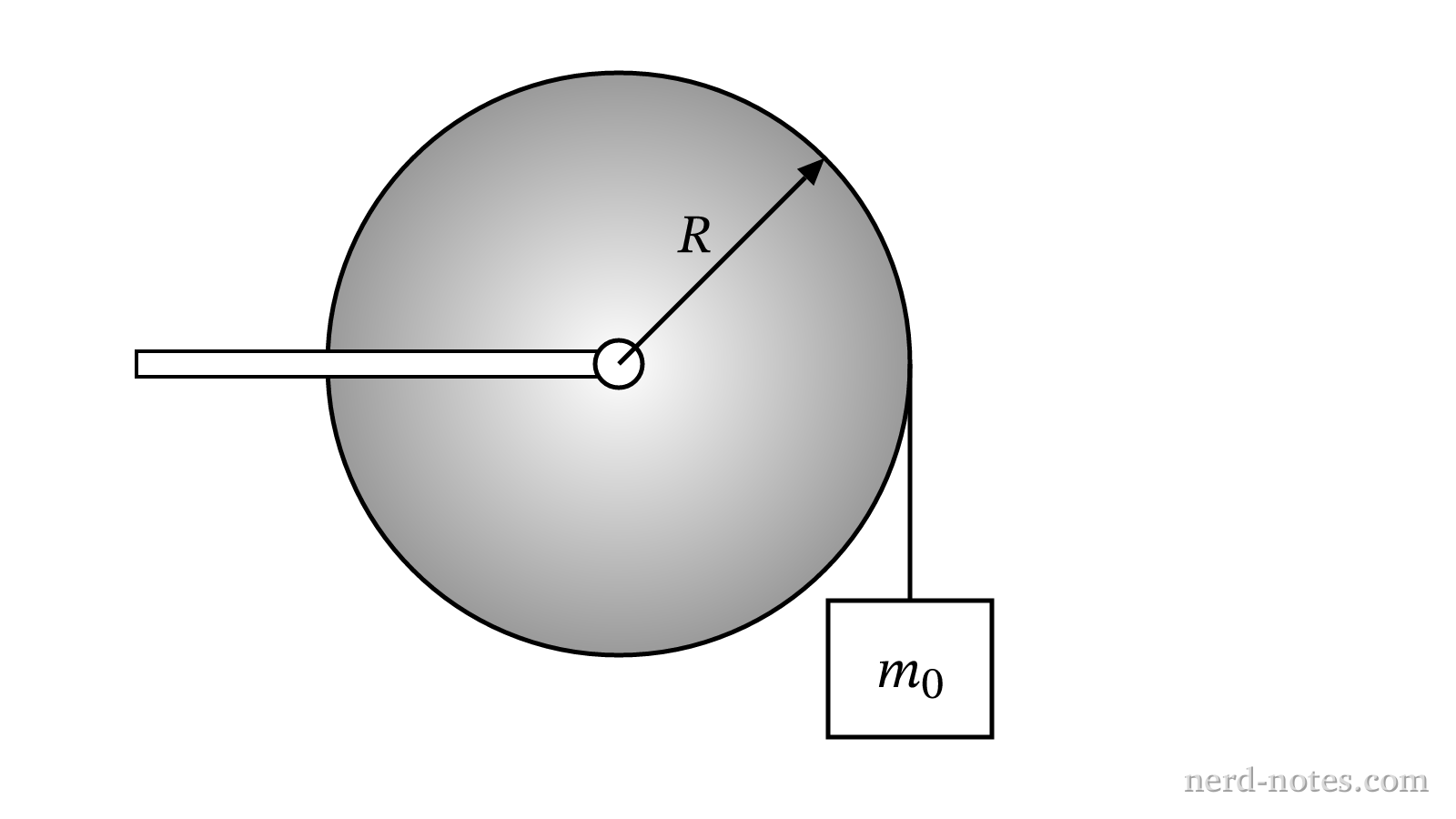
A1 1 For correctly substituting the area mass density into an integral for rotational inertia
A2 1 For correctly expressing the differential mass element \(dm\) in terms of \(r\)
A3 1 For correctly integrating and substituting the given expression for \(c\) to yield the final theoretical rotational inertia
B1 1 For a correct Newton’s second law equation for the translation of the hanging block
B2 1 For a correct Newton’s second law equation for the rotation of the pulley
B3 1 For using the correct relationship between linear and angular acceleration (\(\alpha = a/R\)) and solving for \(a\)
C1 1 For identifying a valid pair of quantities to graph that will yield a straight line whose slope can be used to determine \(I_{exp}\)
D1 1 For correctly labeling both axes with quantities and units consistent with the response in part (c)
D2 1 For scaling both axes linearly such that the plotted data uses at least half the provided grid
D3 1 For accurately plotting the calculated data points based on the student’s chosen quantities
D4 1 For drawing a straight line that represents the trend of the data
E1 1 For correctly calculating the slope using points on the drawn best-fit line
E2 1 For correctly calculating the experimental rotational inertia \(I_{exp}\) using the calculated slope
F1 1 For a modified torque equation or algebraic expression that includes the constant frictional torque
F2 1 For a valid justification that the frictional torque adds a constant term (the y-intercept) without changing the coefficient of acceleration (the slope)

Need Help? Ask Phy To Explain

A Major Upgrade To Phy Is Coming Soon — Stay Tuned

Just Drag and Drop!
Quick Actions ?
×

NEW UBQ QUIZ LAB

100s of AP aligned questions and quizzes to help you get a 5 even faster. Full Mock exams with Auto Grading and Adaptive explanations. Try out Nerd Notes', state of the art, quiz platform.

Topics in this question

We'll help clarify entire units in one hour or less — guaranteed.

A self paced course with videos, problems sets, and everything you need to get a 5. Trusted by over 15k students and over 200 schools.

Go Pro to remove ads + unlimited access to our AI learning tools.

Nerd Notes

Discover the world's best Physics resources

Continue with

By continuing you (1) agree to our Terms of Use and Terms of Sale and (2) consent to sharing your IP and browser information used by this site’s security protocols as outlined in our Privacy Policy.

Error Report

Sign in before submitting feedback.

KinematicsForces
\(\Delta x = v_i t + \frac{1}{2} at^2\)\(F = ma\)
\(v = v_i + at\)\(F_g = \frac{G m_1 m_2}{r^2}\)
\(v^2 = v_i^2 + 2a \Delta x\)\(f = \mu N\)
\(\Delta x = \frac{v_i + v}{2} t\)\(F_s =-kx\)
\(v^2 = v_f^2 \,-\, 2a \Delta x\) 
Circular MotionEnergy
\(F_c = \frac{mv^2}{r}\)\(KE = \frac{1}{2} mv^2\)
\(a_c = \frac{v^2}{r}\)\(PE = mgh\)
\(T = 2\pi \sqrt{\frac{r}{g}}\)\(KE_i + PE_i = KE_f + PE_f\)
 \(W = Fd \cos\theta\)
MomentumTorque and Rotations
\(p = mv\)\(\tau = r \cdot F \cdot \sin(\theta)\)
\(J = \Delta p\)\(I = \sum mr^2\)
\(p_i = p_f\)\(L = I \cdot \omega\)
Simple Harmonic MotionFluids
\(F = -kx\)\(P = \frac{F}{A}\)
\(T = 2\pi \sqrt{\frac{l}{g}}\)\(P_{\text{total}} = P_{\text{atm}} + \rho gh\)
\(T = 2\pi \sqrt{\frac{m}{k}}\)\(Q = Av\)
\(x(t) = A \cos(\omega t + \phi)\)\(F_b = \rho V g\)
\(a = -\omega^2 x\)\(A_1v_1 = A_2v_2\)
ConstantDescription
[katex]g[/katex]Acceleration due to gravity, typically [katex]9.8 , \text{m/s}^2[/katex] on Earth’s surface
[katex]G[/katex]Universal Gravitational Constant, [katex]6.674 \times 10^{-11} , \text{N} \cdot \text{m}^2/\text{kg}^2[/katex]
[katex]\mu_k[/katex] and [katex]\mu_s[/katex]Coefficients of kinetic ([katex]\mu_k[/katex]) and static ([katex]\mu_s[/katex]) friction, dimensionless. Static friction ([katex]\mu_s[/katex]) is usually greater than kinetic friction ([katex]\mu_k[/katex]) as it resists the start of motion.
[katex]k[/katex]Spring constant, in [katex]\text{N/m}[/katex]
[katex] M_E = 5.972 \times 10^{24} , \text{kg} [/katex]Mass of the Earth
[katex] M_M = 7.348 \times 10^{22} , \text{kg} [/katex]Mass of the Moon
[katex] M_M = 1.989 \times 10^{30} , \text{kg} [/katex]Mass of the Sun
VariableSI Unit
[katex]s[/katex] (Displacement)[katex]\text{meters (m)}[/katex]
[katex]v[/katex] (Velocity)[katex]\text{meters per second (m/s)}[/katex]
[katex]a[/katex] (Acceleration)[katex]\text{meters per second squared (m/s}^2\text{)}[/katex]
[katex]t[/katex] (Time)[katex]\text{seconds (s)}[/katex]
[katex]m[/katex] (Mass)[katex]\text{kilograms (kg)}[/katex]
VariableDerived SI Unit
[katex]F[/katex] (Force)[katex]\text{newtons (N)}[/katex]
[katex]E[/katex], [katex]PE[/katex], [katex]KE[/katex] (Energy, Potential Energy, Kinetic Energy)[katex]\text{joules (J)}[/katex]
[katex]P[/katex] (Power)[katex]\text{watts (W)}[/katex]
[katex]p[/katex] (Momentum)[katex]\text{kilogram meters per second (kgm/s)}[/katex]
[katex]\omega[/katex] (Angular Velocity)[katex]\text{radians per second (rad/s)}[/katex]
[katex]\tau[/katex] (Torque)[katex]\text{newton meters (Nm)}[/katex]
[katex]I[/katex] (Moment of Inertia)[katex]\text{kilogram meter squared (kgm}^2\text{)}[/katex]
[katex]f[/katex] (Frequency)[katex]\text{hertz (Hz)}[/katex]

Metric Prefixes

Example of using unit analysis: Convert 5 kilometers to millimeters. 

  1. Start with the given measurement: [katex]\text{5 km}[/katex]

  2. Use the conversion factors for kilometers to meters and meters to millimeters: [katex]\text{5 km} \times \frac{10^3 \, \text{m}}{1 \, \text{km}} \times \frac{10^3 \, \text{mm}}{1 \, \text{m}}[/katex]

  3. Perform the multiplication: [katex]\text{5 km} \times \frac{10^3 \, \text{m}}{1 \, \text{km}} \times \frac{10^3 \, \text{mm}}{1 \, \text{m}} = 5 \times 10^3 \times 10^3 \, \text{mm}[/katex]

  4. Simplify to get the final answer: [katex]\boxed{5 \times 10^6 \, \text{mm}}[/katex]

Prefix

Symbol

Power of Ten

Equivalent

Pico-

p

[katex]10^{-12}[/katex]

Nano-

n

[katex]10^{-9}[/katex]

Micro-

µ

[katex]10^{-6}[/katex]

Milli-

m

[katex]10^{-3}[/katex]

Centi-

c

[katex]10^{-2}[/katex]

Deci-

d

[katex]10^{-1}[/katex]

(Base unit)

[katex]10^{0}[/katex]

Deca- or Deka-

da

[katex]10^{1}[/katex]

Hecto-

h

[katex]10^{2}[/katex]

Kilo-

k

[katex]10^{3}[/katex]

Mega-

M

[katex]10^{6}[/katex]

Giga-

G

[katex]10^{9}[/katex]

Tera-

T

[katex]10^{12}[/katex]

Sign In to View Your Questions

Share This Question

Enjoying UBQ? Share the 🔗 with friends!

Link Copied!

PRO TIER

One price to unlock most advanced version of Phy across all our tools.

$20

per month

Billed Monthly. Cancel Anytime.

We use cookies to improve your experience. By continuing to browse on Nerd Notes, you accept the use of cookies as outlined in our privacy policy.

Physics Shouldn't Be Hard

So I designed the Ultimate AP Physics 1 Course so you can learn faster and score higher in less than 100 hours.
Trusted by 10k+ Students

📚 Predict Your AP Physics Exam Score

Try our free calculator to see what you need to get a 5 on the 2026 AP Physics 1 exam.

Feeling uneasy about your next physics test? We'll boost your grade in 3 lessons or less—guaranteed