| Step | Reasoning |
|---|---|
| Identify the expression for the differential motional EMF induced across a small radial segment of the rotating disk. \[ d\mathcal{E} = v(r) B(r) \, dr \] |
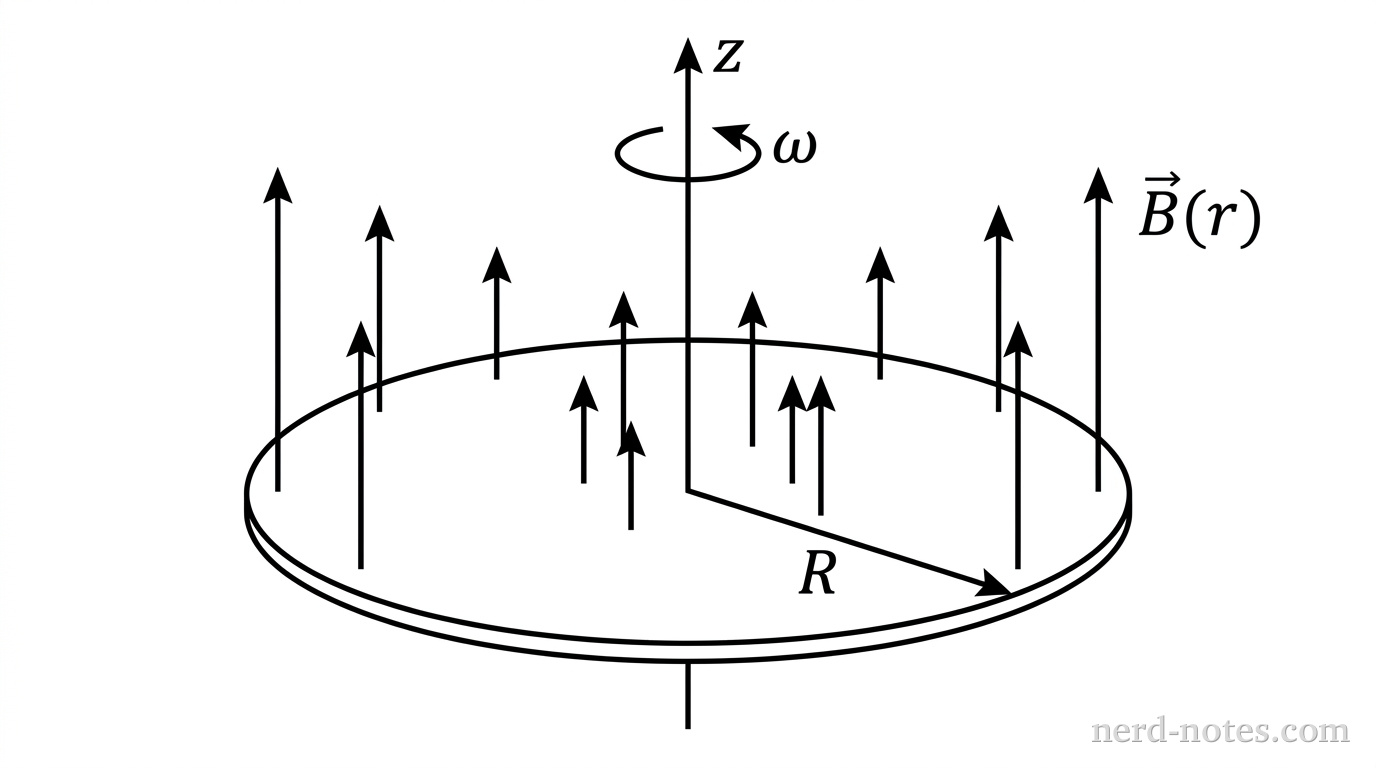
The question asks for the total induced EMF between the center and the rim of a disk rotating in a spatially varying magnetic field. Because the linear speed and magnetic field magnitude both vary with radial position r, we must integrate the motional EMF d\mathcal{E} = v(r) B(r) \, dr along a radial line segment from r = 0 to r = R. |
| Substitute the linear speed v(r) and magnetic field magnitude B(r) as functions of radial distance r. \[ v(r) = \omega r \quad \text{and} \quad B(r) = B_0 \left(\dfrac{r}{R}\right)^2 \] |
To perform the integration, express all position-dependent variables in terms of the integration variable r. |
| Substitute these functional forms into the differential EMF expression and integrate from r = 0 to r = R. \[ \mathcal{E} = \int_0^R (\omega r) \left( B_0 \frac{r^2}{R^2} \right) dr = \frac{B_0 \omega}{R^2} \int_0^R r^3 \, dr = \frac{B_0 \omega}{R^2} \left[ \frac{r^4}{4} \right]_0^R = \frac{1}{4} B_0 \omega R^2 \] |
Integrating the differential contributions from the center (r = 0) to the outer rim (r = R) yields the total radial potential difference. |
Why each choice is correct or incorrect:
(A) Incorrectly includes an additional factor of \(\dfrac{1}{2}\) by attempting to average the linear velocity and field strength separately prior to performing the line integral.
(B) Incorrectly uses a constant average linear speed \(v_{\text{avg}} = \dfrac{1}{2}\omega R\) outside the integral rather than integrating the local speed \(v(r) = \omega r\) inside the integrand.
(C) Incorrectly integrates an extra factor of \(r\) by misinterpreting the differential element as a 2D surface area integral \(2\pi r \, dr\) rather than a 1D radial line element \(dr\).
(D) This is the correct answer.
A Major Upgrade To Phy Is Coming Soon — Stay Tuned
We'll help clarify entire units in one hour or less — guaranteed.
A self paced course with videos, problems sets, and everything you need to get a 5. Trusted by over 15k students and over 200 schools.

A conducting loop is fixed in a region with a magnetic field directed perpendicular to the plane of the loop. The induced electromotive force (EMF) \(\mathcal{E}\) in the loop is measured as a function of time \(t\) and is shown in the graph. At time \(t = 0\), the magnetic flux through the loop is zero (\(\Phi_B = 0\)). Which of the following graphs best represents the magnetic flux \(\Phi_B\) through the loop as a function of time \(t\)?

A rigid circular wire loop of radius \(a\) and total resistance \(R\) lies fixed in a plane perpendicular to a spatially uniform magnetic field. The magnitude of the magnetic field changes with time \(t\) according to \(B(t) = B_0 \left(1 + \dfrac{t}{\tau}\right)^3\), where \(B_0\) and \(\tau\) are positive constants. Which of the following expressions represents the total electric charge \(Q\) that flows past a point in the loop between \(t = 0\) and \(t = \tau\)?

A flat rectangular loop of wire with length \(L\), width \(w\), and resistance \(R\) moves in the \(+x\)-direction at constant speed \(v_0\). At time \(t = 0\), the front edge of the loop enters a magnetic field region extending from \(x = 0\) to \(x = 2L\). Within this region, the magnetic field is directed into the page with spatially varying magnitude \(B(x) = B_0 \dfrac{x}{L}\), where \(B_0\) is a positive constant, and \(B = 0\) elsewhere. Defining counterclockwise current as positive, the induced current \(I(t)\) as a function of time increases linearly from \(0\) to \(+I_0\) for \(0 \le t \le T\), remains constant at \(+I_0\) for \(T \le t \le 2T\), and jumps to \(-I_0\) at \(t = 2T\) before rising linearly to \(0\) at \(t = 3T\), where \(T = \dfrac{L}{v_0}\) and \(I_0 = \dfrac{B_0 w v_0}{R}\). Which of the following claims correctly explains the physical origin of a feature in the \(I(t)\) graph?
An ideal circuit consists of an inductor of inductance \(L\) connected in series with a capacitor of capacitance \(C\). At time \(t = 0\), the capacitor carries an initial charge \(Q_0\) and the current in the circuit is zero. Which of the following graphs best represents the charge \(q(t)\) on the capacitor as a function of time \(t\)?

A square loop of wire with side length \(L\) lies in a region containing a non-uniform magnetic field \(\vec{B} = B_0 \left(\dfrac{x}{L}\right) \hat{k}\), where \(B_0\) is a positive constant and \(x \ge 0\). One edge of the loop is fixed along the \(y\)-axis from \(y = 0\) to \(y = L\). The loop is tilted about the \(y\)-axis by an angle \(\theta\) relative to the \(xy\)-plane. What is the ratio of the magnetic flux through the loop when \(\theta = 60^\circ\) to the magnetic flux through the loop when \(\theta = 0^\circ\)?

A horizontal circular ring of radius \(r\), mass \(m\), and electrical resistance \(R\) falls vertically under the influence of gravity through a region with a non-uniform vertical magnetic field. The vertical component of the magnetic field varies linearly with height \(z\) according to \(B_z(z) = B_0 + bz\), where \(B_0\) and \(b\) are positive constants, and \(z\) is measured upward. Air resistance is negligible. Which of the following expressions correctly represents the magnitude of the ring’s terminal velocity \(v_T\)?

A long, straight cylindrical wire of radius \(R\) carries a steady total current \(I\) distributed uniformly across its circular cross section. The permeability of free space is \(\mu_0\). Which of the following expressions represents the total magnetic energy stored per unit length inside the volume of the wire?

A circular region of radius \(R\) in the \(xy\)-plane contains a time-dependent, non-uniform magnetic field directed perpendicular to the plane. Inside the region (\(r \le R\)), the magnitude of the magnetic field is given by \(B(r,t) = C t \left(\dfrac{r}{R}\right)^2\), where \(C\) is a positive constant and \(r\) is the radial distance from the central axis. Outside the region (\(r > R\)), the magnetic field is zero. Which of the following expressions gives the magnitude of the induced electric field \(E(r)\) as a function of distance \(r\) from the central axis inside the region (\(r < R\))?

In the circuit shown, an ideal battery with potential difference \(V_0\) is connected to three resistors (\(R_1 = R\), \(R_2 = 2R\), \(R_3 = R\)), an ideal inductor \(L\), and a switch \(S\). The switch \(S\) has been closed for a long time. At time \(t = 0\), switch \(S\) is opened. Which of the following expressions represents the magnitude of the current \(I(t)\) through resistor \(R_2\) as a function of time \(t\) for \(t \ge 0\)?

A circuit consists of an ideal battery of constant emf \(\varepsilon\), a resistor of resistance \(R\), an inductor of inductance \(L\), and an open switch connected in series. At time \(t = 0\), the switch is closed. At the instant when the current in the circuit reaches half of its maximum steady-state value, what fraction of the total energy delivered by the battery up to that time is stored in the magnetic field of the inductor?
D
By continuing you (1) agree to our Terms of Use and Terms of Sale and (2) consent to sharing your IP and browser information used by this site’s security protocols as outlined in our Privacy Policy.
| Kinematics | Forces |
|---|---|
| \(\Delta x = v_i t + \frac{1}{2} at^2\) | \(F = ma\) |
| \(v = v_i + at\) | \(F_g = \frac{G m_1 m_2}{r^2}\) |
| \(v^2 = v_i^2 + 2a \Delta x\) | \(f = \mu N\) |
| \(\Delta x = \frac{v_i + v}{2} t\) | \(F_s =-kx\) |
| \(v^2 = v_f^2 \,-\, 2a \Delta x\) |
| Circular Motion | Energy |
|---|---|
| \(F_c = \frac{mv^2}{r}\) | \(KE = \frac{1}{2} mv^2\) |
| \(a_c = \frac{v^2}{r}\) | \(PE = mgh\) |
| \(T = 2\pi \sqrt{\frac{r}{g}}\) | \(KE_i + PE_i = KE_f + PE_f\) |
| \(W = Fd \cos\theta\) |
| Momentum | Torque and Rotations |
|---|---|
| \(p = mv\) | \(\tau = r \cdot F \cdot \sin(\theta)\) |
| \(J = \Delta p\) | \(I = \sum mr^2\) |
| \(p_i = p_f\) | \(L = I \cdot \omega\) |
| Simple Harmonic Motion | Fluids |
|---|---|
| \(F = -kx\) | \(P = \frac{F}{A}\) |
| \(T = 2\pi \sqrt{\frac{l}{g}}\) | \(P_{\text{total}} = P_{\text{atm}} + \rho gh\) |
| \(T = 2\pi \sqrt{\frac{m}{k}}\) | \(Q = Av\) |
| \(x(t) = A \cos(\omega t + \phi)\) | \(F_b = \rho V g\) |
| \(a = -\omega^2 x\) | \(A_1v_1 = A_2v_2\) |
| Constant | Description |
|---|---|
| [katex]g[/katex] | Acceleration due to gravity, typically [katex]9.8 , \text{m/s}^2[/katex] on Earth’s surface |
| [katex]G[/katex] | Universal Gravitational Constant, [katex]6.674 \times 10^{-11} , \text{N} \cdot \text{m}^2/\text{kg}^2[/katex] |
| [katex]\mu_k[/katex] and [katex]\mu_s[/katex] | Coefficients of kinetic ([katex]\mu_k[/katex]) and static ([katex]\mu_s[/katex]) friction, dimensionless. Static friction ([katex]\mu_s[/katex]) is usually greater than kinetic friction ([katex]\mu_k[/katex]) as it resists the start of motion. |
| [katex]k[/katex] | Spring constant, in [katex]\text{N/m}[/katex] |
| [katex] M_E = 5.972 \times 10^{24} , \text{kg} [/katex] | Mass of the Earth |
| [katex] M_M = 7.348 \times 10^{22} , \text{kg} [/katex] | Mass of the Moon |
| [katex] M_M = 1.989 \times 10^{30} , \text{kg} [/katex] | Mass of the Sun |
| Variable | SI Unit |
|---|---|
| [katex]s[/katex] (Displacement) | [katex]\text{meters (m)}[/katex] |
| [katex]v[/katex] (Velocity) | [katex]\text{meters per second (m/s)}[/katex] |
| [katex]a[/katex] (Acceleration) | [katex]\text{meters per second squared (m/s}^2\text{)}[/katex] |
| [katex]t[/katex] (Time) | [katex]\text{seconds (s)}[/katex] |
| [katex]m[/katex] (Mass) | [katex]\text{kilograms (kg)}[/katex] |
| Variable | Derived SI Unit |
|---|---|
| [katex]F[/katex] (Force) | [katex]\text{newtons (N)}[/katex] |
| [katex]E[/katex], [katex]PE[/katex], [katex]KE[/katex] (Energy, Potential Energy, Kinetic Energy) | [katex]\text{joules (J)}[/katex] |
| [katex]P[/katex] (Power) | [katex]\text{watts (W)}[/katex] |
| [katex]p[/katex] (Momentum) | [katex]\text{kilogram meters per second (kgm/s)}[/katex] |
| [katex]\omega[/katex] (Angular Velocity) | [katex]\text{radians per second (rad/s)}[/katex] |
| [katex]\tau[/katex] (Torque) | [katex]\text{newton meters (Nm)}[/katex] |
| [katex]I[/katex] (Moment of Inertia) | [katex]\text{kilogram meter squared (kgm}^2\text{)}[/katex] |
| [katex]f[/katex] (Frequency) | [katex]\text{hertz (Hz)}[/katex] |
Metric Prefixes
Example of using unit analysis: Convert 5 kilometers to millimeters.
Start with the given measurement: [katex]\text{5 km}[/katex]
Use the conversion factors for kilometers to meters and meters to millimeters: [katex]\text{5 km} \times \frac{10^3 \, \text{m}}{1 \, \text{km}} \times \frac{10^3 \, \text{mm}}{1 \, \text{m}}[/katex]
Perform the multiplication: [katex]\text{5 km} \times \frac{10^3 \, \text{m}}{1 \, \text{km}} \times \frac{10^3 \, \text{mm}}{1 \, \text{m}} = 5 \times 10^3 \times 10^3 \, \text{mm}[/katex]
Simplify to get the final answer: [katex]\boxed{5 \times 10^6 \, \text{mm}}[/katex]
Prefix | Symbol | Power of Ten | Equivalent |
|---|---|---|---|
Pico- | p | [katex]10^{-12}[/katex] | 0.000000000001 |
Nano- | n | [katex]10^{-9}[/katex] | 0.000000001 |
Micro- | µ | [katex]10^{-6}[/katex] | 0.000001 |
Milli- | m | [katex]10^{-3}[/katex] | 0.001 |
Centi- | c | [katex]10^{-2}[/katex] | 0.01 |
Deci- | d | [katex]10^{-1}[/katex] | 0.1 |
(Base unit) | – | [katex]10^{0}[/katex] | 1 |
Deca- or Deka- | da | [katex]10^{1}[/katex] | 10 |
Hecto- | h | [katex]10^{2}[/katex] | 100 |
Kilo- | k | [katex]10^{3}[/katex] | 1,000 |
Mega- | M | [katex]10^{6}[/katex] | 1,000,000 |
Giga- | G | [katex]10^{9}[/katex] | 1,000,000,000 |
Tera- | T | [katex]10^{12}[/katex] | 1,000,000,000,000 |
One price to unlock most advanced version of Phy across all our tools.
per month
Billed Monthly. Cancel Anytime.
Try our free calculator to see what you need to get a 5 on the 2026 AP Physics 1 exam.
A quick explanation
Credits are used to grade your FRQs and GQs. Pro users get unlimited credits.
Submitting counts as 1 attempt.
Viewing answers or explanations count as a failed attempts.
Phy gives partial credit if needed
MCQs and GQs are are 1 point each. FRQs will state points for each part.
Phy customizes problem explanations based on what you struggle with. Just hit the explanation button to see.
Understand you mistakes quicker.
Phy automatically provides feedback so you can improve your responses.
10 Free Credits To Get You Started
By continuing you agree to nerd-notes.com Terms of Service, Privacy Policy, and our usage of user data.
Feeling uneasy about your next physics test? We'll boost your grade in 3 lessons or less—guaranteed
NEW! PHY AI accurately solves all questions
🔥 Get up to 30% off Elite Physics Tutoring
🧠 NEW! Learn Physics From Scratch Self Paced Course
🎯 Need exam style practice questions?