All questions
AP Physics 1
8.3 Fluids and Newton’s Laws
8.2 Pressure
8.1 Internal Structure and Density
AdvancedMCQProportional AnalysisConceptual17.4k
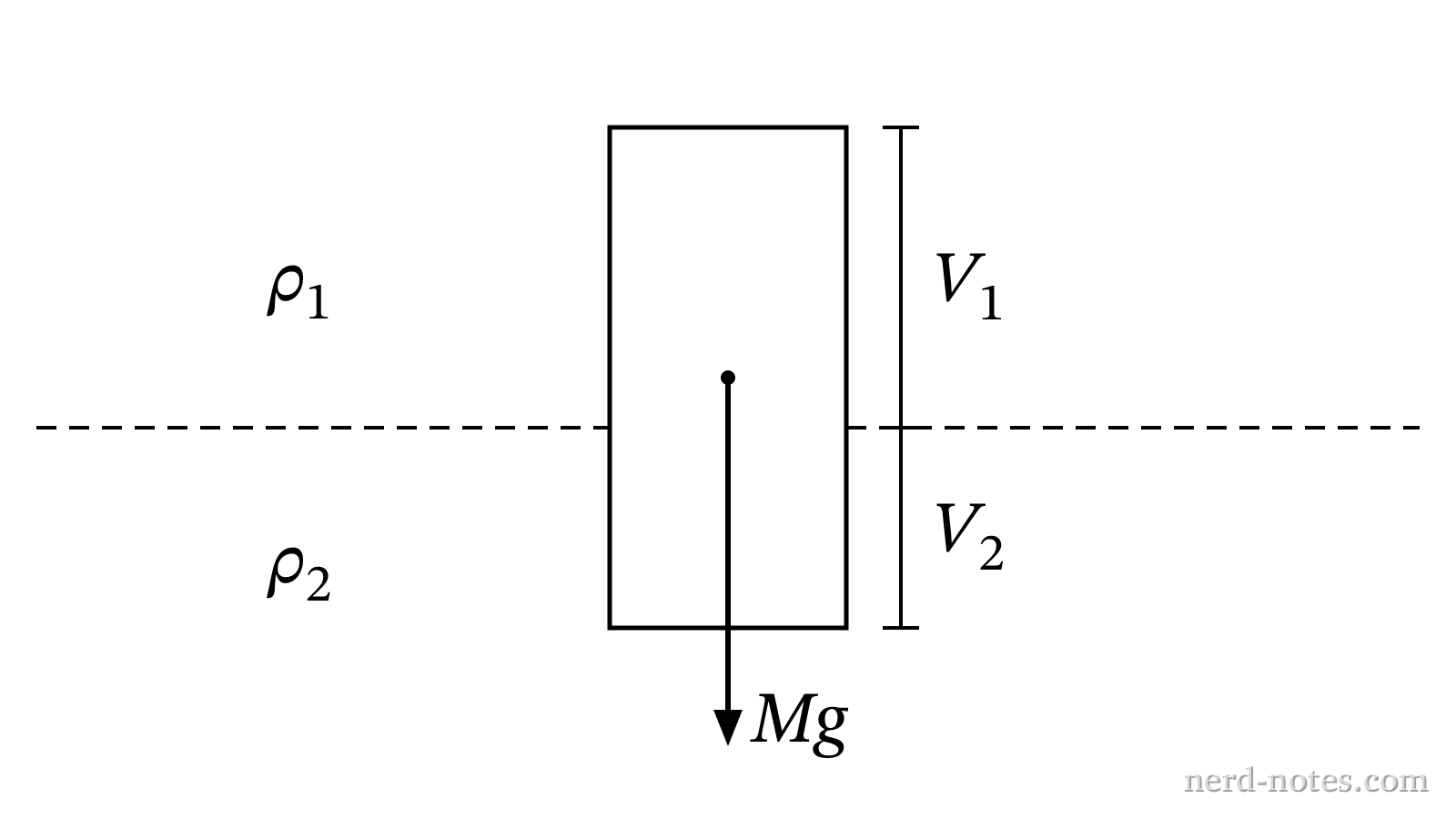
A vertical two-dimensional schematic diagram showing two horizontal fluid layers separated by a sharp horizontal dashed boundary line. The upper layer is labeled with density \(\rho_1\), and the lower layer is labeled with density \(\rho_2\). A vertical cylinder of total mass \(M\) and total volume \(V\) floats upright across the boundary line. The upper portion of the cylinder in the upper layer is bracketed and labeled with submerged volume \(V_1\). The lower portion of the cylinder in the lower layer is bracketed and labeled with submerged volume \(V_2\). A downward arrow from the center of the cylinder is labeled \(Mg\). No other labels, lines, text, or axes appear.
Sensor casing floating at the interface between two seawater layers.
An oceanographic research station deploys a rigid, sealed cylindrical sensor casing of total volume \(V\) and total mass \(M\). The casing floats in translational equilibrium at the boundary between two unmixed seawater layers, with volume \(V_1\) submerged in an upper layer of density \(\rho_1\) and volume \(V_2\) submerged in a lower layer of density \(\rho_2\), where \(\rho_1 < \rho_2\). Warm water rising from a thermal vent plume reduces the density of the upper layer to a new constant value \(\rho_1' < \rho_1\), while the lower layer's density \(\rho_2\) remains unchanged. The casing remains partially submerged in both layers. Which of the following claims correctly describes the change in the submerged volume \(V_2\) in the lower layer, and provides a correct physical justification?

Log In to Continue

Accounts are free! Log in to try this question, see explanations, save progress, and more!

Tools for a 5