All questions
AP Physics 1
8.3 Fluids and Newton’s Laws
2.4 Newton’s First Law
Multi-Unit
IntermediateMCQMathematicalConceptual22.5k
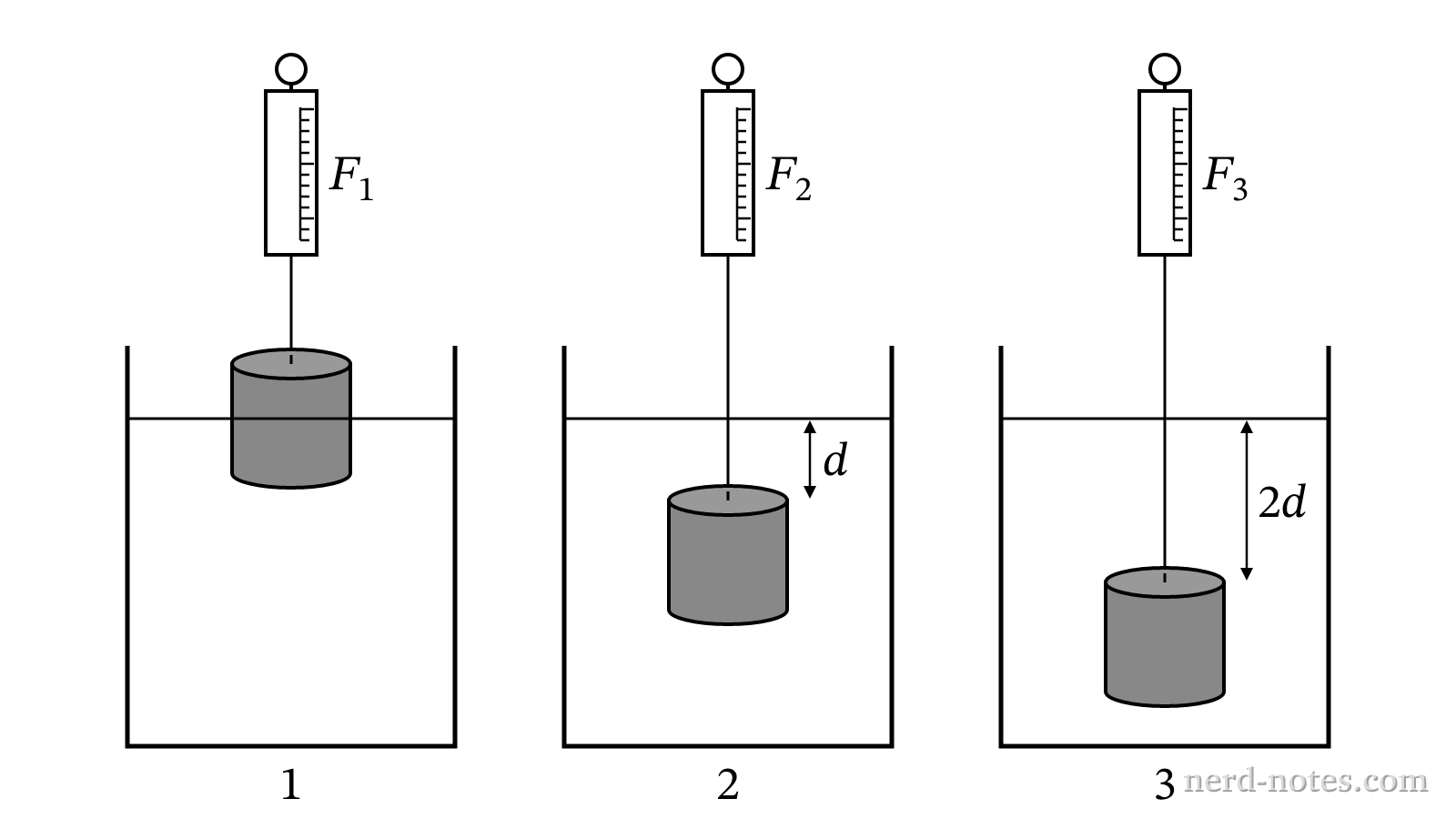
Three identical open-topped rectangular beakers filled with liquid to equal heights are arranged side by side and labeled 1, 2, and 3 from left to right. In beaker 1, a solid gray cylinder hangs from a vertical line representing a string such that exactly half of the cylinder is submerged below the liquid surface. In beaker 2, an identical solid gray cylinder hangs from a vertical string such that it is completely submerged with its top surface located at depth d below the liquid surface. In beaker 3, an identical solid gray cylinder hangs from a vertical string such that it is completely submerged with its top surface located at depth 2d below the liquid surface, suspended above the container floor. Above each beaker, a spring scale attached to the string displays scale readings labeled F_1, F_2, and F_3, respectively. No other labels, lines, text, or axes appear.
Three identical suspended cylinders submerged to different depths in a fluid of uniform density.
Three identical solid metal cylinders of mass \(m\) and volume \(V\) are suspended from ideal spring scales and lowered into identical beakers containing an incompressible fluid of uniform density \(\rho\). In Case 1, the cylinder is held half-submerged. In Case 2, the cylinder is fully submerged with its top surface at a depth \(d\) below the fluid surface. In Case 3, the cylinder is fully submerged with its top surface at a depth \(2d\) below the fluid surface without touching the bottom of the beaker. Which of the following correctly ranks the scale readings \(F_1\), \(F_2\), and \(F_3\) from greatest to least?

Log In to Continue

Accounts are free! Log in to try this question, see explanations, save progress, and more!

Tools for a 5