
AP Chemistry
8.10 Buffer Capacity
8.9 Henderson-Hasselbalch Equation
8.8 Properties of Buffers
A student prepares two separate \(1.0 \text{ L}\) buffer solutions using a weak monoprotic acid, \(\text{HA}\) (\(\text{p}K_a = 5.00\)), and its conjugate base salt, \(\text{NaA}\). Buffer 1 contains \(0.40 \text{ mol}\) of \(\text{HA}\) and \(0.40 \text{ mol}\) of \(\text{NaA}\). Buffer 2 contains \(0.20 \text{ mol}\) of \(\text{HA}\) and \(0.20 \text{ mol}\) of \(\text{NaA}\).
A \(0.10 \text{ mol}\) sample of \(\text{HCl}(g)\) is dissolved into each buffer solution with negligible change in total volume. Which of the following correctly gives the final ratio \(\dfrac{[\text{A}^-]}{[\text{HA}]}\) for each buffer and compares the magnitudes of the \(\text{pH}\) changes (\(\Delta\text{pH} = |\text{pH}_{\text{final}} - \text{pH}_{\text{initial}}|\))?
A \(0.10 \text{ mol}\) sample of \(\text{HCl}(g)\) is dissolved into each buffer solution with negligible change in total volume. Which of the following correctly gives the final ratio \(\dfrac{[\text{A}^-]}{[\text{HA}]}\) for each buffer and compares the magnitudes of the \(\text{pH}\) changes (\(\Delta\text{pH} = |\text{pH}_{\text{final}} - \text{pH}_{\text{initial}}|\))?
Similar Questions
Tools for a 5
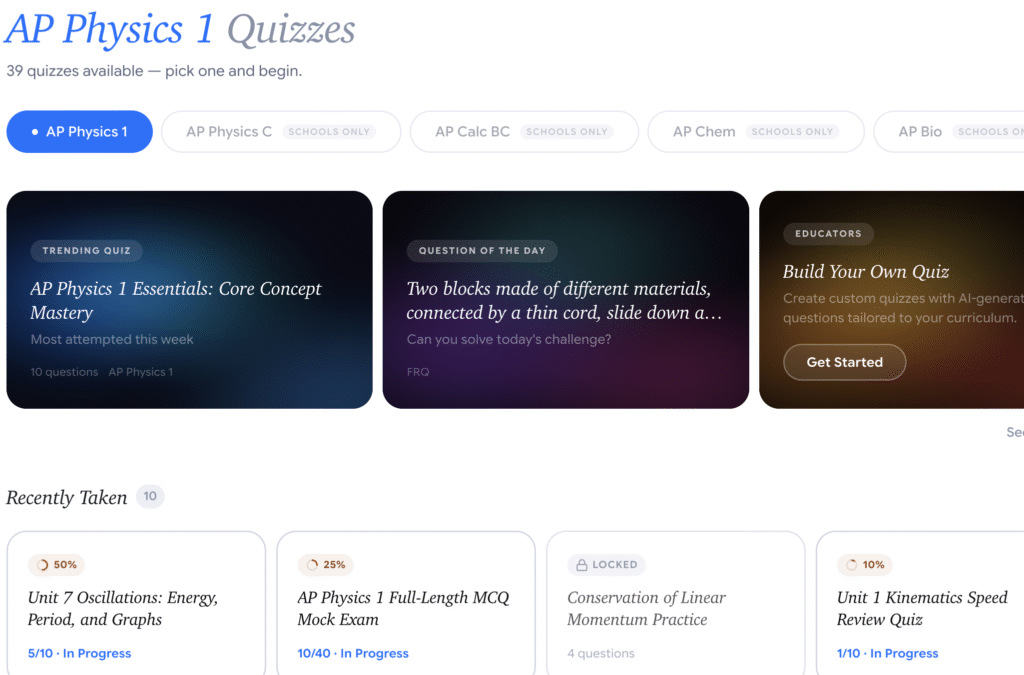 AP aligned mock tests to help you get a 5.
With grading, adaptive explanations, and more.
Find a Quiz
Find, solve, and grade every AP FRQ ever.
Find an FRQ
Stuck on AP Chemistry? Get unstuck with an AP specialist.1 to 1 tutors who know the exam inside out. Understand weeks of material in a single session.Find a Tutor
Learn AP Physics from scratch, quickly. This is the only course you'll need for the year.
A self-paced course with everything you need to get a 5. Trusted by over 15,000 students and 200+ schools. Learn fast, or we'll refund your purchase, backed by our 100% satisfaction guarantee.
Explore the Course
AP aligned mock tests to help you get a 5.
With grading, adaptive explanations, and more.
Find a Quiz
Find, solve, and grade every AP FRQ ever.
Find an FRQ
Stuck on AP Chemistry? Get unstuck with an AP specialist.1 to 1 tutors who know the exam inside out. Understand weeks of material in a single session.Find a Tutor
Learn AP Physics from scratch, quickly. This is the only course you'll need for the year.
A self-paced course with everything you need to get a 5. Trusted by over 15,000 students and 200+ schools. Learn fast, or we'll refund your purchase, backed by our 100% satisfaction guarantee.
Explore the Course