
AP Physics 1
5.5 Rotational Equilibrium and Newton’s First Law in Rotational Form
2.7 Kinetic and Static Friction
2.5 Newton’s Second Law
2.2 Forces and Free-Body Diagrams
Multi-Unit
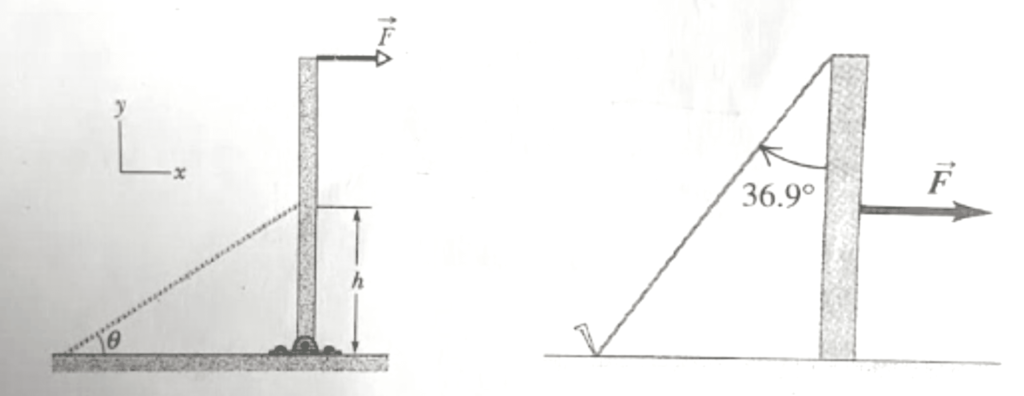
Assume the posts in the two figures are the same and they have a mass of \( 24 \) \( \text{kg} \) and a length \( L \). Both posts are held vertical by cables attached to the ground and making an angle of \( 36.9^\circ \) with the ground and with the pole, respectively. Both posts are pulled by horizontal forces \( F \). The post on the left is hinged at its lower end and the cable is attached at \( 3/5 \) of the post height from the ground. The post on the right rests on a horizontal surface with a static coefficient of friction \( 0.3 \) and the force is applied at \( 3/5 \) of the height from the ground.
Note: \( \sin 36.9 = 0.6 = 3/5 \); \( \cos 36.9 = 0.8 \).
Similar Questions
Tools for a 5
 AP aligned mock tests to help you get a 5.
With grading, adaptive explanations, and more.
Find a Quiz
Find, solve, and grade every AP FRQ ever.
Find an FRQ
Elite Physics Tutoring with Jason.
Fast, 1 to 1 help on AP Physics 1. Understand weeks of complex concepts in just one session.
Book a Session
Learn AP Physics from scratch, quickly. This is the only course you'll need for the year.
A self-paced course with everything you need to get a 5. Trusted by over 15,000 students and 200+ schools. Learn fast, or we'll refund your purchase, backed by our 100% satisfaction guarantee.
Explore the Course