
AP Physics 1
2.8 Spring Forces
2.7 Kinetic and Static Friction
2.5 Newton’s Second Law
2.2 Forces and Free-Body Diagrams
1.2 Displacement, Velocity, and Acceleration
Multi-Unit
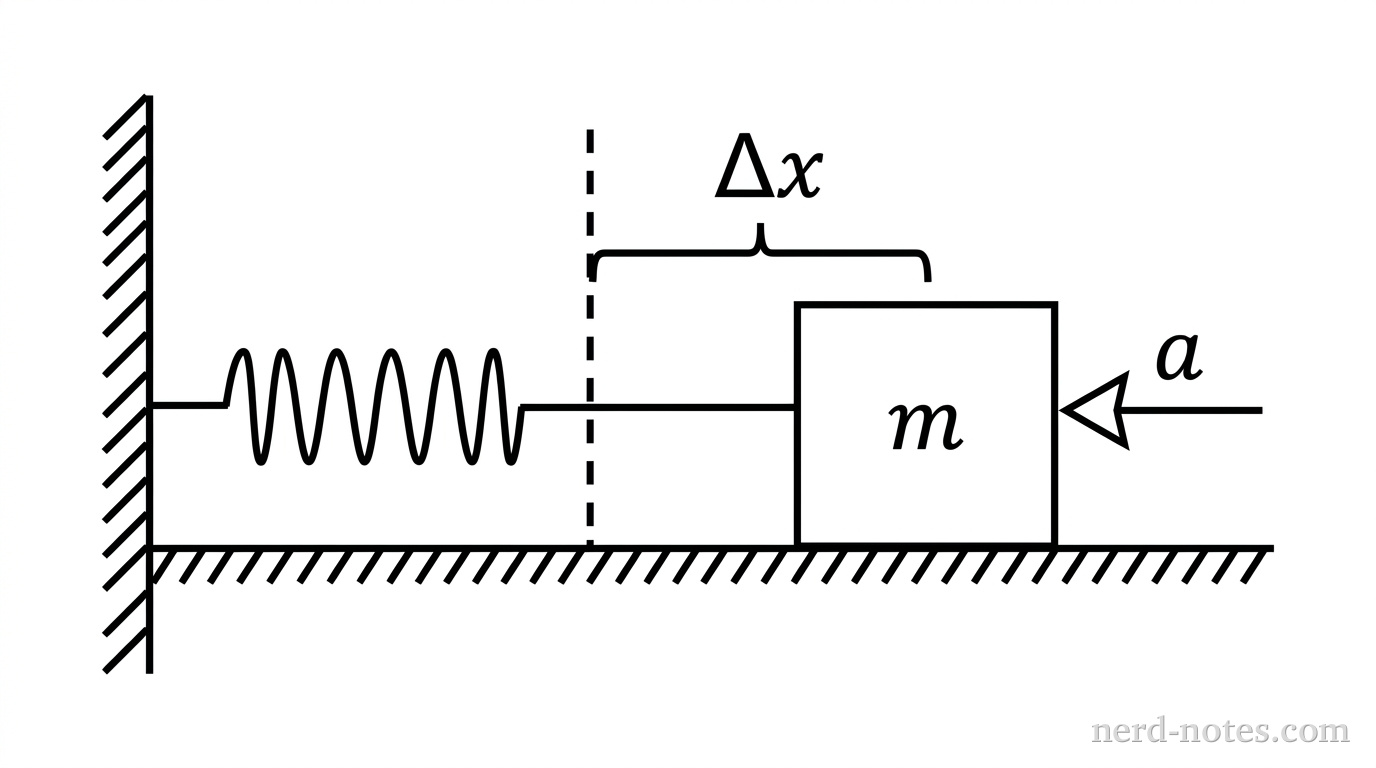
Assume that the initial acceleration \(a\) is measured immediately after the block begins to move, such that the frictional force acting on the block is the kinetic friction force \(f_k\).
Similar Questions
Tools for a 5
 AP aligned mock tests to help you get a 5.
With grading, adaptive explanations, and more.
Find a Quiz
Find, solve, and grade every AP FRQ ever.
Find an FRQ
Elite Physics Tutoring with Jason.
Fast, 1 to 1 help on AP Physics 1. Understand weeks of complex concepts in just one session.
Book a Session
Learn AP Physics from scratch, quickly. This is the only course you'll need for the year.
A self-paced course with everything you need to get a 5. Trusted by over 15,000 students and 200+ schools. Learn fast, or we'll refund your purchase, backed by our 100% satisfaction guarantee.
Explore the Course
AP aligned mock tests to help you get a 5.
With grading, adaptive explanations, and more.
Find a Quiz
Find, solve, and grade every AP FRQ ever.
Find an FRQ
Elite Physics Tutoring with Jason.
Fast, 1 to 1 help on AP Physics 1. Understand weeks of complex concepts in just one session.
Book a Session
Learn AP Physics from scratch, quickly. This is the only course you'll need for the year.
A self-paced course with everything you need to get a 5. Trusted by over 15,000 students and 200+ schools. Learn fast, or we'll refund your purchase, backed by our 100% satisfaction guarantee.
Explore the Course