
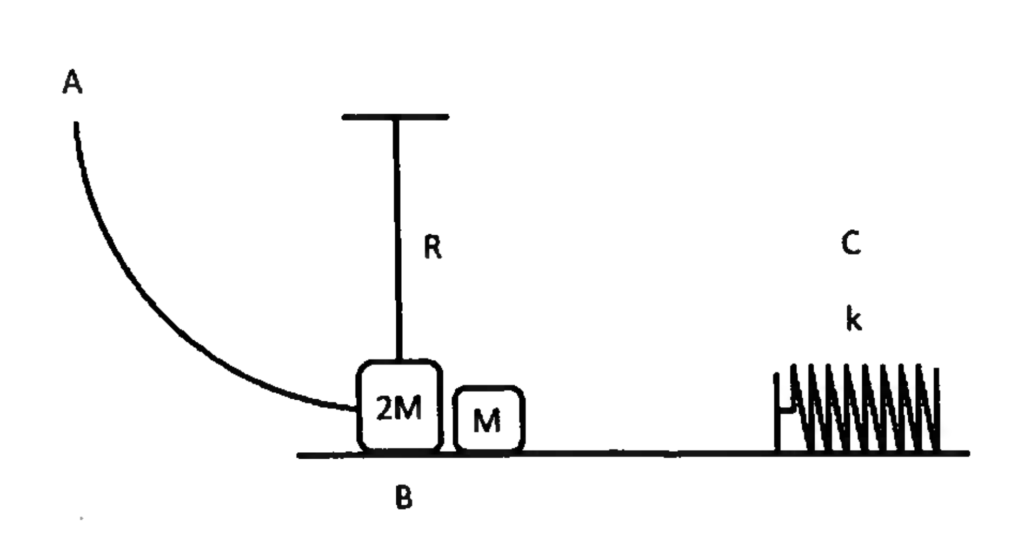
A student is designing an experiment to find the spring constant \( k \) of a spring using only a set of known masses and a stopwatch. Which procedure would work?

Refer to the diagram above and solve all equations in terms of \(R\), \(M\), \(k\), and constants.
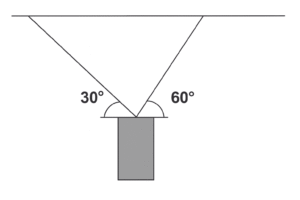
Two wires support an unknown mass as shown in the diagram. The tension in the left wire is measured to be \( 17.5 \) \( \text{N} \) and the tension in the right wire is \( 30.3 \) \( \text{N} \). The left wire makes an angle of \( 30^{\circ} \) with the horizontal, and the right wire makes an angle of \( 60^{\circ} \) with the horizontal. What is the mass of the object?
A string is wound tightly around a fixed pulley having a radius of 5.0 cm. As the string is pulled, the pulley rotates without any slipping of the string. What is the angular speed of the pulley when the string is moving at 5.0 m/s?
An object is thrown upward at \( 65 \, \text{m/s} \) from the top of a \( 800 \, \text{m} \) tall building.
Wanda watches the fish in her fish tank and notices that the angelfish like to feed at the water’s surface, while the catfish feed \( 0.300 \) \( \text{m} \) below at the bottom of the tank. If the average density of the water in the tank is \( 1000. \) \( \text{kg/m}^3 \), what is the pressure on the catfish?
A spring with a spring constant of \( 600. \) \( \text{N/m} \) is used for a scale to weigh fish. What is the mass of a fish that would stretch the spring by \( 7.5 \) \( \text{cm} \) from its normal length?
A spring launches a \(4 \, \text{kg}\) block across a frictionless horizontal surface. The block then ascends a \(30^\circ\) incline with a kinetic friction coefficient of \(\mu_k = 0.25\), stopping after \(55 \, \text{m}\) on the incline. If the spring constant is \(800 \, \text{N/m}\), find the initial compression of the spring. Disregard friction while in contact with the spring.
A baseball is tossed from street level by a student straight up at a speed of \(25.3 \text{ m/s}\). After reaching maximum height, it is caught by another student on the roof of a building, \(17.4 \text{ m}\) above the street. How long did this take?
A linear spring of force constant \( k \) is used in a physics lab experiment. A block of mass \( m \) is attached to the spring and the resulting frequency, \( f \), of the simple harmonic oscillations is measured. Blocks of various masses are used in different trials, and in each case, the corresponding frequency is measured and recorded. If \( f^{2} \) is plotted versus \( \frac{1}{m} \), the graph will be a straight line with slope
A car accelerates from rest with an acceleration of \( 4.3 \, \text{m/s}^2 \) for a time of \( 6.8 \, \text{s} \). The car then slows to a stop with an acceleration of \( 5.1 \, \text{m/s}^2 \). What is the total distance traveled by the car?
The launching mechanism of a toy gun consists of a spring with an unknown spring constant, \( k \). When the spring is compressed \( 0.120 \, \text{m} \) vertically, a \( 35.0 \, \text{g} \) projectile is able to be fired to a maximum height of \( 25 \, \text{m} \) above the position of the projectile when the spring is compressed. Assume that the barrel of the gun is frictionless.
The side of an above-ground pool is punctured, and water gushes out through the hole. If the total depth of the pool is \( 2.5 \) \( \text{m} \), and the puncture is \( 1 \) \( \text{m} \) above the ground level, what is the efflux speed of the water?
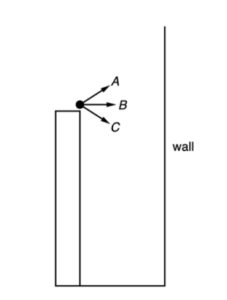
3 clay balls, labeled A, B, and C are launched from the same height at the same speed as shown above. A is launched at \( 30^\circ \) above horizontal, B is launched horizontally, and C is launched \( 30^\circ \) below the horizontal. They all hit the wall (before reaching the ground) in times \( t_A \), \( t_B \), and \( t_C \) respectively. Rank these times from least to greatest.
A forward horizontal force of \(12 \, \text{N}\) is used to pull a \(240 \, \text{N}\) crate at constant velocity across a horizontal floor. The coefficient of friction is

In the laboratory, you are given a cylindrical beaker containing a fluid and you are asked to determine the density \( \rho \) of the fluid. You are to use a spring of negligible mass and unknown spring constant \( k \) that is attached to a vertical stand.
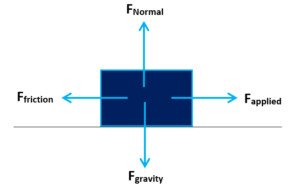
The box in the diagram is sliding to the right across a horizontal table, under the influence of the forces shown. Which force(s) is doing negative work on the box?
Gregory was walking through the halls of the school when he realized that he was walking in perpendicular directions and he could easily calculate his displacement using the incredibly useful techniques he learned in physics. He recognized that he walked \(12.5\ \text{m}\) left and then \(18.9\ \text{m}\) down. How far must he walk to the right so that his resultant displacement is \(20.1\ \text{m}\)?
By continuing you (1) agree to our Terms of Use and Terms of Sale and (2) consent to sharing your IP and browser information used by this site’s security protocols as outlined in our Privacy Policy.
Quick Start Guide
AP physics 1, AP C, honors and advanced physics students.
Quickly filter questions by units and more.
Here’s guide to using 5 UBQ filters.
GQ = general question, MCQ = multiple choice, FRQ = free response.
Click the check or bookmark button.
Now you’ll be able to see completed or bookmarked questions at a glance!
Answer keys, personalized for you.
Phy will be responsible for grading your FRQs and GQs.
No more copy and pasting. Just solve and snap.
Questions for Mastery
By continuing you agree to nerd-notes.com Terms of Service, Privacy Policy, and our usage of user data.