From the top of a \( 74.0 \) \( \text{m} \) high building, a \( 1.00 \) \( \text{kg} \) ball is dropped in the presence of air resistance. The ball reaches the ground with a speed of \( 31.0 \) \( \text{m/s} \), indicating that drag was significant. How much energy was lost in the form of air resistance/drag during the fall?
A car is driving at \(25 \, \text{m/s}\) when a light turns red \(100 \, \text{m}\) ahead. The driver takes an unknown amount of time to react and hit the brakes, but manages to skid to a stop at the red light. If \(\mu_s = 0.9\) and \(\mu_k = 0.65\), what was the reaction time of the driver?

The graph shows the acceleration as a function of time for an object that is at rest at time \( t = 0 \) \( \text{s} \). The distance traveled by the object between \( 0 \) and \( 2 \) \( \text{s} \) is most nearly
A gun can fire a bullet to height \( h \) when fired straight up. If the same gun is pointed at an angle of \( 45^\circ \) from the vertical, what is the new maximum height of the projectile?
An object moves at a constant speed of [katex] 9.0 \frac{m}{s} [/katex] in a circular path of radius of 1.5 m. What is the angular acceleration of the object?
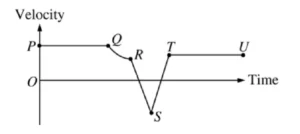
A large beach ball is dropped from the ceiling of a school gymnasium to the floor about 10 meters below. Which of the following graphs would best represent its velocity as a function of time? (do not neglect air resistance)


Two masses, \( m_1 \) and \( m_2 \), are connected by a cord and arranged as shown in the diagram, with \( m_1 \) sliding along a frictionless surface and \( m_2 \) hanging from a light, frictionless pulley. What would be the mass of the falling mass, \( m_2 \), if both the sliding mass, \( m_1 \), and the tension, \( T \), in the cord were known?
A turntable rotates through \( 6 \) \( \text{rad} \) in \( 3 \) \( \text{s} \) as it accelerates uniformly from rest. What is its angular acceleration in \( \text{rad/s}^2 \)?

A small block moving with a constant speed \(v\) collides inelastically with a block \(M\) attached to one end of a spring \(k\). The other end of the spring is connected to a stationary wall. Ignore friction between the blocks and the surface.
A \(100 \, \text{kg}\) person is riding a \(10 \, \text{kg}\) bicycle up a \(25^\circ\) hill. The hill is long and the coefficient of static friction is \(0.9\). The person rides \(10 \, \text{m}\) up the hill then takes a rest at the top. If she then starts from rest from the top of the hill and rolls down a distance of \(7 \, \text{m}\) before squeezing hard on the brakes locking the wheels, how much work is done by friction to bring the bicycle to a full stop, knowing that the coefficient of kinetic friction is \(0.65\)?
A high-speed flywheel in a motor is spinning at \( 500 \) \( \text{rpm} \) when a power failure suddenly occurs. The flywheel has a mass of \( 40 \) \( \text{kg} \) and a diameter of \( 75 \) \( \text{cm} \). The power is off for \( 30 \) \( \text{s} \) and during this time the flywheel slows due to friction in its axle bearings. During this time the flywheel makes \( 200 \) complete revolutions.
A solid ball of mass \( M \) and radius \( R \) has rotational inertia \( \frac{2}{5} M R^{2} \) about its center. It rolls without slipping along a level surface at speed \( v \) just before it begins rolling up an inclined plane. Which of the following expressions correctly represents the maximum vertical height the solid ball can ascend to when it rolls up the incline without slipping?
A cart with an initial velocity of \(5.0 ~ \text{m/s}\)to the right experiences a constant acceleration of \(2.0 ~ \text{m/s}^2\) to the right. What is the cart’s displacement during the first \(6.0 ~ \text{s}\) of this motion?
A liquid flows at a constant flow rate through a pipe with circular cross-sections of varying diameters. At one point in the pipe, the diameter is \(2\) \(\text{cm}\) and the flow speed is \(18\) \(\text{m/s}\). What is the flow speed at another point in this pipe, where the diameter is \(3\) \(\text{cm}\).
A toy car moves off the edge of a table that is \(1.25 \, \text{m}\) high. If the car lands \(0.40 \,\text{m}\) from the base of the table…
Three blocks are stacked on top of one another. The top block has a mass of \( 4.6 \, \text{kg} \), the middle one has a mass of \( 1.2 \, \text{kg} \), and the bottom one has a mass of \( 3.7 \, \text{kg} \).
Identify and calculate any normal forces between the objects.

A massless rigid rod of length [katex]3d[/katex] is pivoted at a fixed point [katex]W[/katex], and two forces each of magnitude [katex]F[/katex] are applied vertically upward as shown above. A third vertical force of magnitude [katex]F[/katex] may be applied, either upward or downward, at one of the labeled points. With the proper choice of direction at each point, the rod can be in equilibrium if the third force of magnitude [katex]F[/katex] is applied at point?
A person whose weight is \(4.92 \times 10^2 \, \text{N}\) is being pulled up vertically by a rope from the bottom of a cave that is \(35.2 \, \text{m}\) deep. The maximum tension that the rope can withstand without breaking is \(592 \, \text{N}\). What is the shortest time, starting from rest, in which the person can be brought out of the cave?
By continuing you (1) agree to our Terms of Use and Terms of Sale and (2) consent to sharing your IP and browser information used by this site’s security protocols as outlined in our Privacy Policy.
Quick Start Guide
AP physics 1, AP C, honors and advanced physics students.
Quickly filter questions by units and more.
Here’s guide to using 5 UBQ filters.
GQ = general question, MCQ = multiple choice, FRQ = free response.
Click the check or bookmark button.
Now you’ll be able to see completed or bookmarked questions at a glance!
Answer keys, personalized for you.
Phy will be responsible for grading your FRQs and GQs.
No more copy and pasting. Just solve and snap.
Questions for Mastery
By continuing you agree to nerd-notes.com Terms of Service, Privacy Policy, and our usage of user data.