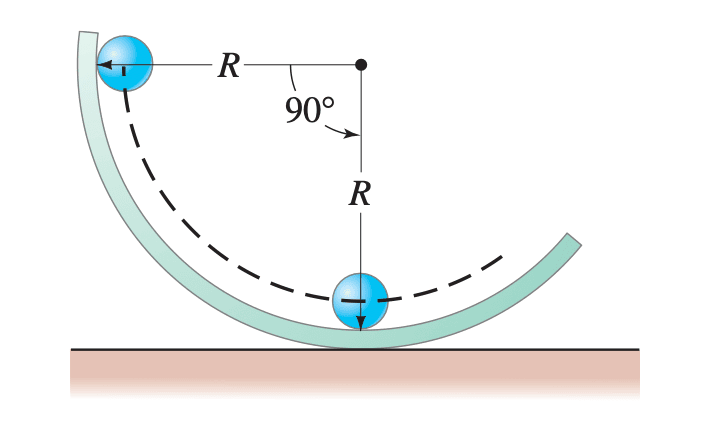
A solid ball and a cylinder roll down an inclined plane. Which reaches the bottom first?
The tub of a washer goes into its spin-dry cycle, starting from rest and reaching an angular speed of \( 5.0 \) \( \text{rev/s} \) in \( 8.0 \) \( \text{s} \). At this point, the person doing the laundry opens the lid, and a safety switch turns off the washer. The tub slows to rest in \( 12.0 \) \( \text{s} \). Through how many revolutions does the tub turn during the entire \( 20 \)-s interval? Assume constant angular acceleration while it is starting and stopping.

Four blocks of masses \( 20 \, \text{kg}, \, 30 \, \text{kg}, \, 40 \, \text{kg}, \, \text{and} \, 50 \, \text{kg} \) are stacked on top of one another in an elevator in order of decreasing mass with the lightest mass on the top of the stack. The elevator moves downward with an acceleration of \( 3.2 \, \text{m/s}^2 \). Find the contact force between the \( 30 \, \text{kg} \) and \( 40 \, \text{kg} \) masses.

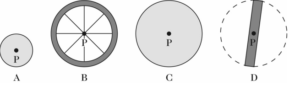
A platform is initially rotating on smooth ice with negligible friction, as shown above. A stationary disk is dropped directly onto the center of the platform. A short time later, the disk and platform rotate together at the same angular velocity, as shown at right in the figure. How does the angular momentum of only the platform change, if at all, after the disk drops? And what is the best justification.
A body starting from rest moves along a straight line under the action of a constant force. After traveling a distance \( d \) the speed of the body is \( v \). The speed of the body when it has travelled a distance \( \dfrac{d}{2} \) from its initial position is

Alcohol has a specific gravity of \( 0.79 \). If a barometer consisting of an open-ended tube placed in a dish of alcohol is used at sea level, to what height in the tube will the alcohol rise?
A projectile is launched at \( 25 \) \( \text{m/s} \) at an angle of \( 37^{\circ} \). It lands on a platform that is \( 5.0 \) \( \text{m} \) above the launch height.
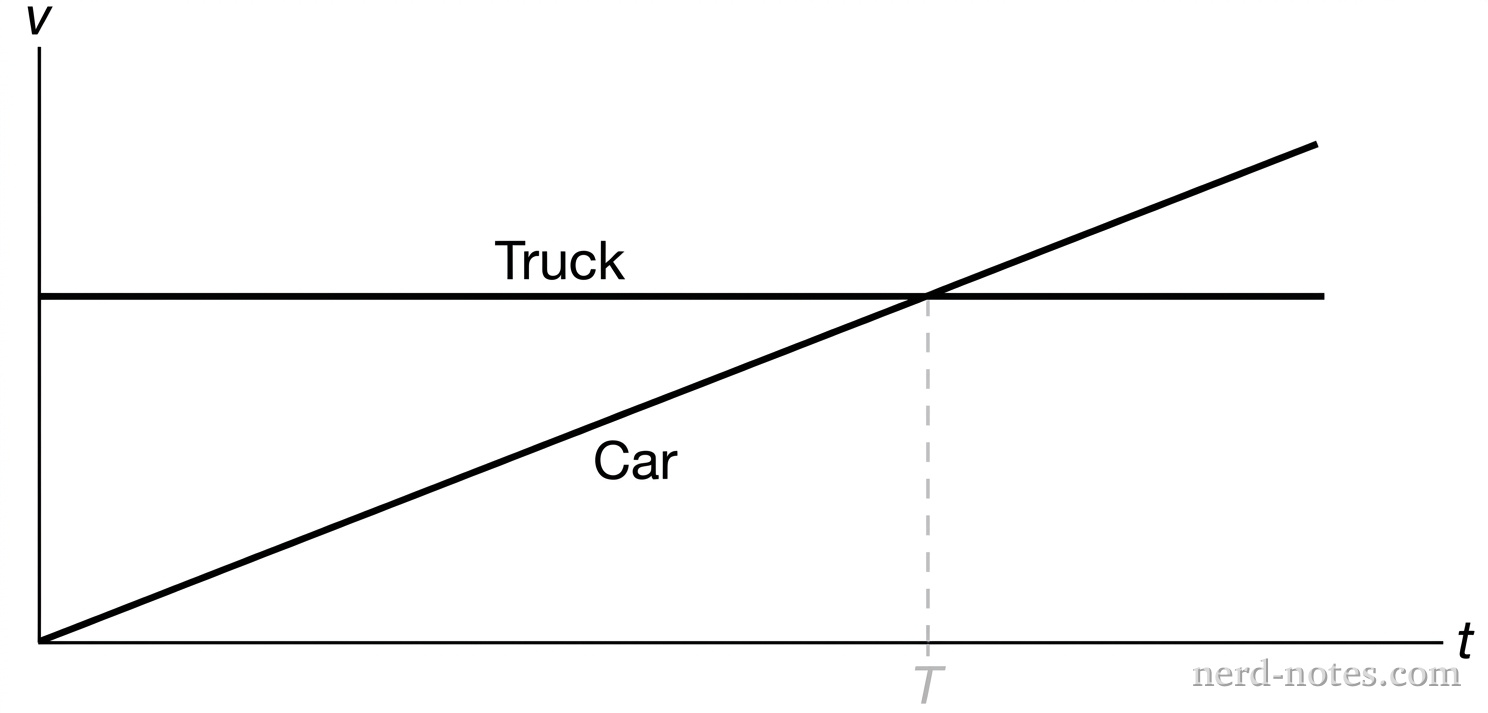
Toy car W travels across a horizontal surface with an acceleration of \( a_w \) after starting from rest. Toy car Z travels across the same surface toward car W with an acceleration of \( a_z \), after starting from rest. Car W is separated from car Z by a distance \( d \). Which of the following pairs of equations could be used to determine the location on the horizontal surface where the two cars will meet, and why?
A bullet moving with an initial speed of \( v_o \) strikes and embeds itself in a block of wood which is suspended by a string, causing the bullet and block to rise to a maximum height \( h \). Which of the following statements is true of the collision.
A car accelerates from rest with an acceleration of \( 4.3 \, \text{m/s}^2 \) for a time of \( 6.8 \, \text{s} \). The car then slows to a stop with an acceleration of \( 5.1 \, \text{m/s}^2 \). What is the total distance traveled by the car?
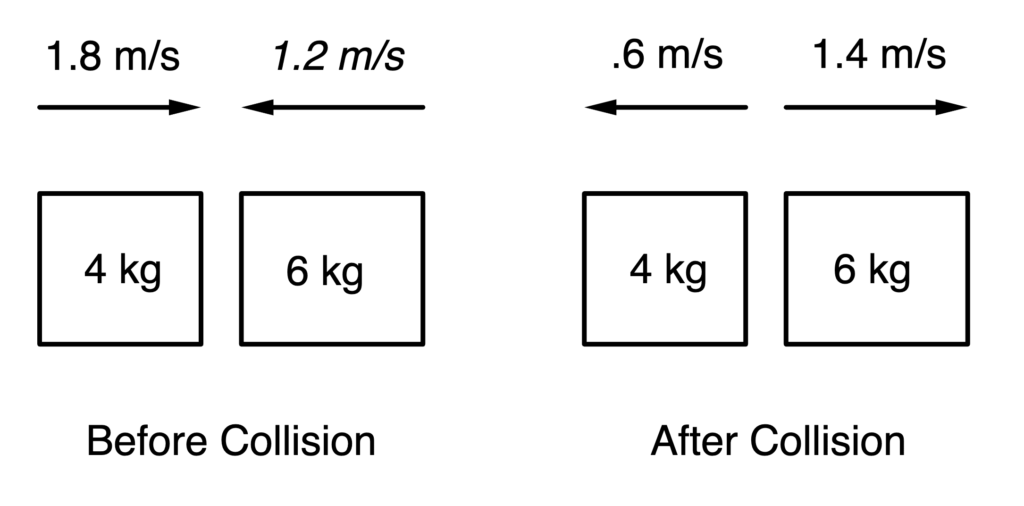
A \( 1.0 \, \text{kg} \) lump of clay is sliding to the right on a frictionless surface with a speed of \( 2 \, \text{m/s} \). It collides head-on and sticks to a \( 0.5 \, \text{kg} \) metal sphere that is sliding to the left with a speed of \( 4 \, \text{m/s} \). What is the kinetic energy of the combined objects after the collision?

A system consists of two small disks, of masses \( m \) and \( 2m \), attached to a rod of negligible mass of length \( 3l \) as shown above. The rod is free to turn about a vertical axis through point \( P \). The two disks rest on a rough horizontal surface; the coefficient of friction between the disks and the surface is \( \mu \). At time \( t = 0 \), the rod has an initial counterclockwise angular velocity \( \omega_0 \) about \( P \). The system is gradually brought to rest by friction. Develop expressions for the following quantities in terms of \( \mu \), \( m \), \( l \), \( g \), and \( \omega_0 \).
In a demonstration, a teacher holds the axle of a wheel that is spinning with constant angular speed. The teacher then releases the axle and the wheel begins to fall toward the ground. As the wheel falls, its angular speed remains constant. Which of the following correctly describes how the rotational kinetic energy \( K_{\text{rot}} \) of the wheel and the total kinetic energy \( K_{\text{tot}} \) of the wheel change, if at all, after the wheel is released but before it reaches the ground?
| \( K_{\text{rot}} \) | \( K_{\text{tot}} \) | |
|---|---|---|
| A | Constant | Constant |
| B | Constant | Increasing |
| C | Increasing | Constant |
| D | Increasing | Increasing |
A car suddenly stops and a passenger lurches forward. This motion is best explained by Newton’s ____ Law.
The downward motion of an elevator is controlled by a cable that unwinds from a cylinder of radius \( 0.20 \) \( \text{m} \). What is the angular velocity of the cylinder when the downward speed of the elevator is \( 1.2 \) \( \text{m/s} \)?
A turntable rotates through \( 6 \) \( \text{rad} \) in \( 3 \) \( \text{s} \) as it accelerates uniformly from rest. What is its angular acceleration in \( \text{rad/s}^2 \)?
A car moving around a circular track with a constant speed has
A delivery truck is traveling north. It then turns along a leftward circular curve. The packages in the truck to slide to the RIGHT. Which of the following is true of the net force on the packages as they are sliding?
By continuing you (1) agree to our Terms of Use and Terms of Sale and (2) consent to sharing your IP and browser information used by this site’s security protocols as outlined in our Privacy Policy.
Quick Start Guide
AP physics 1, AP C, honors and advanced physics students.
Quickly filter questions by units and more.
Here’s guide to using 5 UBQ filters.
GQ = general question, MCQ = multiple choice, FRQ = free response.
Click the check or bookmark button.
Now you’ll be able to see completed or bookmarked questions at a glance!
Answer keys, personalized for you.
Phy will be responsible for grading your FRQs and GQs.
No more copy and pasting. Just solve and snap.
Questions for Mastery
By continuing you agree to nerd-notes.com Terms of Service, Privacy Policy, and our usage of user data.