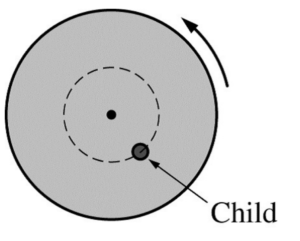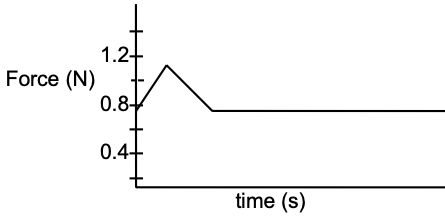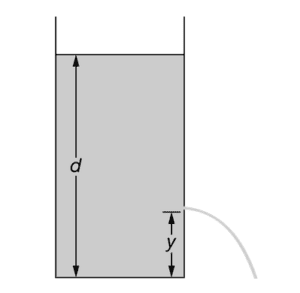
If the acceleration of an object is \( 0 \), are no forces acting on it? Explain.
The radius of the aorta is about \( 1 \) \( \text{cm} \) and the blood flowing through it has a speed of about \( 30 \) \( \frac{\text{cm}}{\text{s}} \). Calculate the average speed of the blood in the capillaries given the total cross section of all the capillaries is about \( 2000 \) \( \text{cm}^2 \).
A person stands on a scale in an elevator. His apparent weight will be the greatest when the elevator
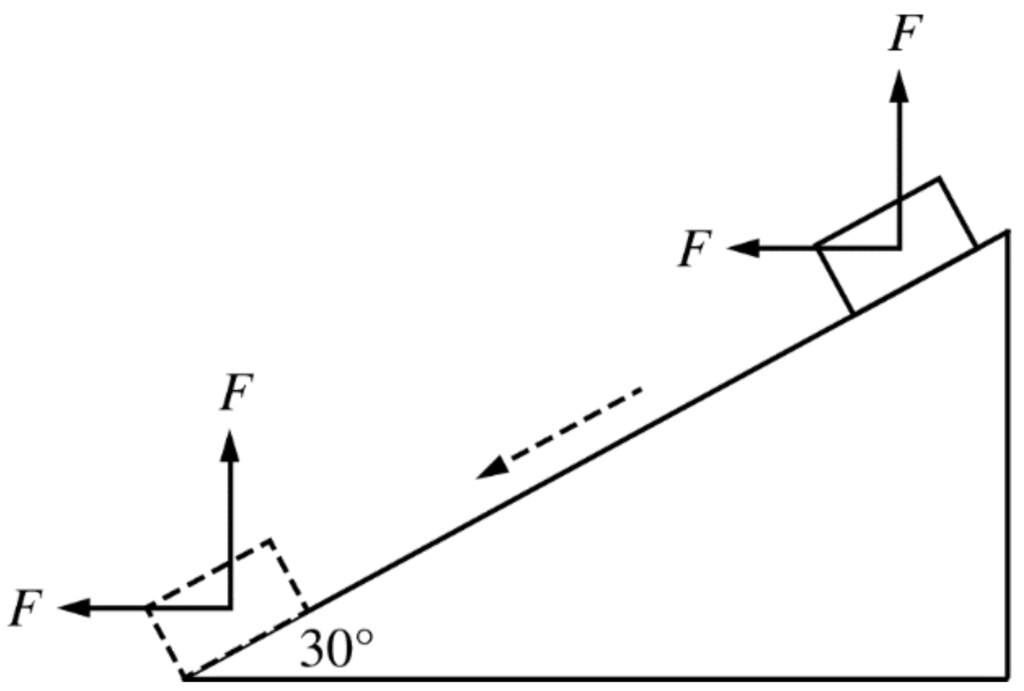
A \(90 \, \text{kg}\) individual is cycling up a hill inclined at \(30^\circ\) on a \(12 \, \text{kg}\) bicycle. The hill is quite steep, and the coefficient of static friction is \(0.85\). The cyclist ascends \(12 \, \text{m}\) up the hill and then pauses at the summit. They then start descending from rest and travel \(9 \, \text{m}\) before firmly applying the brakes, causing the wheels to lock.
Two identical blocks are connected to the opposite ends of a compressed spring. The blocks initially slide together on a frictionless surface with velocity \( v \) to the right. The spring is then released by remote control. At some later instant, the left block is moving at \( \frac{v}{2} \) to the left, and the other block is moving to the right. What is the speed of the center of mass of the system at that instant?
A rocket is fired at a speed of 75.0 m/s from ground level, at an angle of 60.0° above the horizontal. The rocket is fired toward an 11.0-m-high wall, which is located 27.0 m away. The rocket attains its launch speed in a negligibly short period of time, after which its engines shut down and the rocket coasts. By how much does the rocket clear the top of the wall?

The graph in the figure shows the position of a particle as it travels along the x-axis. At what value of \(t\) is the speed of the particle equal to \(0 \, \text{m/s}\)?
note that the slope of position vs time is velocity. And the graph most closely reemsbles a flat or 0 slope at 3 seconds
A projectile has the least speed at what point in its path?
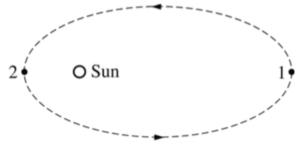
A comet of mass \( m_c = 3.2 \times 10^{14} \) \( \text{kg} \) is orbiting a star with mass \( m_s = 1.8 \times 10^{30} \) \( \text{kg} \). The comet’s orbit is elliptical. At its closest point, the comet is a distance \( r_1 = 8.3 \times 10^{10} \) \( \text{m} \) from the star, and at its farthest point, the comet is a distance \( r_2 = 4.9 \times 10^{11} \) \( \text{m} \) from the star. What is the change in the kinetic energy of the comet as it moves along its orbit from distance \( r_2 \) to distance \( r_1 \) from the star?
A car accelerates from rest with an acceleration of \( 3.5 \, \text{m/s}^2 \) for \( 10 \, \text{s} \). After this, it continues at a constant speed for an unknown amount of time. The driver notices a ramp \( 50 \, \text{m} \) ahead and takes \( 0.6 \, \text{s} \) to react. After reacting, the driver hits the brakes, which slow the car with an acceleration of \( 7.2 \, \text{m/s}^2 \). Unfortunately, the driver does not stop in time and goes off the \( 3 \, \text{m} \) high ramp that is angled at \( 27^\circ \).
You throw a rock straight up with an initial velocity of \( 5.0 \, \text{m/s} \).
A box is sliding down an incline at a constant speed of \( 2 \, \text{m/s} \). The angle of the incline is \( \theta \). The magnitude of the total of the opposing forces is \( 16 \, \text{N} \). Derive an equation for the force of gravity acting on the box.
A brick slides on a horizontal surface. Which of the following will increase the magnitude of the frictional force on it?
A block with mass \( m \) slides at speed \( v_0 \) on a smooth surface and hits a stationary block with mass \( M \). They stick together and move at speed \( \frac{v_0}{3} \). Find \( M \) in terms of \( m \).
A pulley has an initial angular speed of \( 12.5 \) \( \text{rad/s} \) and a constant angular acceleration of \( 3.41 \) \( \text{rad/s}^2 \). Through what angle does the pulley turn in \( 5.26 \) \( \text{s} \)?
A soccer ball with an initial height of \(1.5 \, \text{m}\) above the ground is launched at an angle of \(30^\circ\) above the horizontal. The soccer ball travels a horizontal distance of \(45 \, \text{m}\) to a \(9.0 \, \text{m}\) high castle wall, and passes over \(3.20 \, \text{m}\) above the highest point of the wall. Assume air resistance is negligible.
A 0.72-m-diameter solid sphere can be rotated about an axis through its center by a torque of 10.8 N·m which accelerates it uniformly from rest through a total of 160 revolutions in 15.0 s. What is the mass of the sphere?

A ball of mass \( m \) is suspended from two strings of unequal length as shown above. The magnitudes of the tensions \( T_1 \) and \( T_2 \) in the strings must satisfy which of the following relations?
By continuing you (1) agree to our Terms of Use and Terms of Sale and (2) consent to sharing your IP and browser information used by this site’s security protocols as outlined in our Privacy Policy.
Quick Start Guide
AP physics 1, AP C, honors and advanced physics students.
Quickly filter questions by units and more.
Here’s guide to using 5 UBQ filters.
GQ = general question, MCQ = multiple choice, FRQ = free response.
Click the check or bookmark button.
Now you’ll be able to see completed or bookmarked questions at a glance!
Answer keys, personalized for you.
Phy will be responsible for grading your FRQs and GQs.
No more copy and pasting. Just solve and snap.
Questions for Mastery
By continuing you agree to nerd-notes.com Terms of Service, Privacy Policy, and our usage of user data.