A crate is pulled 2.5 m at constant velocity along a 25° incline. The coefficient of kinetic friction between the crate and the plane is 0.250. What is the efficiency of this procedure?
A \(2 \, \text{kg}\) object slides east at \(4 \, \text{m/s}\) and collides with a stationary \(3 \, \text{kg}\) object. After the collision, the \(2 \, \text{kg}\) object is traveling at an unknown velocity at \(15^\circ\) north of east and the \(3 \, \text{kg}\) object is traveling at \(38^\circ\) south of east. What is each object’s final velocity?
You are a bungee jumping fanatic and want to be the first bungee jumper on Jupiter. The length of your bungee cord is \( 45.0 \) \( \text{m} \). Free fall acceleration on Jupiter is \( 23.1 \) \( \text{m/s}^2 \). What is the ratio of your speed on Jupiter to your speed on Earth when you have dropped \( 45 \) \( \text{m} \)? Ignore the effects of air resistance and assume that you start at rest.
An object is experiencing a nonzero net force. Which of the following statements is most accurate?
An egg dropped on the road usually beaks, while one dropped on the grass usually does not break because for the egg dropped on the grass:
To increase the moment of inertia of a body about an axis, you must
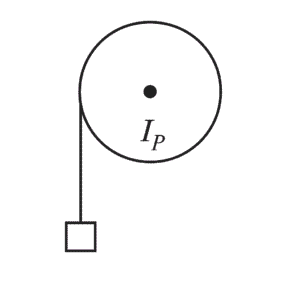
A string is wound tightly around a fixed pulley having a radius of 5.0 cm. As the string is pulled, the pulley rotates without any slipping of the string. What is the angular speed of the pulley when the string is moving at 5.0 m/s?

Two blocks, [katex] m_2 > m_1 [/katex], having the same kinetic energy, move from a frictionless surface onto a surface having friction coefficient [katex] \mu_k [/katex]. Which block will travel further before stopping.
A \(3300 \, \text{m}\)-high mountain is located on the equator. How much faster does a climber on top of the mountain move than a surfer at a nearby beach? The Earth’s radius is \(6400 \, \text{km}\) and the Earth’s mass is \(5.97 \times 10^{24} \, \text{kg}\).

A conical pendulum is formed by attaching a ball of mass \( m \) to a string of length \( L \), then allowing the ball to move in a horizontal circle of radius \( R \).
A block with mass \( m \) slides at speed \( v_0 \) on a smooth surface and hits a stationary block with mass \( M \). They stick together and move at speed \( \frac{v_0}{3} \). Find \( M \) in terms of \( m \).
A rubber ball bounces on the ground. After each bounce, the ball reaches one-half the height of the bounce before it. If the time the ball was in the air between the first and second bounce was 1 second. What would be the time between the second and third bounce?
The driver of a car traveling at \( 30.0 \) \( \text{m/s} \) applies the brakes and undergoes a constant negative acceleration of \( 2.00 \) \( \text{m/s}^2 \). How many revolutions does each tire make before the car comes to a stop, assuming that the car does not skid and that the tires have radii of \( 0.300 \) \( \text{m} \)?
The highest barrier that a projectile can clear is 16.2 m, when the projectile is launched at an angle of 22.0° above the horizontal. What is the projectile’s launch speed?
A car accelerates from rest with an acceleration of \( 3.5 \, \text{m/s}^2 \) for \( 10 \, \text{s} \). After this, it continues at a constant speed for an unknown amount of time. The driver notices a ramp \( 50 \, \text{m} \) ahead and takes \( 0.6 \, \text{s} \) to react. After reacting, the driver hits the brakes, which slow the car with an acceleration of \( 7.2 \, \text{m/s}^2 \). Unfortunately, the driver does not stop in time and goes off the \( 3 \, \text{m} \) high ramp that is angled at \( 27^\circ \).

A Venturi meter is a device used for measuring the speed of a fluid within a pipe. The drawing shows a gas flowing at a speed \( v_2 \) through a horizontal section of pipe with a cross-sectional area \( A_2 = 542 \) \( \text{cm}^2 \). The gas has a density of \( 1.35 \) \( \text{kg/m}^3 \). The Venturi meter has a cross-sectional area of \( A_1 = 215 \) \( \text{cm}^2 \) and has been substituted for a section of the larger pipe. The pressure difference between the two sections \( P_2 – P_1 = 145 \) \( \text{Pa} \).
A ball rolls down a ramp and gains speed. Its velocity is increasing in the negative direction. What can be said about its acceleration?

Students attach a thin strip of metal to a table so that the strip is horizontal in relation to the ground. A section of the strip hangs off the edge of the table. A mass is secured to the end of the hanging section of the strip and is then displaced so that the mass-strip system oscillates, as shown in the figure. Students make various measurements of the net force F exerted on the mass as a result of the force due to gravity and the normal force from the strip, the vertical position y of the mass above and below its equilibrium position y. and the period of oscillation T’ when the mass is displaced by different amplitudes A. Which of the following explanations is correct about the evidence required to conclude that the mass undergoes simple harmonic motion?
By continuing you (1) agree to our Terms of Use and Terms of Sale and (2) consent to sharing your IP and browser information used by this site’s security protocols as outlined in our Privacy Policy.
Quick Start Guide
AP physics 1, AP C, honors and advanced physics students.
Quickly filter questions by units and more.
Here’s guide to using 5 UBQ filters.
GQ = general question, MCQ = multiple choice, FRQ = free response.
Click the check or bookmark button.
Now you’ll be able to see completed or bookmarked questions at a glance!
Answer keys, personalized for you.
Phy will be responsible for grading your FRQs and GQs.
No more copy and pasting. Just solve and snap.
Questions for Mastery
By continuing you agree to nerd-notes.com Terms of Service, Privacy Policy, and our usage of user data.