for free to use all UBQ features

A \( 0.20 \) \( \text{kg} \) object moves along a straight line. The net force acting on the object varies with the object’s displacement as shown in the graph above. The object starts from rest at displacement \( x = 0 \) and time \( t = 0 \) and is displaced a distance of \( 20 \) \( \text{m} \). Determine each of the following.
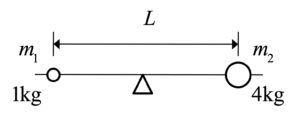
Students attach a thin strip of metal to a table so that the strip is horizontal in relation to the ground. A section of the strip hangs off the edge of the table. A mass is secured to the end of the hanging section of the strip and is then displaced so that the mass-strip system oscillates, as shown in the figure. Students make various measurements of the net force F exerted on the mass as a result of the force due to gravity and the normal force from the strip, the vertical position y of the mass above and below its equilibrium position y. and the period of oscillation T’ when the mass is displaced by different amplitudes A. Which of the following explanations is correct about the evidence required to conclude that the mass undergoes simple harmonic motion?
A projectile is launched at \( 25 \) \( \text{m/s} \) at an angle of \( 37^{\circ} \). It lands on a platform that is \( 5.0 \) \( \text{m} \) above the launch height.
A helicopter is ascending vertically with a speed of \( 5.40 \) \( \text{m/s} \). At a height of \( 105 \) \( \text{m} \) above the Earth, a package is dropped from the helicopter. How much time does it take for the package to reach the ground?
You are piloting a small plane, and you want to reach an airport \(450 \, \text{km}\) due south in \(3.0 \,\text{hours}\). A wind is blowing from the west at \(50.0 \,\text{km/h}\). What heading and airspeed should you choose to reach your destination in time?
Which pair of quantities will always have the same magnitude if motion is in a straight line and in one direction?
A kickball is rolled by the pitcher at a speed of 10 m/s and it is kicked by another student. The kickball deforms a little during the kick, and then rebounds with a velocity of 15 m/s as its shape restores to a perfect sphere. Select all that must be true about the kickball and the kicking foot system.
Late one morning, a mosquito collides with the windshield of a speeding truck. The force of the truck on the mosquito is ____ the force of the mosquito on the truck; the resulting acceleration of the mosquito is ____ the acceleration of the truck.

In the laboratory, you are given a cylindrical beaker containing a fluid and you are asked to determine the density \( \rho \) of the fluid. You are to use a spring of negligible mass and unknown spring constant \( k \) that is attached to a vertical stand.
You pull a box with a constant force across a frictionless table using an attached rope held horizontally. If you now pull the rope with the same force at an angle to the horizontal (with the box remaining flat on the table). Does the acceleration of the box increase, decrease, or remain the same if the rope is pulled at an angle? Explain.

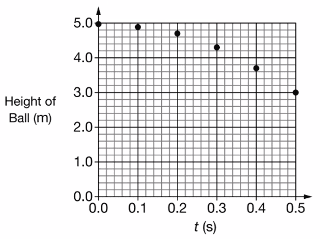
On another planet, a ball is in free fall after being released from rest at time \( t = 0 \). A graph of the height of the ball above the planet’s surface as a function of time \( t \) is shown. The acceleration due to gravity on the planet is most nearly
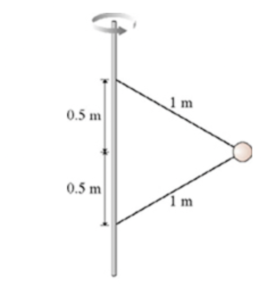
A forward horizontal force of \(12 \, \text{N}\) is used to pull a \(240 \, \text{N}\) crate at constant velocity across a horizontal floor. The coefficient of friction is
An object is moving in a horizontal circle at a constant speed. Which of the following correctly describes the linear and angular velocities of the object between any point along the circular path?
An object with a mass \(m = 80 \, \text{g}\) is attached to a spring with a force constant \(k = 25 \, \text{N/m}\). The spring is stretched \(52.0 \, \text{cm}\) and released from rest. If it is oscillating on a horizontal frictionless surface, determine the velocity of the mass when it is halfway to the equilibrium position.

A fluid flows through the two sections of cylindrical pipe shown in the figure. The narrow section of the pipe has radius \( R \) and the wide section has radius \( 2R \). What is the ratio of the fluid’s speed in the wide section of pipe to its speed in the narrow section of pipe, \( \frac{v_{\text{wide}}}{v_{\text{narrow}}} \)?
Vector \( V_1 \) is \( 6.0 \) units long and points along the negative \( y \) axis. Vector \( V_2 \) is \( 4.5 \) units long and points at \( +45^\circ \) to the positive \( x \) axis.
A car moving at 30 m/s makes a head-on collision with a stone wall. From what height would the car have to fall in order to make an equally hard collision with the ground?
A \(2 \, \text{kg}\) object slides east at \(4 \, \text{m/s}\) and collides with a stationary \(3 \, \text{kg}\) object. After the collision, the \(2 \, \text{kg}\) object is traveling at an unknown velocity at \(15^\circ\) north of east and the \(3 \, \text{kg}\) object is traveling at \(38^\circ\) south of east. What is each object’s final velocity?
A student kicks a soccer ball. The ball exerts a force back on the student’s foot. Why doesn’t the student’s foot accelerate backward as much as the ball accelerates forward?
A rubber ball bounces on the ground. After each bounce, the ball reaches one-half the height of the bounce before it. If the time the ball was in the air between the first and second bounce was 1 second. What would be the time between the second and third bounce?
Two ice skaters push off against each other. Skater A has twice the mass of Skater B. Which statement is correct?
Two identical metal balls are being held side by side at the top of a ramp. Alex lets one ball, \( A \), start rolling down the hill. A few seconds later, Alex’s partner, Bob, starts the second ball, \( B \), down the hill by giving it a push. Ball \( B \) rolls down the hill along a line parallel to the path of the first ball and passes it. At the instant ball \( B \) passes ball \( A \):
You drop a rock off a bridge. When the rock has fallen \( 4 \) \( \text{m} \), you drop a second rock. As the two rocks continue to fall, what happens to their velocities?
A 6.0-cm-diameter gear rotates with angular velocity \( \omega = \left(20-\frac {1}{2} t^2 \right) \, \text {rad/s} \), where \(t\) is in seconds. At \(t = 4.0 \, \text{s}\), what are
By continuing you (1) agree to our Terms of Use and Terms of Sale and (2) consent to sharing your IP and browser information used by this site’s security protocols as outlined in our Privacy Policy.
Quick Start Guide
AP physics 1, AP C, honors and advanced physics students.
Quickly filter questions by units and more.
Here’s guide to using 5 UBQ filters.
GQ = general question, MCQ = multiple choice, FRQ = free response.
Click the check or bookmark button.
Now you’ll be able to see completed or bookmarked questions at a glance!
Answer keys, personalized for you.
Phy will be responsible for grading your FRQs and GQs.
No more copy and pasting. Just solve and snap.
Questions for Mastery
By continuing you agree to nerd-notes.com Terms of Service, Privacy Policy, and our usage of user data.