The side of an above-ground pool is punctured, and water gushes out through the hole. If the total depth of the pool is \( 2.5 \) \( \text{m} \), and the puncture is \( 1 \) \( \text{m} \) above the ground level, what is the efflux speed of the water?
A rubber ball bounces on the ground. After each bounce, the ball reaches one-half the height of the bounce before it. If the time the ball was in the air between the first and second bounce was 1 second. What would be the time between the second and third bounce?
A lighter car and a heavier truck, each traveling to the right with the same speed [katex] v [/katex] hit their brakes. The retarding frictional force F on both cars turns out to be constant and the same. After both vehicles travel a distance [katex] D [/katex] (and both are still moving), which of the following statements is true?

From the figure above, determine which characteristic fits this collision best.
If I weigh \( 741 \) \( \text{N} \) on Earth at a place where \( g = 9.80 \) \( \text{m/s}^2 \) and \( 5320 \) \( \text{N} \) on the surface of another planet, what is the acceleration due to gravity on that planet?

A ball of mass \( m \) is suspended from two strings of unequal length as shown above. The magnitudes of the tensions \( T_1 \) and \( T_2 \) in the strings must satisfy which of the following relations?
You are piloting a small plane, and you want to reach an airport \(450 \, \text{km}\) due south in \(3.0 \,\text{hours}\). A wind is blowing from the west at \(50.0 \,\text{km/h}\). What heading and airspeed should you choose to reach your destination in time?

In both cases, a massless rod is supported by a fulcrum, and a \(200 \, \text{kg}\) hanging mass is suspended from the left end of the rod by a cable. A downward force \(F\) keeps the rod in rest. The rod in Case A is \(50 \, \text{cm}\) long, and the rod in Case B is \(40 \, \text{cm}\) long (each rod is marked at \(10 \, \text{cm}\) intervals). The magnitude of each vertical force \(F\) exerted on the rod will be
A student is running at her top speed of \( 5.0 \, \text{m/s} \) to catch a bus, which is stopped at the bus stop. When the student is still \( 40.0 \, \text{m} \) from the bus, it starts to pull away, moving with a constant acceleration of \( 0.170 \, \text{m/s}^2 \).
Two objects are attracted to each other by a gravitational force \( F \). If each mass is tripled, so that each becomes \( 3 \) times its original value, and the distance between the objects is cut in half to \( \dfrac{1}{2} \) of its original separation, what is the new gravitational force between the objects in terms of \( F \)?

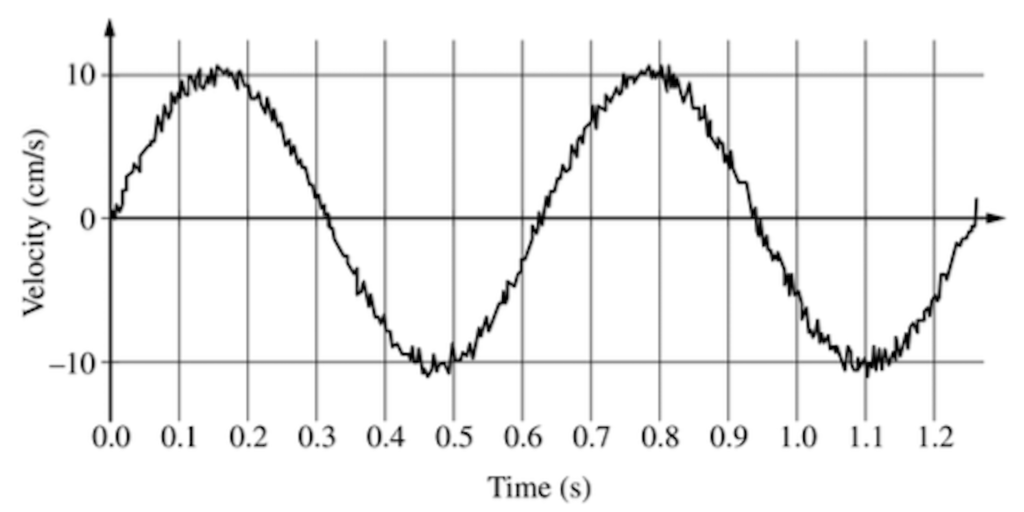
The displacement \( x \) of an object moving in one dimension is shown above as a function of time \( t \). The acceleration of this object must be
A constant force of strength \( 20 \) \( \text{N} \) acts on an object of mass \( 3 \) \( \text{kg} \) as it moves a distance of \( 4 \) \( \text{m} \). If this force is applied perpendicular to the \( 4 \) \( \text{m} \) displacement, the work done by the force is equal to:
Find the approximate minimum mass needed for a spherical ball with a \(40\) \(\text{cm}\) radius to sink in a liquid of density \(1.4 \times 10^3\) \(\text{kg/m}^3\). Use \(9.8 \text{m/s}^2\) for \(g\).
A girl throws a stone from a bridge. Consider the following ways she might throw the stone. The speed of the stone as it leaves her hand is the same in each case.
Case A: Thrown straight up.
Case B: Thrown straight down.
Case C: Thrown out at an angle of 45° above horizontal.
Case D: Thrown straight out horizontally.
In which case will the speed of the stone be greatest when it hits the water below if there is no significant air resistance, assuming equal initial speeds?
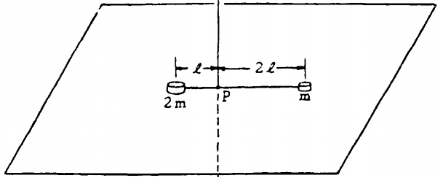
A child of mass \( 3 \) \( \text{kg} \) rotates on a platform of \( 10 \) \( \text{kg} \). They start walking towards the center while the platform is rotating. Which of the following could possibly decrease the total angular momentum of the child-platform system?
You are adding vectors of length \( 20 \) and \( 40 \) units. Which of the following choices is a possible resultant magnitude?
A car is safely negotiating an unbanked circular turn at a speed of 21 m/s. The road is dry, and the maximum static frictional force acts on the tires. Suddenly a wet patch in the road decreases the maximum static frictional force to one-third its dry road value. If the car is to continue safely around the curve, to what speed must the driver slow the car?
By continuing you (1) agree to our Terms of Use and Terms of Sale and (2) consent to sharing your IP and browser information used by this site’s security protocols as outlined in our Privacy Policy.
Quick Start Guide
AP physics 1, AP C, honors and advanced physics students.
Quickly filter questions by units and more.
Here’s guide to using 5 UBQ filters.
GQ = general question, MCQ = multiple choice, FRQ = free response.
Click the check or bookmark button.
Now you’ll be able to see completed or bookmarked questions at a glance!
Answer keys, personalized for you.
Phy will be responsible for grading your FRQs and GQs.
No more copy and pasting. Just solve and snap.
Questions for Mastery
By continuing you agree to nerd-notes.com Terms of Service, Privacy Policy, and our usage of user data.