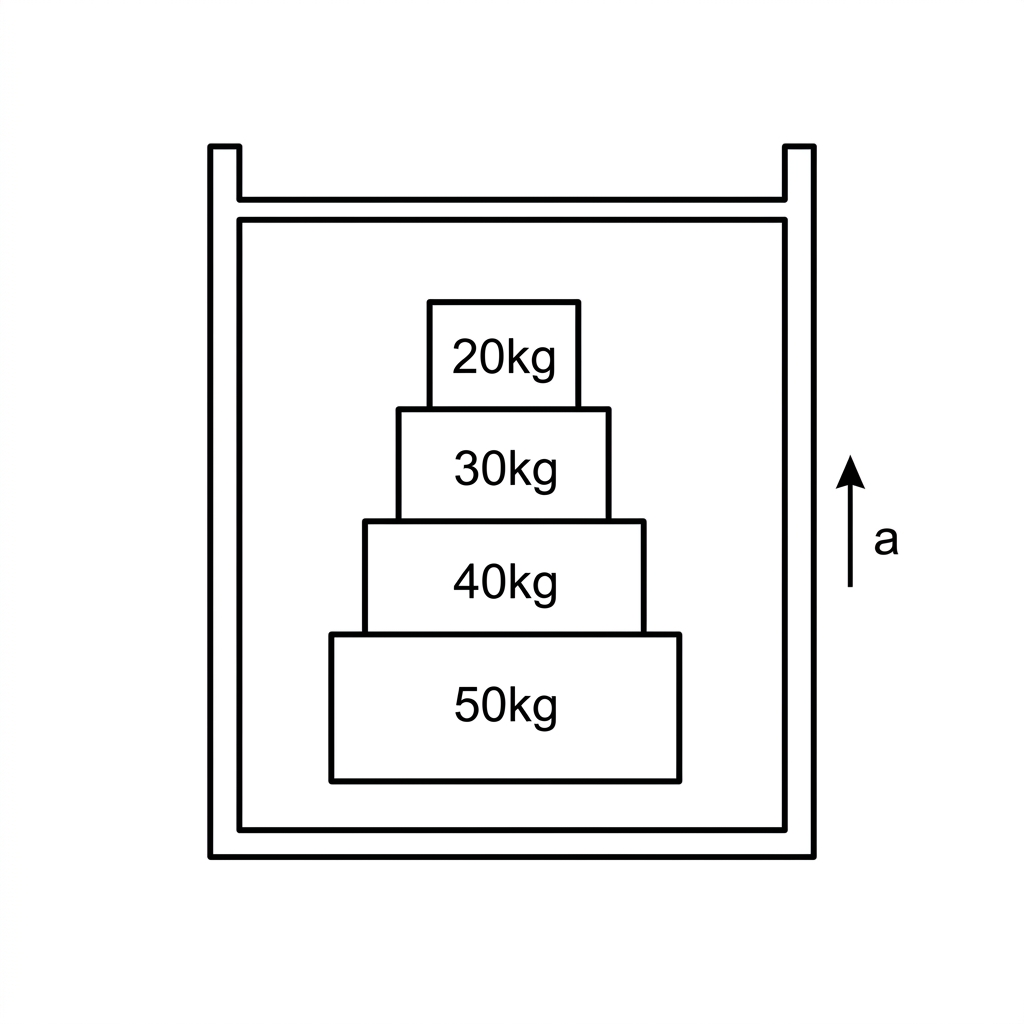
Four blocks of masses \( 20 \, \text{kg}, \, 30 \, \text{kg}, \, 40 \, \text{kg}, \, \text{and} \, 50 \, \text{kg} \) are stacked on top of one another in an elevator in order of decreasing mass with the lightest mass on the top of the stack. The elevator moves downward with an acceleration of \( 3.2 \, \text{m/s}^2 \). Find the contact force between the \( 30 \, \text{kg} \) and \( 40 \, \text{kg} \) masses.
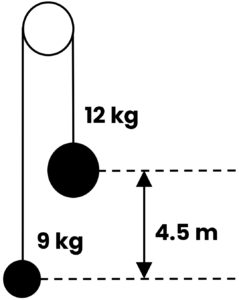
Using only work and energy, find the velocity of the masses after they have traveled \(0.8 \, \text{m}\). Refer to the image above.

A block is attached to a horizontal spring and is initially at rest at the equilibrium position \( x = 0 \), as shown in Figure \( 1 \). The block is then moved to position \( x = -A \), as shown in Figure \( 2 \), and released from rest, undergoing simple harmonic motion. At the instant the block reaches position \( x = +A \), another identical block is dropped onto and sticks to the block, as shown in Figure \( 3 \). The two–block–spring system then continues to undergo simple harmonic motion. Which of the following correctly compares the total mechanical energy \( E_{\text{tot},2} \) of the two–block–spring system after the collision to the total mechanical energy \( E_{\text{tot},1} \) of the one–block–spring system before the collision?
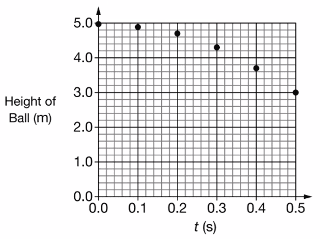
On another planet, a ball is in free fall after being released from rest at time \( t = 0 \). A graph of the height of the ball above the planet’s surface as a function of time \( t \) is shown. The acceleration due to gravity on the planet is most nearly
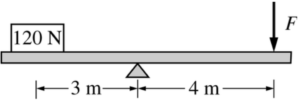
An object weighing 120 N is set on a rigid beam of negligible mass at a distance of 3 m from a pivot, as shown above. A vertical force is to be applied to the other end of the beam a distance of 4 m from the pivot to keep the beam at rest and horizontal. What is the magnitude F of the force required?
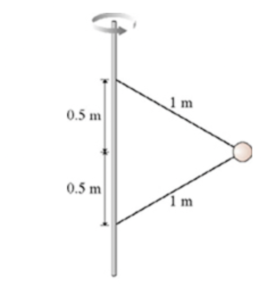
Two wires are tied to the \(500 \, \text{g}\) sphere as shown above. The sphere revolves in a horizontal circle at a constant speed of \(7.2 \, \text{m/s}\). What is the tension in the upper wire? What is the tension in the lower wire?
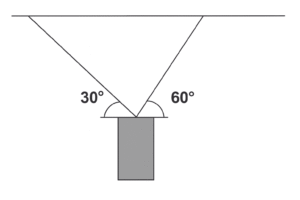
Two wires support an unknown mass as shown in the diagram. The tension in the left wire is measured to be \( 17.5 \) \( \text{N} \) and the tension in the right wire is \( 30.3 \) \( \text{N} \). The left wire makes an angle of \( 30^{\circ} \) with the horizontal, and the right wire makes an angle of \( 60^{\circ} \) with the horizontal. What is the mass of the object?
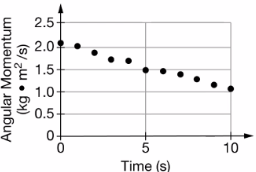
During the experiment, students collect data about the angular momentum of a rigid, uniform spinning wheel about an axle as a function of time, which was used to create the graph that is shown. A frictional torque is exerted on the wheel. A student makes the following statement about the data. “The frictional torque exerted on the wheel is independent of the wheel’s angular speed.” Does the data from the graph support the student’s statement? Justify your selection.