for free to use all UBQ features
The maximum acceleration a pilot can withstand without blacking out is about \( 7.0 \) \( g \). In an endurance test for a jet plane’s pilot, what is the maximum speed he can tolerate if he is spun in a horizontal circle of diameter \( 85 \) \( \text{m} \)?
A mass is attached to the end of a spring and set into simple harmonic motion with an amplitude \( A \) on a horizontal frictionless surface. Determine the following in terms of only the variable \( A \).
An airplane is traveling \( 900. \) \( \text{km/h} \) in a direction \( 38.5^\circ \) west of north.
An object is thrown upward at \( 65 \, \text{m/s} \) from the top of a \( 800 \, \text{m} \) tall building.
A \(4 \, \text{kg}\) mass is traveling at \(10 \, \text{m/s}\) to the right when it collides inelastically with a stationary \(7 \, \text{kg}\) mass. The \(7 \, \text{kg}\) mass then travels at \(2 \, \text{m/s}\) at an angle of \(22^\circ\) below the horizontal. What are the velocity and the angle of the \(4 \, \text{kg}\) mass?
Nancy is using a turkey baster (a kitchen tool with a rubber bulb on one end and a tube on the other) to collect juices from a roasting turkey. When she squeezes and then releases the rubber bulb, it creates suction with a pressure of \( 99{,}800 \) \( \text{Pa} \). This suction causes the turkey juice to rise \( 9 \) \( \text{cm} \) up the tube. Based on this information, what is the density of the turkey juice?
A runner pushes against the track to sprint forward. Which two action–reaction FORCE pairs are involved? Select two letters.
A satellite circling Earth completes each orbit in \(132 \, \text{minutes}\).

A simple pendulum oscillates with amplitude \(A\) and period \(T\), as represented on the graph above. Which option best represents the magnitude of the pendulum’s velocity \(v\) and acceleration \(a\) at time \(\frac{T}{2}\)?
A rotating, rigid body makes 10 complete revolutions in 10 seconds. What is its average angular velocity?
An elevator carrying a person of mass \( m \) is moving upward and slowing down. How does the magnitude \( F \) of the force exerted on the person by the elevator floor compare with the magnitude \( mg \) of the gravitational force?
A girl throws a stone from a bridge. Consider the following ways she might throw the stone. The speed of the stone as it leaves her hand is the same in each case.
Case A: Thrown straight up.
Case B: Thrown straight down.
Case C: Thrown out at an angle of 45° above horizontal.
Case D: Thrown straight out horizontally.
In which case will the speed of the stone be greatest when it hits the water below if there is no significant air resistance, assuming equal initial speeds?
A block is attached to a horizontal spring. The block is held so the spring is stretched and the block is released from rest, undergoing simple harmonic motion with a frequency of \( 2 \) \( \text{Hz} \). How long after release will the block first reach a point where it is momentarily at rest?
A \(1 \, \text{kg}\) mass and an unknown mass \(M\) hang on opposite sides of a pulley suspended from the ceiling. When the masses are released, \(M\) accelerates downward at \(5 \, \text{m/s}^2\). Find the value of \(M\).
Suppose you place a ball in the middle of a wagon, and then accelerate the wagon forward. Describe the motion of the ball relative to the ground. Describe its motion relative to the wagon.
When is the angular momentum of a system constant?

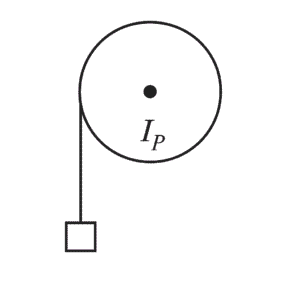
Using only work and energy, find the velocity of the masses after they have traveled \(0.8 \, \text{m}\). Refer to the image above.
A ski lift carries skiers along a \(695 \, \text{m}\) slope inclined at \(34^\circ\). To lift a single rider, it is necessary to move \(72 \, \text{kg}\) of mass to the top of the lift. Under maximum load conditions, five riders per minute arrive at the top. If \(65\%\) of the energy supplied by the motor goes to overcoming friction, what average power must the motor supply?
Toy car W travels across a horizontal surface with an acceleration of \( a_w \) after starting from rest. Toy car Z travels across the same surface toward car W with an acceleration of \( a_z \), after starting from rest. Car W is separated from car Z by a distance \( d \). Which of the following pairs of equations could be used to determine the location on the horizontal surface where the two cars will meet, and why?

The system in the Figure is in equilibrium. A concrete block of mass 225 kg hangs from the end of a uniform strut whose mass is 45.0 kg.

In both cases, a massless rod is supported by a fulcrum, and a \(200 \, \text{kg}\) hanging mass is suspended from the left end of the rod by a cable. A downward force \(F\) keeps the rod in rest. The rod in Case A is \(50 \, \text{cm}\) long, and the rod in Case B is \(40 \, \text{cm}\) long (each rod is marked at \(10 \, \text{cm}\) intervals). The magnitude of each vertical force \(F\) exerted on the rod will be

A block is attached to a horizontal spring and is initially at rest at the equilibrium position \( x = 0 \), as shown in Figure \( 1 \). The block is then moved to position \( x = -A \), as shown in Figure \( 2 \), and released from rest, undergoing simple harmonic motion. At the instant the block reaches position \( x = +A \), another identical block is dropped onto and sticks to the block, as shown in Figure \( 3 \). The two–block–spring system then continues to undergo simple harmonic motion. Which of the following correctly compares the total mechanical energy \( E_{\text{tot},2} \) of the two–block–spring system after the collision to the total mechanical energy \( E_{\text{tot},1} \) of the one–block–spring system before the collision?

On another planet, a ball is in free fall after being released from rest at time \( t = 0 \). A graph of the height of the ball above the planet’s surface as a function of time \( t \) is shown. The acceleration due to gravity on the planet is most nearly

You have a giant cask of water with a spigot some height below the water surface. The surface of the water, which is essentially at rest, is exposed to atmosphere (\( \approx 10^5 \text{Pa} \)). The water density is \( \approx 1000 \text{kg/m}^3 \). The water pours out of the spigot at \( 3 \text{m/s} \). How far below the water surface is the spigot positioned?
By continuing you (1) agree to our Terms of Use and Terms of Sale and (2) consent to sharing your IP and browser information used by this site’s security protocols as outlined in our Privacy Policy.
Quick Start Guide
AP physics 1, AP C, honors and advanced physics students.
Quickly filter questions by units and more.
Here’s guide to using 5 UBQ filters.
GQ = general question, MCQ = multiple choice, FRQ = free response.
Click the check or bookmark button.
Now you’ll be able to see completed or bookmarked questions at a glance!
Answer keys, personalized for you.
Phy will be responsible for grading your FRQs and GQs.
No more copy and pasting. Just solve and snap.
Questions for Mastery
By continuing you agree to nerd-notes.com Terms of Service, Privacy Policy, and our usage of user data.