Phy UBQ Count Message Here
Advanced
Mathematical
FRQ

An airplane with a speed of \( 97.5 \, \text{m/s} \) is climbing upward at an angle of \( 50.0^\circ \) with respect to the horizontal. When the plane’s altitude is \( 732 \, \text{m} \), the pilot releases a package.

Advanced
Proportional Analysis
MCQ

A block with a mass of \( 4 \) \( \text{kg} \) is attached to a spring on the wall that oscillates back and forth with a frequency of \( 4 \) \( \text{Hz} \) and an amplitude of \( 3 \) \( \text{m} \). What would the frequency be if the block were replaced by one with one‑fourth the mass and the amplitude of the block is increased to \( 9 \) \( \text{m} \)?

Intermediate
Mathematical
GQ

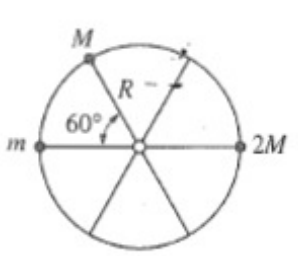
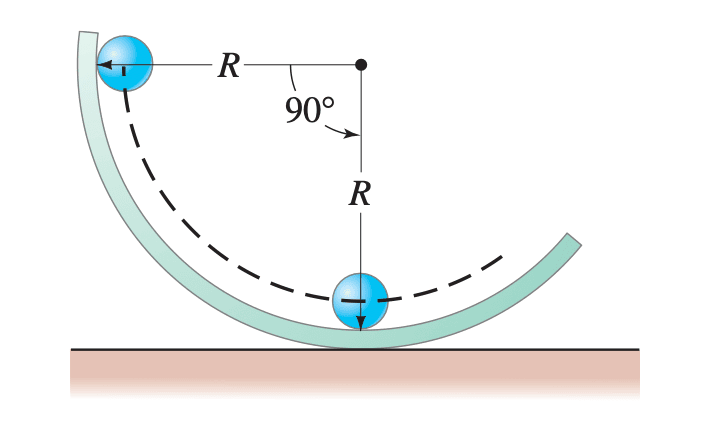
In lacrosse, a typical throw is made by rotating the stick through an angle of roughly \(90^\circ\), then releasing the ball when the stick is vertical, as shown above. If the \(1 \, \text{meter}\) long stick is at rest when horizontal and the ball leaves the stick with a velocity of \(10 \, \text{m/s}\), what angular acceleration must the stick experience?

Beginner
Conceptual
MCQ

A skateboarder coasts to a stop on a flat sidewalk. The net force acting on the skateboarder must be ____.

Intermediate
Mathematical
GQ

The maximum acceleration a pilot can withstand without blacking out is about \( 7.0 \) \( g \). In an endurance test for a jet plane’s pilot, what is the maximum speed he can tolerate if he is spun in a horizontal circle of diameter \( 85 \) \( \text{m} \)?

Intermediate
Conceptual
GQ

If you stand on a bathroom scale in a moving elevator, does its reading change?

Beginner
Mathematical
GQ

A trash compactor pushes down with a force of \( 500 \) \( \text{N} \) on a \( 3 \) \( \text{cm}^2 \) input piston, causing a force of \( 30,000 \) \( \text{N} \) to crush the trash. What is the area of the output piston that crushes the trash?

Advanced
Mathematical
GQ

An object of unknown mass is acted upon by multiple forces:

  • \(100 \, \text{N}\) to the right at \(20^\circ\)
  • \(400 \, \text{N}\) to the left at \(40^\circ\) below the horizontal
  • \(500 \, \text{N}\) to the right at \(10^\circ\) below the horizontal

The coefficients of friction are \(\mu_s = 0.6\) and \(\mu_k = 0.2\). Starting from rest, the object travels \(10 \, \text{m}\) in \(4.5 \, \text{s}\). What is the mass of the unknown object?

Advanced
Conceptual
MCQ

A child of mass \( 3 \) \( \text{kg} \) rotates on a platform of \( 10 \) \( \text{kg} \). They start walking towards the center while the platform is rotating. Which of the following could possibly decrease the total angular momentum of the child-platform system?

Beginner
Conceptual
GQ

Why are doorknobs located on the side of the door opposite the hinges?

Beginner
Mathematical
GQ

Determine the distance from the Earth’s center to a point outside the Earth where the gravitational acceleration due to the Earth is \( \dfrac{1}{10} \) of its value at the Earth’s surface.

Beginner
Conceptual
MCQ

A small boat coasts at constant speed under a bridge. A heavy sack of sand is dropped from the bridge onto the boat. The speed of the boat

Beginner
Mathematical
GQ

A spring with a spring constant of \( 600. \) \( \text{N/m} \) is used for a scale to weigh fish. What is the mass of a fish that would stretch the spring by \( 7.5 \) \( \text{cm} \) from its normal length?

Advanced
Mathematical
GQ

A \(2 \, \text{kg}\) object slides east at \(4 \, \text{m/s}\) and collides with a stationary \(3 \, \text{kg}\) object. After the collision, the \(2 \, \text{kg}\) object is traveling at an unknown velocity at \(15^\circ\) north of east and the \(3 \, \text{kg}\) object is traveling at \(38^\circ\) south of east. What is each object’s final velocity?

Advanced
Mathematical
FRQ

The drawing above shows a spherical reservoir that contains \( 455,000 \) \( \text{kg} \) of water when full. The reservoir is vented to the atmosphere at the top. Assuming the reservoir is full and the diameter of the reservoir is much larger than any of the pipes on the ground.

Intermediate
Mathematical
FRQ

Will Clark throws a baseball with a horizontal component of velocity of \(25 \, \text{m/s}\). It takes \(3 \, \text{s}\) to come back to its original height. Calculate the baseball’s:

Beginner
Conceptual
GQ

If the acceleration of an object is \( 0 \), are no forces acting on it? Explain.

Intermediate
Conceptual
MCQ

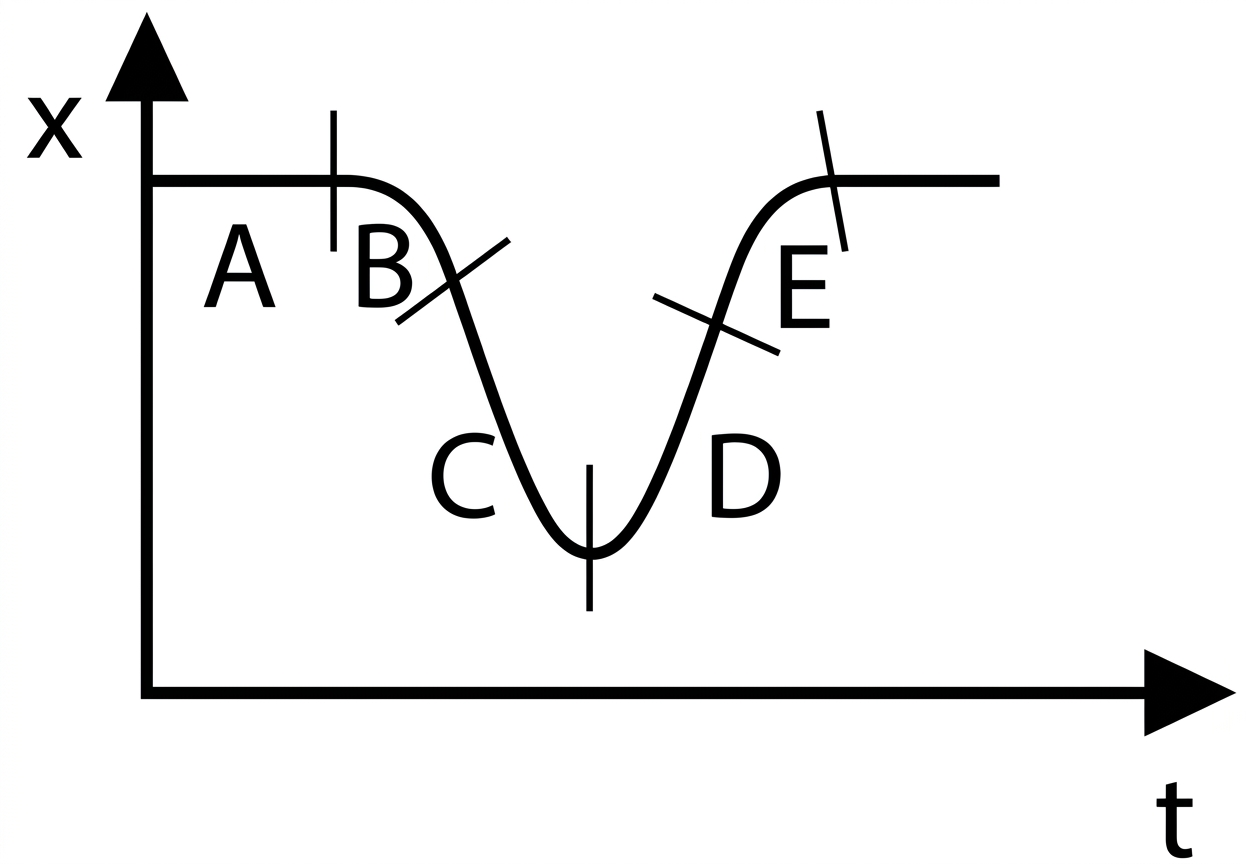
Which of the following graphs shows runners moving at the same speed? Assume the \(y\)-axis is measured in meters and the \(x\)-axis is measured in seconds.

Intermediate
Mathematical
GQ

The International Space Station travels at \( 7660 \, \text{m/s} \). Find the average velocity of the space station if it takes \( 90 \, \text{minutes} \) to make one full orbit around Earth.

Advanced
Conceptual
MCQ

A block is released from rest and slides down a frictionless ramp inclined at  \( 30^\circ \) from the horizontal. When the block reaches the bottom, the block-Earth system has mechanical energy \( \text{E}_i \). The experiment is repeated, but now horizontal and vertical forces of magnitude \( F \) are exerted on the block while it slides, as shown above. When the block reaches the bottom, the mechanical energy of the block-Earth system.

Intermediate
Mathematical
FRQ

A projectile of mass 0.750 kg is shot straight up with an initial speed of 18.0 m/s.

Advanced
Conceptual
MCQ

A block of weight \( W \) is pulled along a horizontal surface at constant speed by a force \( F \), which acts at an angle of \( \theta \) with the horizontal. The normal force exerted on the block by the surface has magnitude:

Advanced
Mathematical
FRQ

A \( 4700 \, \text{kg} \) truck carrying a \( 900 \, \text{kg} \) crate is traveling at \( 25 \, \text{m/s} \) to the right along a straight, level highway, as shown above. The truck driver then applies the brakes, and as it slows down, the truck travels \( 55 \, \text{m} \) in the next \( 3.0 \, \text{s} \). The crate does not slide on the back of the truck.

Intermediate
Mathematical
GQ

Determine the sum of the three vectors given below. Calculate the resultant \( \vec{R} \) expressed as:

(a) Vector components
(b) Resultant vector (its total magnitude and direction)

\[\vec{A} = 26.5 \, \text{m} \ @ \ 56^\circ \, \text{NW}\]

\[\vec{B} = 44 \, \text{m} \ @ \ 28^\circ \, \text{NE}\]

\[\vec{C} = 31 \, \text{m} \, \text{South}\]

Nerd Notes

Discover the world's best Physics resources

Continue with

By continuing you (1) agree to our Terms of Use and Terms of Sale and (2) consent to sharing your IP and browser information used by this site’s security protocols as outlined in our Privacy Policy.

Sign In to View Your Questions

PRO TIER

One price to unlock most advanced version of Phy across all our tools.

$20

per month

Billed Monthly. Cancel Anytime.

We use cookies to improve your experience. By continuing to browse on Nerd Notes, you accept the use of cookies as outlined in our privacy policy.