for free to use all UBQ features
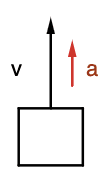
A person stands on a scale in an elevator. If the scale reads \( 600 \, \text{N} \) when that person is riding upward at a constant velocity of \( 4 \, \text{m/s} \), what is the scale reading when the elevator is at rest? Hint: The reading on the scale is simply the normal force.
A car of mass \( M \) moves around a circularly banked curve on a freeway off-ramp. The off-ramp has a radius of curvature \( R \) and is raised to an angle \( \theta \) from the horizontal. The road is slick, and friction is negligible.
For linear motion the term “inertia” refers to the same physical concept of
A motorcycle has tires with a diameter of \( 44.0 \) \( \text{cm} \). Cruising down the highway, they are rotating at \( 1150 \) \( \text{rpm} \) (revolutions per minute).
An object weighs \( 432 \) \( \text{N} \) on the surface of Earth. At a height of \( 3R_{\text{Earth}} \) above Earth’s surface, what is its weight?

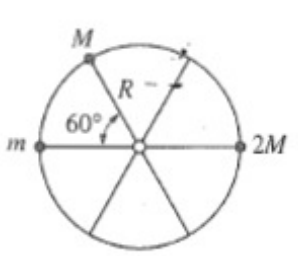
The diagram above shows a top view of a child of mass \(M\) on a circular platform of mass \(5M\)that is rotating counterclockwise. Assume the platform rotates without friction. Which of the following describes an action by the child that will result in an increase in the total angular momentum of the child-platform system?

The figure above shows a cart of mass \( M \) accelerating to the right with acceleration \( a \). A block of mass \( m \) is pressed against the cart’s front vertical surface and is held there only by friction. The coefficient of friction between the block and the cart is \( \mu \). What is the minimum acceleration \( a \) of the cart such that the block will not fall?
A rifle is used to shoot a target twice, using identical cartridges. The first time, the rifle is aimed parallel to the ground and directly at the center of the bull’s-eye. The bullet strikes the target at a distance of \( H_A \) below the center, however. The second time, the rifle is similarly aimed, but from twice the distance from the target. This time the bullet strikes the target at a distance of \( H_B \) below the center. Find the ratio \( H_B / H_A \).
Which of these scenarios involve accelerated motion? (Select all that apply)

A hungry bear weighing 700 N walks out on a beam in an attempt to retrieve a basket of goodies hanging at the end of the beam. The beam is uniform, weighs 200 N, and is 6.00 m long. The goodies weigh 80 N.

Projectiles 1 and 2 are launched from level ground at the same time and follow the trajectories shown in the figure. Which one of the projectiles, if either, returns to the ground first, and why?
A disk increases from 2 complete revolutions in 2 seconds to 5 complete revolutions in 2 seconds. What is its average angular acceleration?
An \( 80 \, \text{kg} \) block is placed \( 2 \, \text{m} \) away from the endpoint of a horizontal steel beam of length \( 6.6 \, \text{m} \) and mass \( 1,450 \, \text{kg} \). The plank makes contact with a vertical wall on one end (assume it does not slip). The other end of the beam is attached to a massless cable that makes an angle of \( 30^\circ \) with the horizontal and ties into the vertical wall as well. Calculate the (1) tension force in the cable and (2) the total force the wall exerts on the beam.
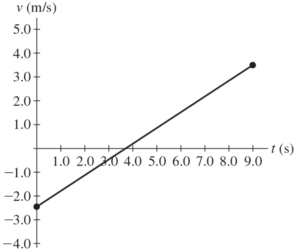
Above is the graph of the velocity vs. time of a duck flying due south for the winter. At what point might the duck begin reversing directions?
Two balls have their centers \( 2.0 \) \( \text{m} \) apart. One ball has a mass of \( 8.0 \) \( \text{kg} \). The other has a mass of \( 6.0 \) \( \text{kg} \). What is the gravitational force between them?
A box is sliding down an incline at a constant speed of \( 2 \) \( \text{m s}^{-1} \). The angle of the incline is \( \theta \). The magnitude of the total of the opposing forces is \( 16 \) \( \text{N} \). What is the force of gravity acting on the box?
A friend is balancing a fork on one finger. Which of the following are correct explanations of how he accomplishes this? Select two answers.
A car travels east at a steady \( 30 \) \( \text{m/s} \) for \( 5 \) \( \text{s} \). What is its acceleration during this motion?
Two objects are dropped from rest from the same height. Object \( A \) falls through a distance \( d_A \) during a time \( t \), and object \( B \) falls through a distance \( d_B \) during a time \( 2t \). If air resistance is negligible, what is the relationship between \( d_A \) and \( d_B \)?
A pendulum consists of a ball of mass \( m \) suspended at the end of a massless cord of length \( L \). The pendulum is drawn aside through an angle of \( 60^\circ \) with the vertical and released. At the low point of its swing, the speed of the pendulum ball is
| Experiment | Initial Velocity of Cart X \( (\text{m/s}) \) | Initial Velocity of Cart Y \( (\text{m/s}) \) | Final Velocity of Cart X \( (\text{m/s}) \) | Final Velocity of Cart Y \( (\text{m/s}) \) |
|---|---|---|---|---|
| \( 1 \) | \( 1 \) | \( 0 \) | \( 0 \) | \( 1 \) |
| \( 2 \) | \( 1 \) | \( -1 \) | \( -1 \) | \( 1 \) |
| \( 3 \) | \( 2 \) | \( 1 \) | \( 1 \) | \( 2 \) |
A student performs several experiments in which two carts collide as they travel along a horizontal surface. Cart X and Cart Y both have a mass of \( 1 \) \( \text{kg} \). Data collected from the three experiments are shown in the table above. During which experiment does the center of mass of the system of two carts have the greatest change in its momentum?
In a 4.0-kilometer race, a runner completes the first kilometer in 5.9 minutes, the second kilometer in 6.2 minutes, the third kilometer in 6.3 minutes, and the final kilometer in 6.0 minutes. What is the average speed of the runner? Use standard units: m/s.
A \(2 \, \text{kg}\) object slides east at \(4 \, \text{m/s}\) and collides with a stationary \(3 \, \text{kg}\) object. After the collision, the \(2 \, \text{kg}\) object is traveling at an unknown velocity at \(15^\circ\) north of east and the \(3 \, \text{kg}\) object is traveling at \(38^\circ\) south of east. What is each object’s final velocity?
An object of unknown mass is acted upon by multiple forces:
The coefficients of friction are \(\mu_s = 0.6\) and \(\mu_k = 0.2\). Starting from rest, the object travels \(10 \, \text{m}\) in \(4.5 \, \text{s}\). What is the mass of the unknown object?
By continuing you (1) agree to our Terms of Use and Terms of Sale and (2) consent to sharing your IP and browser information used by this site’s security protocols as outlined in our Privacy Policy.
Quick Start Guide
AP physics 1, AP C, honors and advanced physics students.
Quickly filter questions by units and more.
Here’s guide to using 5 UBQ filters.
GQ = general question, MCQ = multiple choice, FRQ = free response.
Click the check or bookmark button.
Now you’ll be able to see completed or bookmarked questions at a glance!
Answer keys, personalized for you.
Phy will be responsible for grading your FRQs and GQs.
No more copy and pasting. Just solve and snap.
Questions for Mastery
By continuing you agree to nerd-notes.com Terms of Service, Privacy Policy, and our usage of user data.