Phy UBQ Count Message Here
Intermediate
Mathematical
MCQ

A mass is attached to a spring of spring constant 60 N/m along a horizontal, frictionless surface. The spring is initially stretched by a force of 5.0 N and let go. It takes the mass 0.50 s to go back to its equilibrium position when it is oscillating. What is the amplitude?

Beginner
Mathematical
GQ

A spring with spring constant \( k = 2.3 \) \( \text{N/m} \) is attached to an object of mass \( 10 \) \( \text{kg} \). If the object is hung from the ceiling by this spring, how much would the spring be stretched?

Beginner
Conceptual
MCQ

To increase the moment of inertia of a body about an axis, you must

Beginner
Mathematical
GQ

Diamond has a density of \( 3500 \) \( \text{kg/m}^3 \). During a physics lab, a diamond drops out of Virginia’s necklace and falls into her graduated cylinder filled with \( 5.00 \times 10^{-5} \) \( \text{m}^3 \) of water. This causes the water level to rise to the \( 5.05 \times 10^{-5} \) \( \text{m}^3 \) mark. What is the mass of Virginia’s diamond?

Advanced
Proportional Analysis
MCQ

A gun can fire a bullet to height \( h \) when fired straight up. If the same gun is pointed at an angle of \( 45^\circ \) from the vertical, what is the new maximum height of the projectile?

Intermediate
Mathematical
GQ

A spring with a spring constant of \( 50. \) \( \text{N/m} \) is hanging from a stand. A second spring with a spring constant of \( 100. \) \( \text{N/m} \) is hanging from the first spring. How far do they stretch if a \( 0.50 \) \( \text{kg} \) mass is hung from the bottom spring?

Intermediate
Mathematical
GQ

Rex, an auto mechanic, is raising a \( 1200 \) \( \text{kg} \) car on his hydraulic lift so that he can work underneath. If the area of the input piston is \( 12.0 \) \( \text{cm}^2 \), while the output piston has an area of \( 700 \) \( \text{cm}^2 \), what force must be exerted on the input piston to lift the car?

Intermediate
Mathematical
GQ

Two blocks, A and B, are connected by a light string that passes over a frictionless pulley. Block A, of mass \( 10 \) \( \text{kg} \), rests on a rough plane that makes an angle of \( 45^{\circ} \) with the horizontal, while block B, of mass \( 17 \) \( \text{kg} \), hangs vertically. Starting from rest, what is the minimum coefficient of static friction between block A and the plane required to keep the system in static equilibrium?

Intermediate
Mathematical
FRQ

A train consists of \(50\) cars, each of which has a mass of \(6.1 \times 10^{3} \, \text{kg}\). The train has an acceleration of \(8.0 \times 10^{-2} \, \text{m/s}^2\). Ignore friction and determine the tension in the coupling at the following places:

Intermediate
Mathematical
MCQ

A ball falls straight down through the air under the influence of gravity. There is a retarding force \(F\) on the ball with magnitude given by \(F=bv\), where \(v\) is the speed of the ball and \(b\) is a positive constant. The ball reaches a terminal velocity after a time \(t\). The magnitude of the acceleration at time \(t/2\) is

Beginner
Conceptual
MCQ

You are pushing a heavy box across a rough floor. When you are initially pushing the box and it is accelerating,

Intermediate
Mathematical
MCQ
Speed \( 10 \, \mathrm{m/s} \) \( 20 \, \mathrm{m/s} \) \( 30 \, \mathrm{m/s} \)
Braking Distance \( 6.1 \, \mathrm{m} \) \( 23.9 \, \mathrm{m} \) \( 53.5 \, \mathrm{m} \)

A car of mass \( 1500 \, \mathrm{kg} \) is traveling at one of the speeds listed when the brakes are first applied. Using the data above, what is the magnitude of the average braking force required to stop the car?

Intermediate
Mathematical
GQ

A \(0.5 \, \text{kg}\) cart, on a frictionless \(2 \, \text{m}\) long table, is being pulled by a \(0.1 \, \text{kg}\) mass connected by a string and hanging over a pulley. The system is released from rest. After the hanging mass falls \(0.5 \, \text{m}\), calculate the speed of the cart on the table. Use ONLY forces and energy.

Intermediate
Mathematical
GQ

A 2.00 x10² g block on a 50.0 cm long string swings in a circle on a horizontal, frictionless table at 75.0 rpm. What is the speed of block? What is the tension in the string?

Intermediate
Mathematical
FRQ

A firecracker in a coconut blows the coconut into three pieces. Two pieces of equal mass fly off south and west, perpendicular to each other, at \( 18 \) \( \text{m/s} \). The third piece has \( 2.5 \) times the mass as the other two.

Intermediate
Proportional Analysis
FRQ

Imagine a hypothetical planet that has two moons. Moon \(\#1\) is in a circular orbit of radius \(R\) and has a mass \(M\).

Intermediate
Mathematical
MCQ

A cart is initially moving at 0.5 m/s along a track. The cart comes to rest after traveling 1 m. The experiment is repeated on the same track, but now the cart is initially moving at 1 m/s. How far does the cart travel before coming to rest?

Intermediate
Mathematical
GQ

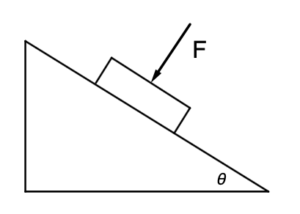
A 2.0 kg wood box slides down a vertical wood wall while you push on it at a 45 ° angle. The coefficient of kinetic friction of wood µk = 0.200. What magnitude of force should you apply to cause the box to slide down at a constant speed?

Advanced
Mathematical
FRQ

A ball of mass \( 0.5 \, \text{kg} \), initially at rest, is kicked directly toward a fence from a point \( 32 \, \text{m} \) away, as shown above. The velocity of the ball as it leaves the kicker’s foot is \( 20 \, \text{m/s} \) at an angle of \( 37^\circ \) above the horizontal. The top of the fence is \( 2.5 \, \text{m} \) high. The ball hits nothing while in flight and air resistance is negligible.

Beginner
Proportional Analysis
GQ

You try to open a door, but you are unable to push at a right angle to the door. So, you push the door at an angle of \( 35^{\circ} \) from the horizontal. How much harder would you have to push to open the door just as fast as if you were to push it at \( 90^{\circ} \)?

Beginner
Conceptual
MCQ

Which pair of quantities will always have the same magnitude if motion is in a straight line and in one direction?

Intermediate
Mathematical
FRQ
A right-triangle ramp is drawn on the left side of a horizontal baseline. The ramp’s hypotenuse slopes downward from left to right at an angle labeled “θ0” between the hypotenuse and the rightward horizontal baseline. The horizontal run of the ramp (its base) is marked as length D, starting at x = –D on the leftmost top point of the ramp and ending at x = 0 at the foot of the ramp. From x = 0 to x = 4D, the baseline is a straight horizontal line representing the rough surface. Tick marks on the baseline indicate positions x = 0, D, 2D, 3D, and 4D. The inclined segment is frictionless; the horizontal segment is shaded or marked as rough. No block is explicitly drawn on the diagram.

A block is initially at rest on top of an inclined ramp that makes an angle \( \theta_0 \) with the horizontal. The distance measured along the base of the ramp is \( D \). After the block is released from rest, it slides down the frictionless ramp and then continues onto a rough horizontal surface until it finally comes to rest at the position \( x = 4D \) measured from the base of the ramp. The coefficient of kinetic friction between the block and the rough horizontal surface is \( \mu_k \).

Intermediate
Mathematical
FRQ

A projectile of mass 0.750 kg is shot straight up with an initial speed of 18.0 m/s.

Intermediate
Conceptual
MCQ

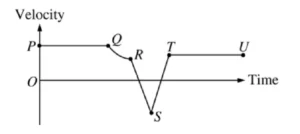
In which of the following is the rate of change of the particle’s momentum zero?

Nerd Notes

Discover the world's best Physics resources

Continue with

By continuing you (1) agree to our Terms of Use and Terms of Sale and (2) consent to sharing your IP and browser information used by this site’s security protocols as outlined in our Privacy Policy.

Sign In to View Your Questions

PRO TIER

One price to unlock most advanced version of Phy across all our tools.

$20

per month

Billed Monthly. Cancel Anytime.

We use cookies to improve your experience. By continuing to browse on Nerd Notes, you accept the use of cookies as outlined in our privacy policy.