You are working out on a rowing machine. Each time you pull the rowing bar toward you, it moves a distance of \(1.25 \, \text{m}\) in a time of \(0.84 \, \text{s}\). The readout on the display indicates that the average power you are producing is \(76 \, \text{W}\). What is the magnitude of the force that you exert on the handle?
The graph below is a plot of position versus time. For which labeled segments is the velocity positive and the acceleration negative?
A big bird has a mass of about 0.021 kg. Suppose it does 0.36 J of work against gravity, so that it ascends straight up with a net acceleration of 0.625 m/s2. How far up does it move?
A rubber ball bounces on the ground. After each bounce, the ball reaches one-half the height of the bounce before it. If the time the ball was in the air between the first and second bounce was 1 second. What would be the time between the second and third bounce?
A \(90 \, \text{kg}\) individual is cycling up a hill inclined at \(30^\circ\) on a \(12 \, \text{kg}\) bicycle. The hill is quite steep, and the coefficient of static friction is \(0.85\). The cyclist ascends \(12 \, \text{m}\) up the hill and then pauses at the summit. They then start descending from rest and travel \(9 \, \text{m}\) before firmly applying the brakes, causing the wheels to lock.

In lacrosse, a typical throw is made by rotating the stick through an angle of roughly \(90^\circ\), then releasing the ball when the stick is vertical, as shown above. If the \(1 \, \text{meter}\) long stick is at rest when horizontal and the ball leaves the stick with a velocity of \(10 \, \text{m/s}\), what angular acceleration must the stick experience?

The diagram above shows a top view of a child of mass \(M\) on a circular platform of mass \(2M\) that is rotating counterclockwise. Assume the platform rotates without friction. Which of the following describes an action by the child that will increase the angular speed of the platform-child system and gives the correct reason why?
A block hangs from the ceiling by a massless rope. A \( 3.0 \, \text{kg} \) block is attached to the first block and hangs below it on another piece of massless rope. The tension in the top rope is \( 63.0 \, \text{N} \).
A [katex] 2 \, \text{kg}[/katex] mass is attached to a spring with spring constant [katex] k = 100 \, \text{N/m}[/katex] and negligible mass.
A horizontal, uniform board of weight \( 125 \, \text{N} \) and length \( 4 \, \text{m} \) is supported by vertical chains at each end. A person weighing \( 500 \, \text{N} \) is hanging from the board. The tension in the right chain is \( 250 \, \text{N} \).
A block rests on a frictionless incline. Which statement is correct?
A block starts at rest on a frictionless inclined track which then turns into a circular loop of radius \( R \) and is vertical. In terms of \( R \) and constants, find the minimum height \( h \) above the bottom of the loop the block must start from so it makes it around the loop.
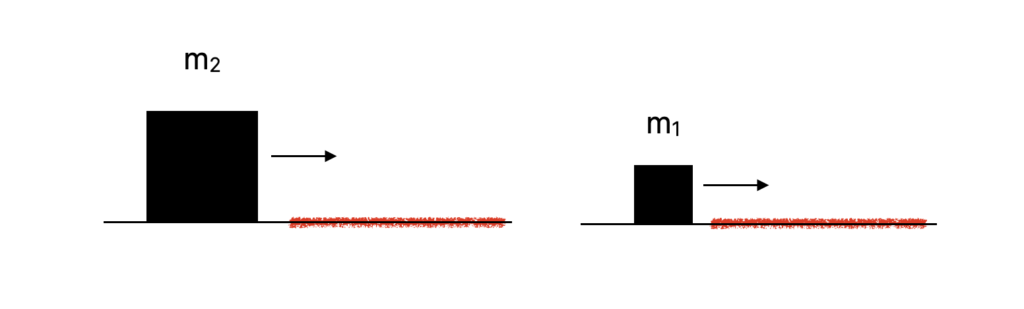
A kickball is rolled by the pitcher at a speed of 10 m/s and it is kicked by another student. The kickball deforms a little during the kick, and then rebounds with a velocity of 15 m/s as its shape restores to a perfect sphere. Select all that must be true about the kickball and the kicking foot system.
Two uniform disks have the same radius but different masses: disk \( 1 \) has a mass \( M \), disk \( 2 \) has a mass \( 2M \). What is the ratio of the moment of inertia of the first disk to the second disk?
A 45 kg crate accelerates at 1.65 m/s2 when pulled by a rope with a force of 200 N. Find the angle the rope is pulled at. Friction is negligible.
Diamond has a density of \( 3500 \) \( \text{kg/m}^3 \). During a physics lab, a diamond drops out of Virginia’s necklace and falls into her graduated cylinder filled with \( 5.00 \times 10^{-5} \) \( \text{m}^3 \) of water. This causes the water level to rise to the \( 5.05 \times 10^{-5} \) \( \text{m}^3 \) mark. What is the mass of Virginia’s diamond?
A trash compactor pushes down with a force of \( 500 \) \( \text{N} \) on a \( 3 \) \( \text{cm}^2 \) input piston, causing a force of \( 30,000 \) \( \text{N} \) to crush the trash. What is the area of the output piston that crushes the trash?

The figure shows scale drawings of four objects, each of the same mass and uniform thickness, with the mass distributed uniformly. Which one has the greatest moment of inertia when rotated about an axis perpendicular to the plane of the drawing at point P?
By continuing you (1) agree to our Terms of Use and Terms of Sale and (2) consent to sharing your IP and browser information used by this site’s security protocols as outlined in our Privacy Policy.
Quick Start Guide
AP physics 1, AP C, honors and advanced physics students.
Quickly filter questions by units and more.
Here’s guide to using 5 UBQ filters.
GQ = general question, MCQ = multiple choice, FRQ = free response.
Click the check or bookmark button.
Now you’ll be able to see completed or bookmarked questions at a glance!
Answer keys, personalized for you.
Phy will be responsible for grading your FRQs and GQs.
No more copy and pasting. Just solve and snap.
Questions for Mastery
By continuing you agree to nerd-notes.com Terms of Service, Privacy Policy, and our usage of user data.