for free to use all UBQ features

Refer to the diagram above and solve all equations in terms of \(R\), \(M\), \(k\), and constants.
Which of the following must be zero if an object is spinning at a constant rate? There may be more than one right answer.
A car moves at constant speed in a circle of radius 75 m on a horizontal road. The coefficient of static friction is 0.62. Find the maximum speed the car can go without sliding.
When the speed of a rear-wheel-drive car is increasing on a horizontal road, what is the direction of the frictional force on the tires?
A boy of mass \( m \) and a girl of mass \( 2m \) are initially at rest at the center of a frozen pond. They push each other so that she slides to the left at speed \( v \) across the frictionless ice surface and he slides to the right. What is the total work done by the children?
A wheel 31 cm in diameter accelerates uniformly from 240rpm to 360rpm in 6.8 s. How far will a point on the edge of the wheel have traveled in this time?
Which of these scenarios involve accelerated motion? (Select all that apply)
Two blocks of ice, one five times as heavy as the other, are at rest on a frozen lake. A person then pushes each block the same distance \(d\). Ignore friction and assume that an equal force \(F\) is exerted on each block. Which of the following statements is true about the kinetic energy of the heavier block after the push?

The figure shows a person’s foot. In that figure, the Achilles tendon exerts a force of magnitude F = 720 N. What is the magnitude of the torque that this force produces about the ankle joint?
A cart with a mass of \( 20 \) \( \text{kg} \) is pressed against a wall by a horizontal spring with spring constant \( k = 244 \) \( \text{N/m} \) placed between the cart and the wall. The spring is compressed by \( 0.1 \) \( \text{m} \). While the spring is compressed, an additional constant horizontal force of \( 20 \) \( \text{N} \) continues to push the cart toward the wall. What is the resulting acceleration of the cart?
Two uniform solid balls, one of radius \( R \) and mass \( M \), the other of radius \( 2R \) and mass \( 8M \), roll down a high incline. They start together from rest at the top of the incline. Which one will reach the bottom of the incline first?
A \(0.5 \, \text{mm}\) wire made of carbon and manganese can just barely support the weight of a \(70.0 \, \text{kg}\) person that is holding on vertically. Suppose this wire is used to lift a \(45.0 \, \text{kg}\) load. What maximum vertical acceleration can be achieved without breaking the wire?
In a demonstration, a teacher holds the axle of a wheel that is spinning with constant angular speed. The teacher then releases the axle and the wheel begins to fall toward the ground. As the wheel falls, its angular speed remains constant. Which of the following correctly describes how the rotational kinetic energy \( K_{\text{rot}} \) of the wheel and the total kinetic energy \( K_{\text{tot}} \) of the wheel change, if at all, after the wheel is released but before it reaches the ground?
| \( K_{\text{rot}} \) | \( K_{\text{tot}} \) | |
|---|---|---|
| A | Constant | Constant |
| B | Constant | Increasing |
| C | Increasing | Constant |
| D | Increasing | Increasing |
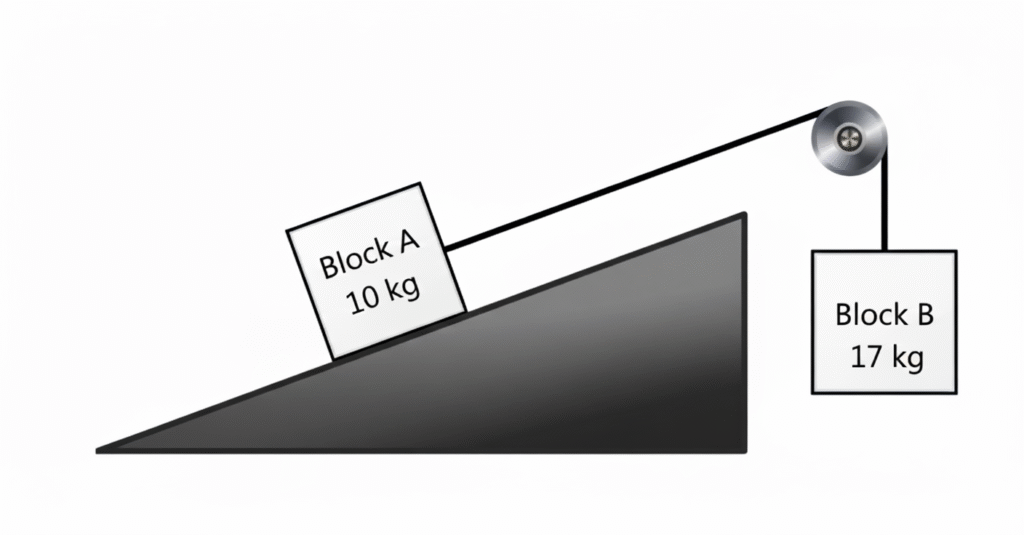
A \( 15 \) \( \text{N} \) force is pushing a \( 40 \) \( \text{N} \) block down a incline. The angle of the inline is \( \alpha = 40^{\circ} \). The coefficient of static friction between the block and the incline is \( \mu_s = 0.75 \) and the coefficient of kinetic friction is \( \mu_k = 0.65 \).
The two blocks of masses \( M \) and \( 2M \) travel at the same speed \( v \) but in opposite directions. They collide and stick together. How much mechanical energy is lost to other forms of energy during the collision?
Consider a solid uniform sphere of radius \(R\) and mass \(M\) rolling without slipping. Which form of its kinetic energy is larger, translational or rotational?
The driver of a car traveling at \( 30.0 \) \( \text{m/s} \) applies the brakes and undergoes a constant negative acceleration of \( 2.00 \) \( \text{m/s}^2 \). How many revolutions does each tire make before the car comes to a stop, assuming that the car does not skid and that the tires have radii of \( 0.300 \) \( \text{m} \)?
A pendulum has a period of \(2.0 \, \text{s}\) on Earth. What is its length?
A \( 7.3 \) \( \text{kg} \) mass is placed on a spring with a spring constant of \( 34 \) \( \text{N/cm} \). How much does this stretch the spring?
A gun can fire a bullet to height \( h \) when fired straight up. If the same gun is pointed at an angle of \( 45^\circ \) from the vertical, what is the new maximum height of the projectile?
A friend is balancing a fork on one finger. Which of the following are correct explanations of how he accomplishes this? Select two answers.

A \( 4700 \, \text{kg} \) truck carrying a \( 900 \, \text{kg} \) crate is traveling at \( 25 \, \text{m/s} \) to the right along a straight, level highway, as shown above. The truck driver then applies the brakes, and as it slows down, the truck travels \( 55 \, \text{m} \) in the next \( 3.0 \, \text{s} \). The crate does not slide on the back of the truck.
By continuing you (1) agree to our Terms of Use and Terms of Sale and (2) consent to sharing your IP and browser information used by this site’s security protocols as outlined in our Privacy Policy.
Quick Start Guide
AP physics 1, AP C, honors and advanced physics students.
Quickly filter questions by units and more.
Here’s guide to using 5 UBQ filters.
GQ = general question, MCQ = multiple choice, FRQ = free response.
Click the check or bookmark button.
Now you’ll be able to see completed or bookmarked questions at a glance!
Answer keys, personalized for you.
Phy will be responsible for grading your FRQs and GQs.
No more copy and pasting. Just solve and snap.
Questions for Mastery
By continuing you agree to nerd-notes.com Terms of Service, Privacy Policy, and our usage of user data.