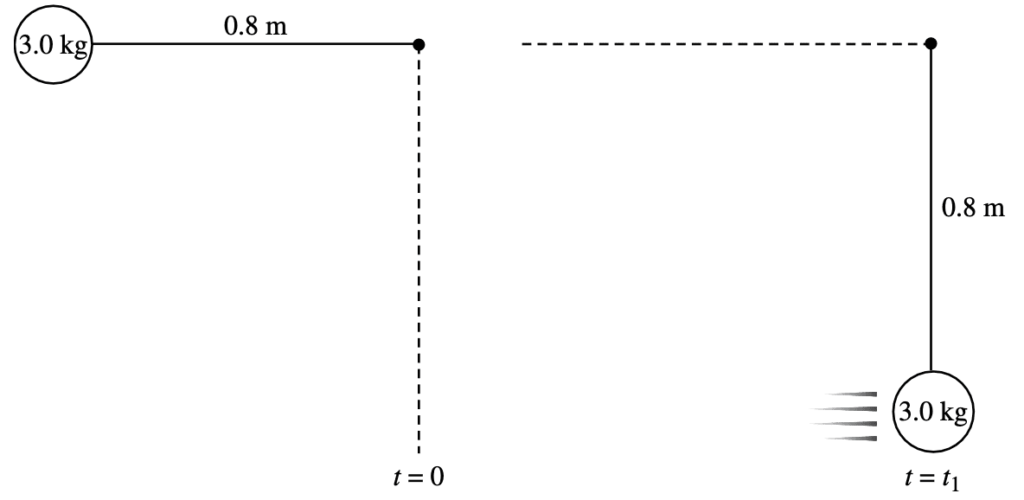
One end of a string is wrapped around a pulley that is free to rotate with negligible friction about an axle at its center. The other end of the string is attached to a block. The block is released from rest and moves downward with constant acceleration. Which of the following correctly indicates whether the amount of work done on the pulley by the string during each successive complete rotation remains constant or increases, and provides a valid justification?
The diagram above shows a marble rolling down an incline, the bottom part of which has been bent into a loop. The marble is released from point A at a height of \(0.80 \, \text{m}\) above the ground. Point B is the lowest point and point C the highest point of the loop. The diameter of the loop is \(0.35 \, \text{m}\). The mass of the marble is \(0.050 \, \text{kg}\). Friction forces and any gain in kinetic energy due to the rotating of the marble can be ignored. When answering the following questions, consider the marble when it is at point C.
A block of weight \( W \) is pulled along a horizontal surface at constant speed by a force \( F \), which acts at an angle of \( \theta \) with the horizontal. The normal force exerted on the block by the surface has magnitude:

A block is attached to a horizontal spring and is initially at rest at the equilibrium position \( x = 0 \), as shown in Figure \( 1 \). The block is then moved to position \( x = -A \), as shown in Figure \( 2 \), and released from rest, undergoing simple harmonic motion. At the instant the block reaches position \( x = +A \), another identical block is dropped onto and sticks to the block, as shown in Figure \( 3 \). The two–block–spring system then continues to undergo simple harmonic motion. Which of the following correctly compares the total mechanical energy \( E_{\text{tot},2} \) of the two–block–spring system after the collision to the total mechanical energy \( E_{\text{tot},1} \) of the one–block–spring system before the collision?
Two workers are holding a thin plate with length \(5 \, \text{m}\) and height \(2 \, \text{m}\) at rest by supporting the plate in the bottom corners. The workers are standing at rest on a slope of \(10^\circ\). Treat these supporting forces as vertical normal forces and calculate their magnitudes and state if both workers are sharing “the job” fairly.

The elliptical orbit of a comet is shown above. Positions \(1\) and \(2\) are, respectively, the farthest and nearest positions to the Sun, and at position \(1\) the distance from the comet to the Sun is \(10\) times that at position \(2\). What is the ratio \(\dfrac{F_1}{F_2}\), the force on the comet at position \(1\) to the force on the comet at position \(2\)?
Which of the following must be true for an object at translational equilibrium?
A \(5\)-meter long ladder is leaning against a wall, with the bottom of the ladder \(3\) meters from the wall. The ladder is uniform and has a mass of \(20 \, \text{kg}\). A person of mass \(80 \, \text{kg}\) is standing on the ladder at a distance of \(4\) meters from the bottom of the ladder. What is the force exerted by the wall on the ladder?
A drinking fountain projects water at an initial angle of \( 50^ \circ \) above the horizontal, and the water reaches a maximum height of \( 0.150 \) \( \text{m} \) above the point of exit. Assume air resistance is negligible.
A toy car moves off the edge of a table that is \(1.25 \, \text{m}\) high. If the car lands \(0.40 \,\text{m}\) from the base of the table…
A block attached to spring demonstrates simple harmonic motion about its equilibrium position with amplitude [katex] A [/katex] and angular frequency [katex] \omega [/katex]. What is the maximum magnitude of the block’s velocity?
A student kicks a soccer ball. The ball exerts a force back on the student’s foot. Why doesn’t the student’s foot accelerate backward as much as the ball accelerates forward?
By continuing you (1) agree to our Terms of Use and Terms of Sale and (2) consent to sharing your IP and browser information used by this site’s security protocols as outlined in our Privacy Policy.
Quick Start Guide
AP physics 1, AP C, honors and advanced physics students.
Quickly filter questions by units and more.
Here’s guide to using 5 UBQ filters.
GQ = general question, MCQ = multiple choice, FRQ = free response.
Click the check or bookmark button.
Now you’ll be able to see completed or bookmarked questions at a glance!
Answer keys, personalized for you.
Phy will be responsible for grading your FRQs and GQs.
No more copy and pasting. Just solve and snap.
Questions for Mastery
By continuing you agree to nerd-notes.com Terms of Service, Privacy Policy, and our usage of user data.