Phy UBQ Count Message Here
Advanced
Mathematical
MCQ

A sphere starts from rest and rolls down an incline of height \( H = 1.0 \) \( \text{m} \) at an angle of \( 25^\circ \) with the horizontal, as shown above. The radius of the sphere \( R = 15 \) \( \text{cm} \), and its mass \( m = 1.0 \) \( \text{kg} \). The moment of inertia for a sphere is \( \frac{2}{5}mR^2 \). What is the speed of the sphere when it reaches the bottom of the plane?
Beginner
Mathematical
MCQ

A force of \(17 \, \text{N}\) is applied to the end of a \(0.63 \, \text{m}\) long torque wrench at an angle \(45^\circ\) from a line joining the pivot point to the handle. What is the magnitude of the torque about the pivot point produced by this force?

Advanced
Proportional Analysis
MCQ

A ball is tossed directly upward. Its total time in the air is \( T \). Its maximum height is \( H \). What is its height after it has been in the air a time \( T/4 \)? Air resistance is negligible.

Beginner
Conceptual
GQ

Why do you tend to slide across the car seat when the car makes a sharp turn?

Intermediate
Conceptual
MCQ

A merry-go-round spins freely when Diego moves quickly to the center along a radius of the merry-go-round. As he does this, it is true to say that

Beginner
Conceptual
MCQ

A car suddenly stops and a passenger lurches forward. This motion is best explained by Newton’s ____ Law.

Advanced
Mathematical
MCQ

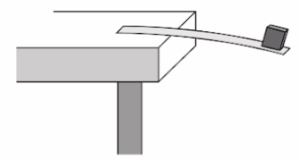
Students attach a thin strip of metal to a table so that the strip is horizontal in relation to the ground. A section of the strip hangs off the edge of the table. A mass is secured to the end of the hanging section of the strip and is then displaced so that the mass-strip system oscillates, as shown in the figure. Students make various measurements of the net force \( F \) exerted on the mass as a result of the force due to gravity and the normal force from the strip, the vertical position \( y \) of the mass above and below its equilibrium position \( y \), and the period of oscillation \( T’ \) when the mass is displaced by different amplitudes \( A \). Which of the following explanations is correct about the evidence required to conclude that the mass undergoes simple harmonic motion?
Advanced
Mathematical
GQ

A new car is tested on a \(230 \, \text{m}\)-diameter track. If the car speeds up at a steady \(1.4 \, \text{m/s}^2\), how long after starting is the magnitude of its centripetal acceleration equal to the tangential acceleration?

Advanced
Mathematical
MCQ

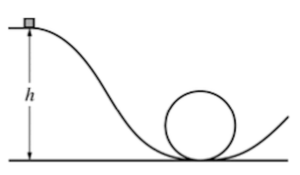
A small block slides without friction along a track toward a circular loop. The block has more than enough speed to remain firmly in contact with the track as it goes around the loop. The magnitude of the block’s acceleration at the top of the loop is
Intermediate
Conceptual
MCQ

An experimenter has a simple pendulum of length \( L \) and a mass–spring system with mass \( m \) and spring constant \( k \). Both are found to have the same period of oscillation \( T \) on Earth. If both systems are taken to the Moon, where the acceleration due to gravity is approximately \( \frac{1}{6} g \) of Earth, what will happen to their periods?

Intermediate
Proportional Analysis
MCQ

Two thin coins are made from identically the same metal, but one coin has triple the diameter of the other. What is the ratio of the moment of inertia of the large coin compared to the small coin? Take the axis of rotation to be perpendicular to the coin and through its center; assume that the coins have the same thickness. Hint: The moment of inertia of a solid disk about its center is \(\frac{1}{2} M R^{2}\).

Advanced
Mathematical
GQ

A red car, initially at rest, travels east with an acceleration of \( 3.5 \, \text{m/s}^2 \). At the same time as the red car starts to move, a blue car is traveling west at \( 15 \, \text{m/s} \) and accelerating at \( 1.2 \, \text{m/s}^2 \). If they are \( 600 \, \text{m} \) apart the moment the red car starts to move and they are traveling towards each other, where and when will they meet?

Intermediate
Conceptual
MCQ

An ideal fluid flows through a pipe with radius \( Q \) and flow speed \( V \). If the pipe splits up into three separate paths, each with radius \( \frac{Q}{2} \), what is the flow speed through each of the paths?

Advanced
Mathematical
FRQ

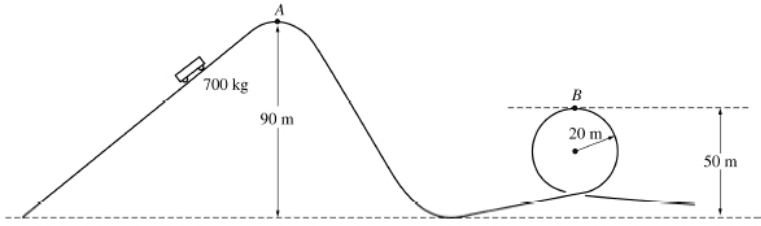
A roller coaster ride at an amusement park lifts a car of mass \( 700 \, \text{kg} \) to point \( A \) at a height of \( 90 \, \text{m} \) above the lowest point on the track, as shown above. The car starts from rest at \( A \), rolls with negligible friction down the incline and follows the track around a loop of radius \( 20 \, \text{m} \). Point \( B \), the highest point on the loop, is at a height of \( 50 \, \text{m} \) above the lowest point on the track.
Beginner
Proportional Analysis
MCQ

Two objects are attracted to each other by a gravitational force \( F \). If each mass is tripled, so that each becomes \( 3 \) times its original value, and the distance between the objects is cut in half to \( \dfrac{1}{2} \) of its original separation, what is the new gravitational force between the objects in terms of \( F \)?

Beginner
Conceptual
MCQ

A ball is thrown straight up. At what point does the ball have the most energy?

Beginner
Conceptual
FRQ

When a golf ball is dropped to the pavement, it bounces back up.

Advanced
Mathematical
FRQ
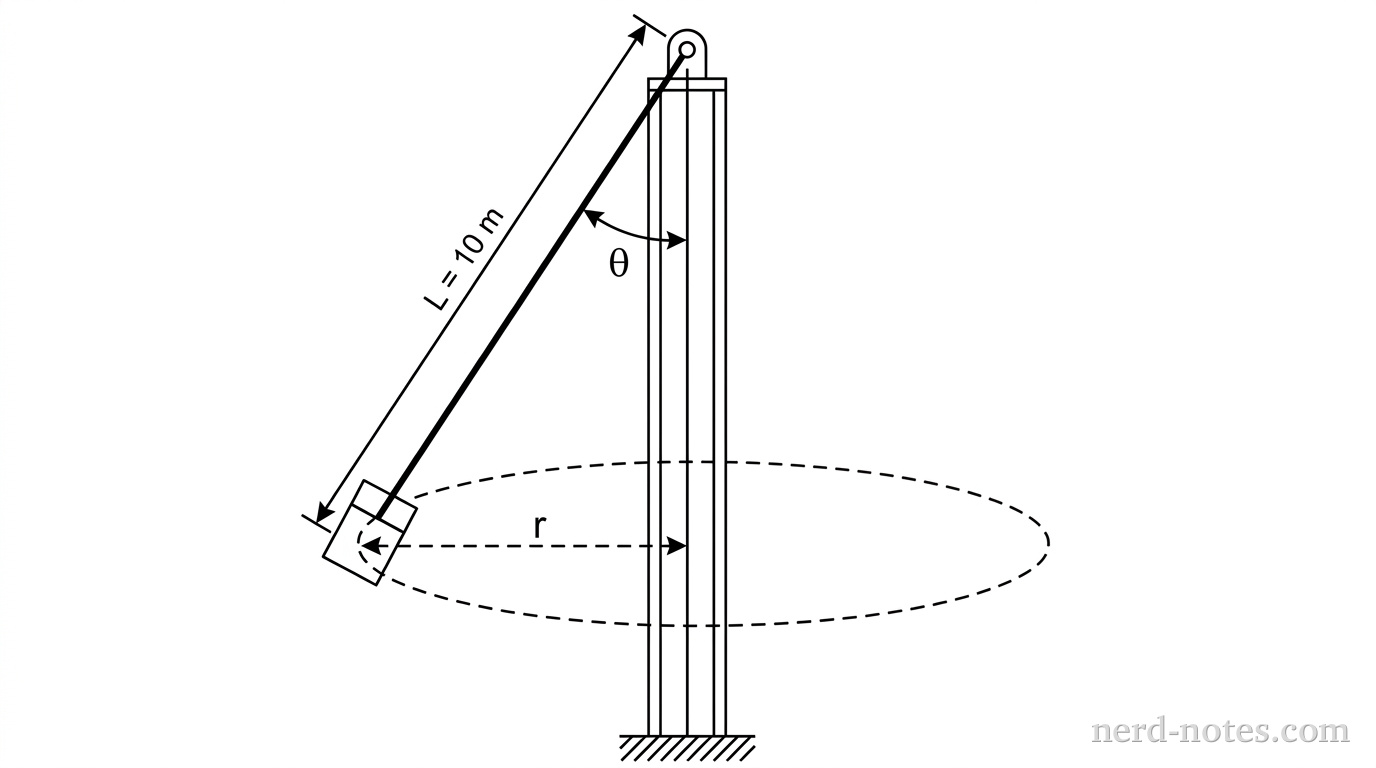
A physical setup diagram showing a tall vertical tower with a pivot point at the top. A single chain of length 10 meters hangs from the pivot, connected to a chair. The chair and chain are drawn at an angle theta from the vertical. The child is depicted as a simplified block sitting in the chair. A dashed circular path is drawn indicating the radius of rotation of the chair. A horizontal dimension line indicates the radius r, and an arc marker labels the angle theta between the vertical tower and the taut chain.

A neighbor’s child wants to go to a carnival to experience the wild rides. The neighbor is worried about safety because one of the rides looks particularly dangerous. She knows that you have taken physics and so asks you for advice. The ride in question has a \(4 \, \text{kg}\) chair which hangs freely from a \(10 \, \text{m}\) long chain attached to a pivot on the top of a tall tower. When the child enters the ride, the chain is hanging straight down. The child is then attached to the chair with a seat belt and shoulder harness. When the ride starts up, the chain rotates about the tower. Soon the chain reaches its maximum speed and remains rotating at that speed, which corresponds to one rotation about the tower every \(3 \, \text{seconds}\). When you ask the operator, he says the ride is perfectly safe. He demonstrates this by sitting in the stationary chair. The chain creaks but holds, and he weighs \(90 \, \text{kg}\).
Advanced
Mathematical
FRQ

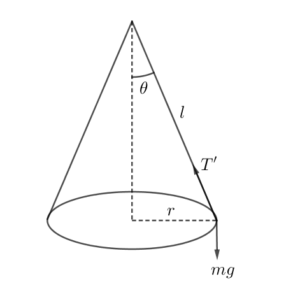
A conical pendulum is formed by attaching a ball of mass \( m \) to a string of length \( L \), then allowing the ball to move in a horizontal circle of radius \( R \).
Beginner
Conceptual
GQ

Why do you push down harder on the pedals of a bicycle when first starting out than when moving at constant speed? Why do you need to pedal at all when cycling at constant speed?

Beginner
Conceptual
MCQ

A cannon fires a cannonball forward. The recoil of the cannon is backward. Why doesn’t the cannon move backward as fast as the cannonball moves forward?

Intermediate
Conceptual
MCQ

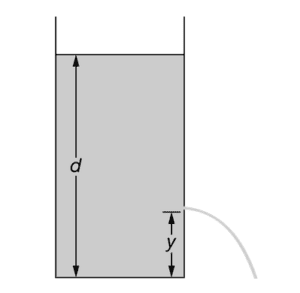
The figure shows a container filled with water to a depth \( d \). The container has a hole a distance \( y \) above its bottom, allowing water to exit with an initially horizontal velocity. Which of the following correctly predicts and explains how the speed of the water as it exits the hole would change if the distance \( y \) above the bottom of the container increased?


Intermediate
Conceptual
MCQ

Two blocks of the same size are floating in a container of water. The first block is submerged \( 80\% \) while the second block is submerged by \( 20\% \) beneath the water. Which of the following is a correct statement about the two blocks?

Beginner
Conceptual
MCQ

Block \( 1 \) of mass \( m_1 \) and Block \( 2 \) of mass \( m_2 = 2 m_1 \) are each attached to identical horizontal springs. Each block is displaced from equilibrium by an unknown amount and the blocks are released from rest simultaneously, undergoing simple harmonic motion. A student claims that Block \( 1 \) will make its first return to its equilibrium position before Block \( 2 \) first returns to its equilibrium position. Is this claim correct? Why or why not?

Nerd Notes

Discover the world's best Physics resources

Continue with

By continuing you (1) agree to our Terms of Use and Terms of Sale and (2) consent to sharing your IP and browser information used by this site’s security protocols as outlined in our Privacy Policy.

We use cookies to improve your experience. By continuing to browse on Nerd Notes, you accept the use of cookies as outlined in our privacy policy.

Sign In to View Your Questions

PRO TIER

One price to unlock most advanced version of Phy across all our tools.

$20

per month

Billed Monthly. Cancel Anytime.