NewTry UBQ Quiz Lab. 40+ custom built quizzes to get a 5 on AP Physics 1.
for free to use all UBQ features
A child whirls a ball in a vertical circle. Assuming the speed of the ball is constant (an approximation), when would the tension in the cord connected to the ball be greatest?
A Corvette is traveling at a constant velocity \( 30 \, \text{m/s} \) when it passes a stationary supped up Civic. At that moment, the Civic puts the pedal to the floor and accelerates at \( 6 \, \text{m/s}^2 \). The Civic eventually catches up to the Corvette.
You are lying in bed and want to shut your bedroom door. You have a bouncy “superball” and a blob of clay, both with the same mass \( m \). Which one would be more effective to throw at your door to close it?
A lighter car and a heavier truck, each traveling to the right with the same speed \( v \) hit their brakes. The retarding frictional force F on both cars turns out to be constant and the same. After both vehicles travel a distance \( D \) (and both are still moving), which of the following statements is true?

A \( 0.20 \) \( \text{kg} \) object moves along a straight line. The net force acting on the object varies with the object’s displacement as shown in the graph above. The object starts from rest at displacement \( x = 0 \) and time \( t = 0 \) and is displaced a distance of \( 20 \) \( \text{m} \). Determine each of the following.
Two blocks are on a horizontal, frictionless surface. Block \( A \) is moving with an initial velocity of \( v_0 \) toward block \( B \), which is stationary. The two blocks collide, stick together, and move off with a velocity of \( \frac{v_0}{3} \). Which block, if either, has the greater mass?
Water at a gauge pressure of \( 3.8 \) \( \text{atm} \) at street level flows into an office building at a speed of \( 0.78 \) \( \text{m/s} \) through a pipe \( 5.0 \) \( \text{cm} \) in diameter. The pipe tapers down to \( 2.8 \) \( \text{cm} \) in diameter by the top floor, \( 16 \) \(\text{m} \) above, where the faucet has been left open. Calculate the flow velocity AND the gauge pressure in the pipe on the top floor. Assume no branch pipes and ignore viscosity.

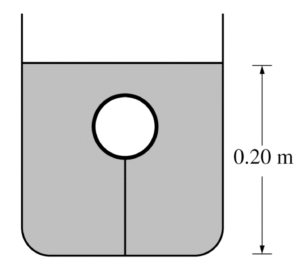
A beaker weighing \( 2.0 \) \( \text{N} \) is filled with \( 5.0 \times 10^{-3} \) \( \text{m}^3 \) of water. A rubber ball weighing \( 3.0 \) \( \text{N} \) is held entirely underwater by a massless string attached to the bottom of the beaker, as represented in the figure above. The tension in the string is \( 4.0 \) \( \text{N} \). The water fills the beaker to a depth of \( 0.20 \) \( \text{m} \). Water has a density of \( 1000 \) \( \text{kg/m}^3 \). The effects of atmospheric pressure may be neglected.
A cube of side length \( s \) rests on the bottom surface of a container of fluid. The fluid is at a height \( y \) above the bottom of the tank. The fluid has density \( \rho \) and the atmospheric pressure is \( P_{\text{atm}} \).
Which of the following expressions is equal to the absolute pressure exerted by the fluid on the top surface of the cube?
A car travels east at a steady \( 30 \) \( \text{m/s} \) for \( 5 \) \( \text{s} \). What is its acceleration during this motion?

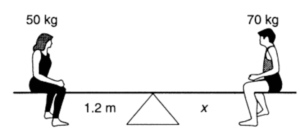
A \( 50 \, \text{kg} \) person is sitting on a seesaw \( 1.2 \, \text{m} \) from the balance point. On the other side, a \( 70 \, \text{kg} \) person is balanced. How far from the balance point is the second person sitting?
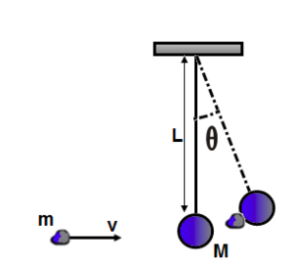
A \(20 \, \text{g}\) piece of clay moving at a speed of \(50 \, \text{m/s}\) strikes a \(500 \, \text{g}\) pendulum bob at rest. The length of a string is \(0.8 \, \text{m}\). After the collision, the clay-bob system starts to oscillate as a simple pendulum.
A baseball, mass \(0.5 \, \text{kg}\), is traveling to the right at \(32.2 \, \text{m/s}\) when it is hit by a bat and travels the opposite direction at \(72.2 \, \text{m/s}\). The bat hits the ball with a force of \(1,222 \, \text{N}\). What is the ball’s change in momentum and how long was the ball in contact with the bat?
A train is moving to the right at \( 20 \) \( \text{m/s} \). A passenger on the train throws a ball horizontally to the left at \( 5 \) \( \text{m/s} \) (relative to the train).
A \(100 \, \text{kg}\) person is riding a \(10 \, \text{kg}\) bicycle up a \(25^\circ\) hill. The hill is long and the coefficient of static friction is \(0.9\). The person rides \(10 \, \text{m}\) up the hill then takes a rest at the top. If she then starts from rest from the top of the hill and rolls down a distance of \(7 \, \text{m}\) before squeezing hard on the brakes locking the wheels, how much work is done by friction to bring the bicycle to a full stop, knowing that the coefficient of kinetic friction is \(0.65\)?
How does the time t1 of a block m reaching the bottom of slide 1 compare with t2, the time taken block of mass 2m to reach the end of slide 2 that’s curved? The blocks are released from the same height.
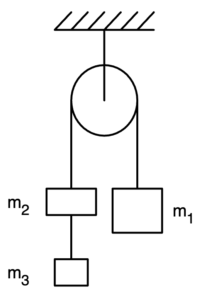
Three blocks of masses \(m_3 = 1.0 \, \text{kg}\), \(m_2 = 2.0 \, \text{kg}\), and \(m_1 = 4.0 \, \text{kg}\) are connected by massless strings, one of which passes over a frictionless pulley of negligible mass, as shown above.
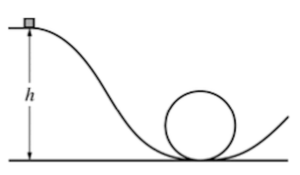
A small block slides without friction along a track toward a circular loop. The block has more than enough speed to remain firmly in contact with the track as it goes around the loop. The magnitude of the block’s acceleration at the top of the loop is
An airliner arrives at the terminal, and the engines are shut off. The rotor of one of the engines has an initial clockwise angular velocity of \( 2000 \) \( \text{rad/s} \). The engine’s rotation slows with an angular acceleration of magnitude \( 80.0 \) \( \text{rad/s}^2 \).
A rubber ball and a piece of clay have equal masses. They are dropped from the same height on horizontal steel platform. The ball bounces back with nearly the same speed with which it hit. The clay sticks to the platform. Choose all that is true about the ball/platform and the clay/platform systems.

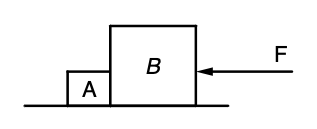
In the diagram shown, a \(20 \, \text{N}\) force is applied to block \(B\) (\(7 \, \text{kg}\)). Block \(A\) has a mass of \(3 \, \text{kg}\). Assume frictionless conditions.
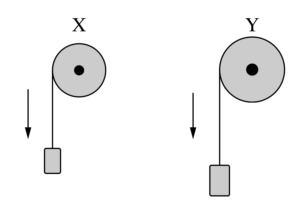
Pulleys \( X \) and \( Y \) are each attached to a block by a string that wraps around the pulley. Both blocks are released and have the same linear acceleration \( a \). As the blocks fall, the pulleys rotate about their centers. Pulley \( Y \) has a larger radius than Pulley \( X \). How does the angular acceleration \( \alpha_X \) of Pulley \( X \) compare to the angular acceleration \( \alpha_Y \) of Pulley \( Y \)?
Which pulls harder gravitationally, the Earth on the Moon, or the Moon on the Earth? Which accelerates more?

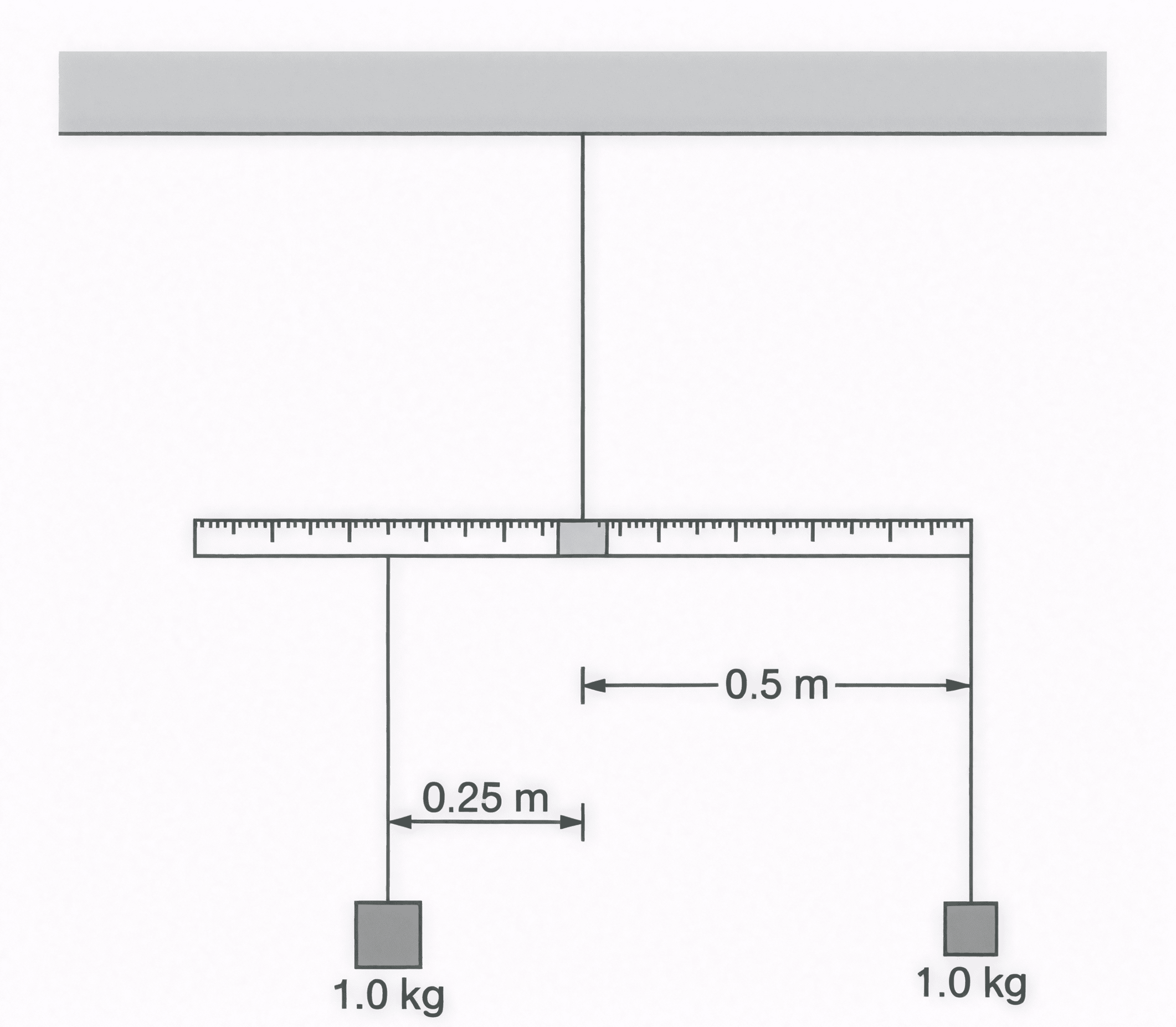
A meterstick is supported at its center, which is aligned with the center of a cradle located at position \( x = 0 \) \( \text{m} \). Two identical objects of mass \( 1.0 \) \( \text{kg} \) are suspended from the meterstick. One object hangs \( 0.25 \) \( \text{m} \) to the left of the support point, and the other object hangs \( 0.50 \) \( \text{m} \) to the right of the support point. The system is released from rest and is free to rotate. Which of the following claims correctly describes the subsequent motion of the system containing the meterstick, cradle, and the two objects?
By continuing you (1) agree to our Terms of Use and Terms of Sale and (2) consent to sharing your IP and browser information used by this site’s security protocols as outlined in our Privacy Policy.
One price to unlock most advanced version of Phy across all our tools.
per month
Billed Monthly. Cancel Anytime.
Quick Start Guide
AP physics 1, AP C, honors and advanced physics students.
Quickly filter questions by units and more.
Here’s guide to using 5 UBQ filters.
GQ = general question, MCQ = multiple choice, FRQ = free response.
Click the check or bookmark button.
Now you’ll be able to see completed or bookmarked questions at a glance!
Answer keys, personalized for you.
Phy will be responsible for grading your FRQs and GQs.
No more copy and pasting. Just solve and snap.
Questions for Mastery
By continuing you agree to nerd-notes.com Terms of Service, Privacy Policy, and our usage of user data.