NewTry UBQ Quiz Lab. 40+ custom built quizzes to get a 5 on AP Physics 1.
for free to use all UBQ features

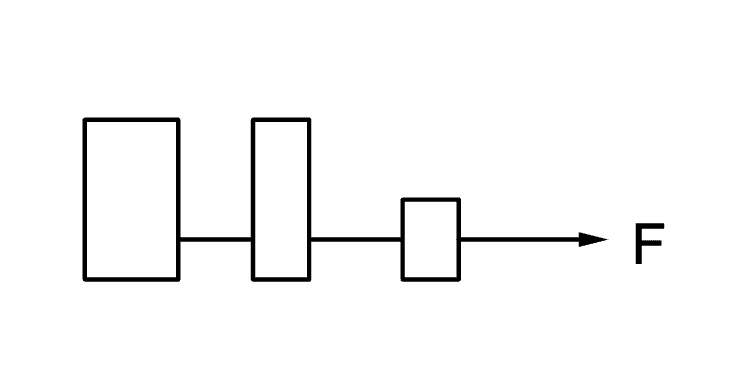
Shown above are three masses of \(6 \, \text{kg}\), \(3 \, \text{kg}\), and \(1 \, \text{kg}\) (in order from left to right). You pull on the 1kg mass with a force \(F\) of \(15 \, \text{N}\) along a frictionless surface.
A new car is tested on a \(230 \, \text{m}\)-diameter track. If the car speeds up at a steady \(1.4 \, \text{m/s}^2\), how long after starting is the magnitude of its centripetal acceleration equal to the tangential acceleration?
A centrifuge in a medical laboratory is rotating at an angular speed of \( 3600 \) \( \text{rev/min} \). When switched off, it rotates \( 50.0 \) times before coming to rest. Find the constant angular deceleration of the centrifuge.
An object in simple harmonic motion obeys the following position versus time equation: \( y = (0.50 \text{ m}) \sin \left( \frac{\pi}{2} t \right) \). What is the amplitude of vibration?

A \( 0.20 \) \( \text{kg} \) object moves along a straight line. The net force acting on the object varies with the object’s displacement as shown in the graph above. The object starts from rest at displacement \( x = 0 \) and time \( t = 0 \) and is displaced a distance of \( 20 \) \( \text{m} \). Determine each of the following.
An object’s angular momentum changes by \( 10 \,\text{kg} \cdot \text{m}^2/\text{s} \) in \( 2.0 \) \( \text{s} \). What magnitude average torque acted on this object?
A constant force of 8.0 N is exerted on a 16 kg object initially at rest. How much speed will the object gain after 4 seconds?
Suppose you are a passenger traveling in car along a road that bends to the left. Why will you feel like you are being thrown against the door. What causes this force?
Can an object’s average velocity equal zero when object’s speed is greater than zero? Explain using the formula for average velocity vs speed.
Wanda watches the fish in her fish tank and notices that the angelfish like to feed at the water’s surface, while the catfish feed \( 0.300 \) \( \text{m} \) below at the bottom of the tank. If the average density of the water in the tank is \( 1000\) \( \text{kg/m}^3 \), what is the absolute pressure on the catfish?
A driver is traveling at a speed of \( 18.0 \) \( \text{m/s} \) when she sees a red light ahead. Her car is capable of decelerating at a rate of \( 3.65 \) \( \text{m/s}^2 \). If it takes her \( 0.350 \) \( \text{s} \) to get the brakes on and she is \( 20.0 \) \( \text{m} \) from the intersection when she sees the light, will she be able to stop in time? How far from the beginning of the intersection will she be, and in what direction?
An object at rest suddenly explodes into two fragments (\(m_1\) and \(m_2\)) by an explosion. Fragment \(m_1\) acquires \(3\) times the kinetic energy of the other. What is the ratio of \(m_1\) to \(m_2\)?
An object undergoes constant acceleration. Starting from rest, the object travels \( 5 \, \text{m} \) in the first second. Then it travels \( 15 \, \text{m} \) in the next second. What total distance will be covered after the 3rd second?
A \( 25.0 \) \( \text{kg} \) block is placed at the top of an inclined plane set at an angle of \( 35 \) degrees to the horizontal. The block slides down the \( 1.5 \) \( \text{m} \) slope at a constant rate. How much work did friction do on the block?
Two masses, \( m_1 \) and \( m_2 \), are suspended on either side of a pulley with a radius \( R \), as shown. The heavier mass, \( m_2 \), is initially held at rest above the ground by a distance \( h \) before being released. An student measures that it takes an amount of time \( t \) for the heavier mass to hit the ground after being released.
Water balloons are tossed from the roof of a building, all with the same speed but with different launch angles. Which one has the highest speed when it hits the ground? Ignore air resistance. Without using equations, explain your answer.
Two satellites are in circular orbits around Earth. Satellite A has speed \(v_A\). Satellite B has an orbital radius nine times that of satellite A. What is the speed of satellite B?
A \( 240 \) \( \text{kg} \) block is dropped from \( 3.0 \) meters onto a spring, compresses the spring and comes to rest.
Seo-Jun throws a ball to her friend Zuri. The ball leaves Seo-Jun’s hand from a height \( h = 1.5 \) \( \text{m} \) above the ground with an initial speed \( \vec{v}_{s,0} = 12 \) \( \text{m/s} \) at an angle of \( \theta = 25^\circ \) with respect to the horizontal. Zuri catches the ball at a height of \( h = 1.5 \) \( \text{m} \) above the ground.
After catching the ball, Zuri throws it back to Seo-Jun. The ball leaves Zuri’s hand from a height \( h = 1.5 \) \( \text{m} \) above the ground. The ball is moving with a speed of \( 15 \) \( \text{m/s} \) when it reaches a maximum height of \( 5.8 \) \( \text{m} \) above the ground.
At what height \( h’ \) above the ground will the ball be when the return throw reaches Seo-Jun?
Which graph below shows that one of the runners started 10 meters further ahead of the other? Assume the y-axis is measured in meters and the x-axis is measured in seconds.
Two objects are attracted to each other by a gravitational force \( F \). If each mass is tripled, so that each becomes \( 3 \) times its original value, and the distance between the objects is cut in half to \( \dfrac{1}{2} \) of its original separation, what is the new gravitational force between the objects in terms of \( F \)?
Two thin coins are made from identically the same metal, but one coin has triple the diameter of the other. What is the ratio of the moment of inertia of the large coin compared to the small coin? Take the axis of rotation to be perpendicular to the coin and through its center; assume that the coins have the same thickness. Hint: The moment of inertia of a solid disk about its center is \(\frac{1}{2} M R^{2}\).
A sample of an unknown material appears to weigh \( 285 \) \( \text{N} \) in air and \( 195 \) \( \text{N} \) when immersed in alcohol of specific gravity \( 0.700 \).
A projectile is launched at a speed of \( 22 \) \( \text{m/s} \) at an angle of \( 60^{\circ} \) above the horizontal. It lands on a ramp that is \( 5 \) \( \text{m} \) lower than the launch height. How long does it take for the projectile to hit the ramp?
By continuing you (1) agree to our Terms of Use and Terms of Sale and (2) consent to sharing your IP and browser information used by this site’s security protocols as outlined in our Privacy Policy.
One price to unlock most advanced version of Phy across all our tools.
per month
Billed Monthly. Cancel Anytime.
Quick Start Guide
AP physics 1, AP C, honors and advanced physics students.
Quickly filter questions by units and more.
Here’s guide to using 5 UBQ filters.
GQ = general question, MCQ = multiple choice, FRQ = free response.
Click the check or bookmark button.
Now you’ll be able to see completed or bookmarked questions at a glance!
Answer keys, personalized for you.
Phy will be responsible for grading your FRQs and GQs.
No more copy and pasting. Just solve and snap.
Questions for Mastery
By continuing you agree to nerd-notes.com Terms of Service, Privacy Policy, and our usage of user data.