NewTry UBQ Quiz Lab. 40+ custom built quizzes to get a 5 on AP Physics 1.
for free to use all UBQ features

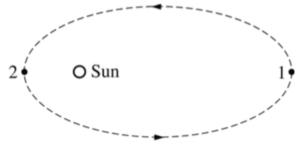
The elliptical orbit of a comet is shown above. Positions 1 and 2 are, respectively, the farthest and nearest positions to the Sun, and at position 1 the distance from the comet to the Sun is 10 times that at position 2. At position 2, the comet’s kinetic energy is
A rubber ball bounces on the ground. After each bounce, the ball reaches one-half the height of the bounce before it. If the time the ball was in the air between the first and second bounce was 1 second. What would be the time between the second and third bounce?
In which of the following cases does a car have a negative velocity and a positive acceleration? A car that is traveling in the:

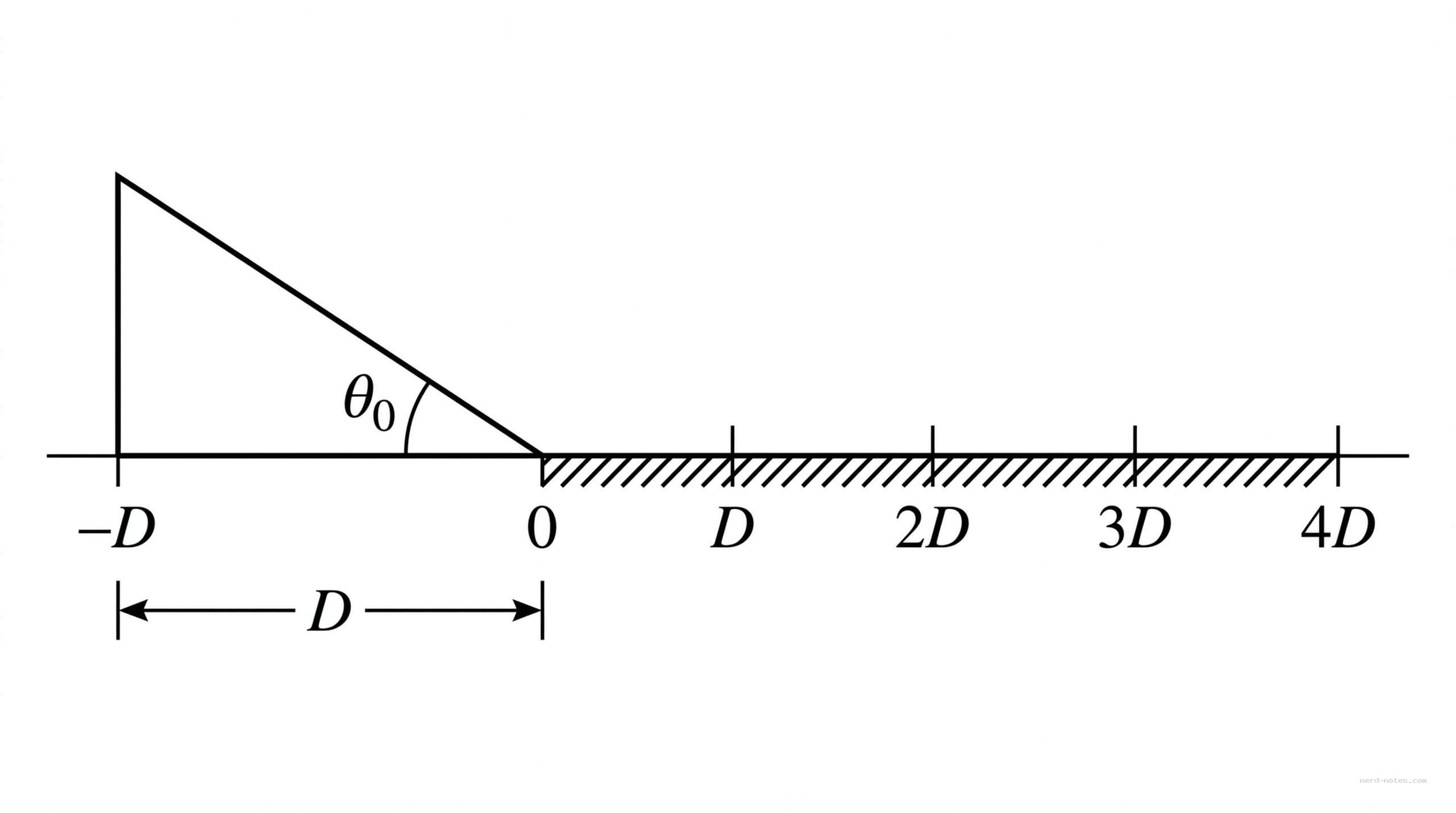
A block is initially at rest on top of an inclined ramp that makes an angle \( \theta_0 \) with the horizontal. The distance measured along the base of the ramp is \( D \). After the block is released from rest, it slides down the frictionless ramp and then continues onto a rough horizontal surface until it finally comes to rest at the position \( x = 4D \) measured from the base of the ramp. The coefficient of kinetic friction between the block and the rough horizontal surface is \( \mu_k \).
Two masses, \( m_1 \) and \( m_2 \), are suspended on either side of a pulley with a radius \( R \), as shown. The heavier mass, \( m_2 \), is initially held at rest above the ground by a distance \( h \) before being released. An student measures that it takes an amount of time \( t \) for the heavier mass to hit the ground after being released.
A disk of radius 35 cm rotates at a constant angular velocity of 10 rad/s. How fast does a point on the rim of the disk travel (in m/s)?
In a carbonated drink dispenser, bubbles flow through a horizontal tube that gradually narrows in diameter. Assuming the change in height is negligible, which of the following best describes how the bubbles behave as they move from the wider section of the tube to the narrower section?
A block hangs from the ceiling by a massless rope. A \( 3.0 \, \text{kg} \) block is attached to the first block and hangs below it on another piece of massless rope. The tension in the top rope is \( 63.0 \, \text{N} \).
A car is driving at \(25 \, \text{m/s}\) when a light turns red \(100 \, \text{m}\) ahead. The driver takes an unknown amount of time to react and hit the brakes, but manages to skid to a stop at the red light. If \(\mu_s = 0.9\) and \(\mu_k = 0.65\), what was the reaction time of the driver?
A ranger in a national park is driving at \( 56 \, \text{km/h} \) when a deer jumps onto the road \( 65 \, \text{m} \) ahead of the vehicle. After a reaction time of \( t \, \text{s} \), the ranger applies the brakes to produce an acceleration of \( -3 \, \text{m/s}^2 \). What is the maximum reaction time allowed if the ranger is to avoid hitting the deer?
A centrifuge in a medical laboratory is rotating at an angular speed of \( 3600 \) \( \text{rev/min} \). When switched off, it rotates \( 50.0 \) times before coming to rest. Find the constant angular deceleration of the centrifuge.
A ball is thrown straight up. What are the velocity and acceleration of the ball at the highest point in its path?
An airplane accelerates down a runway at \( 10 \, \text{m/s}^2 \). It reaches a final velocity of \( 200 \, \text{m/s} \) until it finally lifts off the ground. Determine the distance traveled before takeoff.

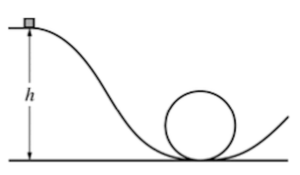
A small block slides without friction along a track toward a circular loop. The block has more than enough speed to remain firmly in contact with the track as it goes around the loop. The magnitude of the block’s acceleration at the top of the loop is
A 150-kg merry-go-round in the shape of a uniform, solid, horizontal disk of radius 1.50 m is set in motion by wrapping a rope about the rim of the disk and pulling on the rope.
What constant force must be exerted on the rope to bring the merry-go-round from rest to an angular speed of 0.500 rev/s in 2.00 s?
Note: \( I_\text{disk} = \frac{1}{2}mr^2 \)
Johnny the auto mechanic is raising a \( 1200 \) \( \text{kg} \) car on her hydraulic lift so that she can work underneath. If the area of the input piston is \( 12 \) \( \text{cm}^2 \), while the output piston has an area of \( 700 \) \( \text{cm}^2 \), what force must be exerted on the input piston to lift the car?
A ball of mass \( m \) is fastened to a string. The ball swings at constant speed in a vertical circle of radius \( R \) with the other end of the string held fixed. Neglecting air resistance, what is the difference between the string’s tension at the bottom of the circle and at the top of the circle?
What is the effect on the period of a pendulum if you double its length?
A horizontal spring with spring constant 162 N/m is compressed 50 cm and used to launch a 3 kg box across a frictionless, horizontal surface. After the box travels some distance, the surface becomes rough. The coefficient of kinetic friction of the box on the rough surface is 0.2. Find the total distance the box travels before stopping.
A student designs an experiment to determine the density of an unknown fluid. The student pours the fluid into a graduated cylinder and attaches an object to a force probe. The object has a density greater than the density of the fluid. The student partially submerges the object into the fluid and records both the volume of fluid displaced in the graduated cylinder and the reading on the force probe. The student then submerges the object further and, at each trial, records the new values of displaced volume and force probe reading until the object is fully submerged. The student constructs a graph of force probe reading (vertical axis) as a function of volume of fluid displaced (horizontal axis). Which of the following statements correctly describes how a feature of this graph is related to the density of the fluid?
A \( 1.0 \)\( \text{-kg} \) object is moving with a velocity of \( 6.0 \) \( \text{m/s} \) to the right. It collides and sticks to a \( 2.0 \)\( \text{-kg} \) object moving with a velocity of \( 3.0 \) \( \text{m/s} \) in the same direction. How much kinetic energy was lost in the collision?
A block of mass \( m \) is attached to a horizontal spring with spring constant \( k \) and undergoes simple harmonic motion with amplitude \( A \) along the \( x \)-axis. Which of the following equations could represent the position \( x \) of the object as a function of time?
A \( 50 \) \( \text{g} \) ice cube can slide up and down a frictionless \( 30^{\circ}\) slope. At the bottom, a spring with spring constant \( 25 \) \( \text{N/m} \) is compressed \( 10 \) \( \text{cm} \) and is used to launch the ice cube up the slope. How high does it go above its starting point? Express your answer with the appropriate units.
A projectile is launched at an upward angle of \( 30^\circ \) to the horizontal with a speed of \( 30 \) \( \text{m/s} \). How does the horizontal component of its velocity \( 1.0 \) \( \text{s} \) after launch compare with its horizontal component of velocity \( 2.0 \) \( \text{s} \) after launch, ignoring air resistance?
By continuing you (1) agree to our Terms of Use and Terms of Sale and (2) consent to sharing your IP and browser information used by this site’s security protocols as outlined in our Privacy Policy.
One price to unlock most advanced version of Phy across all our tools.
per month
Billed Monthly. Cancel Anytime.
Quick Start Guide
AP physics 1, AP C, honors and advanced physics students.
Quickly filter questions by units and more.
Here’s guide to using 5 UBQ filters.
GQ = general question, MCQ = multiple choice, FRQ = free response.
Click the check or bookmark button.
Now you’ll be able to see completed or bookmarked questions at a glance!
Answer keys, personalized for you.
Phy will be responsible for grading your FRQs and GQs.
No more copy and pasting. Just solve and snap.
Questions for Mastery
By continuing you agree to nerd-notes.com Terms of Service, Privacy Policy, and our usage of user data.