NewTry UBQ Quiz Lab. 40+ custom built quizzes to get a 5 on AP Physics 1.
for free to use all UBQ features

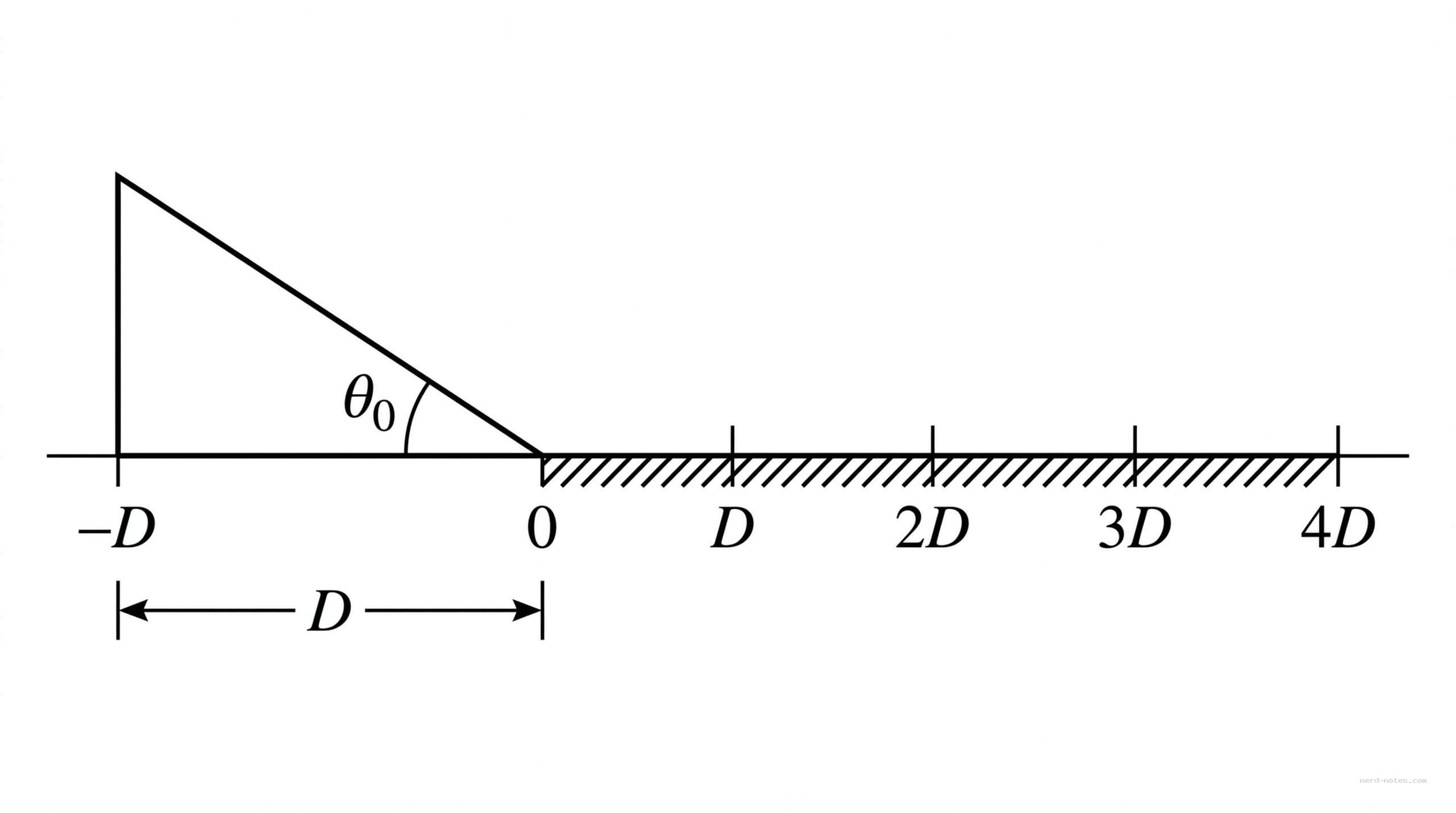
A block is initially at rest on top of an inclined ramp that makes an angle \( \theta_0 \) with the horizontal. The distance measured along the base of the ramp is \( D \). After the block is released from rest, it slides down the frictionless ramp and then continues onto a rough horizontal surface until it finally comes to rest at the position \( x = 4D \) measured from the base of the ramp. The coefficient of kinetic friction between the block and the rough horizontal surface is \( \mu_k \).
You try to open a door, but you are unable to push at a right angle to the door. So, you push the door at an angle of \( 35^{\circ} \) from the horizontal. How much harder would you have to push to open the door just as fast as if you were to push it at \( 90^{\circ} \)?
An airliner arrives at the terminal, and the engines are shut off. The rotor of one of the engines has an initial clockwise angular velocity of \( 2000 \) \( \text{rad/s} \). The engine’s rotation slows with an angular acceleration of magnitude \( 80.0 \) \( \text{rad/s}^2 \).
Which pair of quantities will always have the same magnitude if motion is in a straight line and in one direction?
A \(25 \, \text{g}\) steel ball is attached to the top of a \(24 \, \text{cm}\)-diameter vertical wheel of negligible mass. Starting from rest, the wheel accelerates at \(470 \, \text{rad/s}^2\). The ball is released after \(\frac{3}{4}\) of a revolution. How high does it go above the center of the wheel?
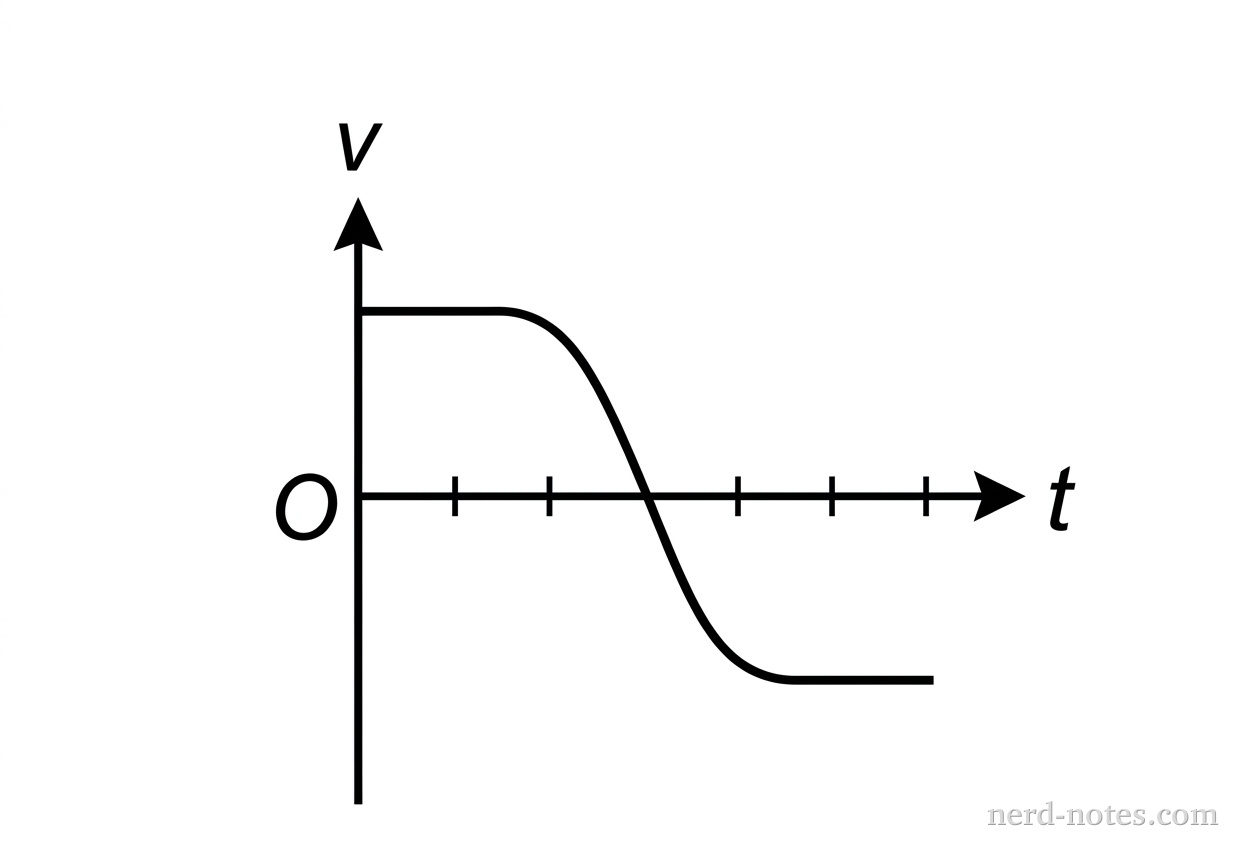
A skater glides across the ice at a constant \( 6 \) \( \text{m/s} \). After \( 4 \) \( \text{s} \), friction gradually slows them down until they come to rest in \( 6 \) \( \text{s} \). They pause for \( 2 \) \( \text{s} \), then push off in the opposite direction, steadily gaining speed for \( 5 \) \( \text{s} \). Draw the velocity vs. time graph.
A body moving in the positive \( x \) direction passes the origin at time \( t = 0 \). Between \( t = 0 \) and \( t = 1 \, \text{second} \), the body has a constant speed of \( 24 \, \text{m/s} \). At \( t = 1 \, \text{second} \), the body is given a constant acceleration of \( 6 \, \text{m/s}^2 \) in the negative \( x \) direction. The position \( x \) of the body at \( t = 11 \, \text{seconds} \) is
A car starts from rest and accelerates uniformly over a time of 5 seconds for a distance of 100 m. Determine the acceleration of the car.
A meter stick of mass \( .2 \) kg is pivoted at one end and supported horizontally. A force of \( 3 \) N downwards is applied to the free end, perpendicular to the length of the meter stick. What is the net torque about the pivot point?

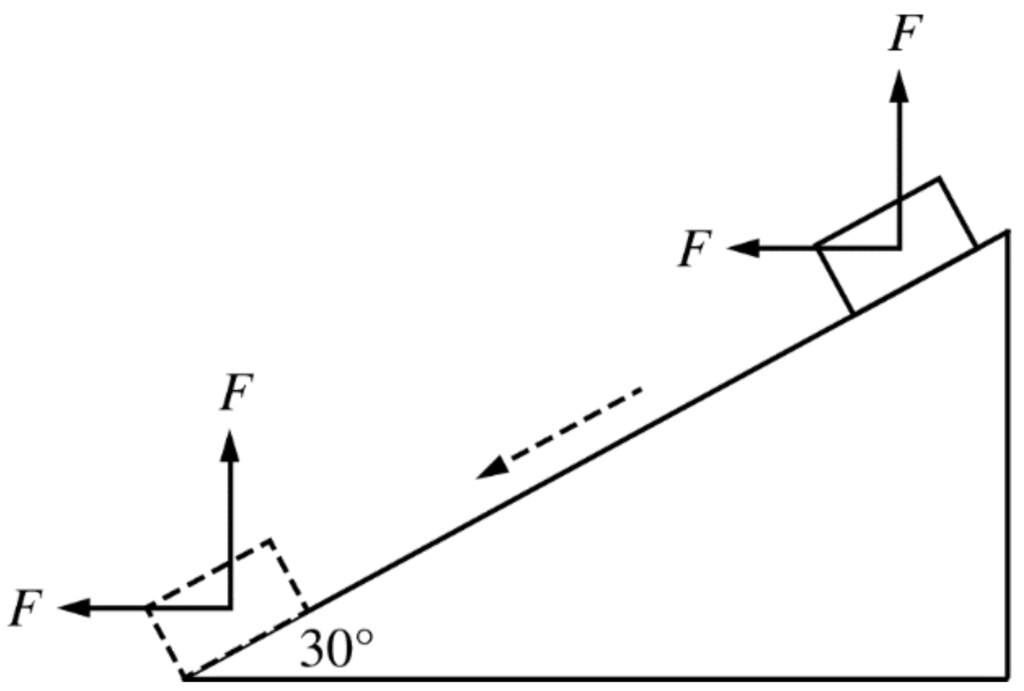
A block is released from rest and slides down a frictionless ramp inclined at \( 30^\circ \) from the horizontal. When the block reaches the bottom, the block-Earth system has mechanical energy \( \text{E}_i \). The experiment is repeated, but now horizontal and vertical forces of magnitude \( F \) are exerted on the block while it slides, as shown above. When the block reaches the bottom, the mechanical energy of the block-Earth system.
A cart with a mass of \( 20 \) \( \text{kg} \) is pressed against a wall by a horizontal spring with spring constant \( k = 244 \) \( \text{N/m} \) placed between the cart and the wall. The spring is compressed by \( 0.1 \) \( \text{m} \). While the spring is compressed, an additional constant horizontal force of \( 20 \) \( \text{N} \) continues to push the cart toward the wall. What is the resulting acceleration of the cart?
A baseball is thrown vertically into the air with a velocity \( v \), and reaches a maximum height \( h \). At what height was the baseball moving with one-half its original velocity? Assume air resistance is negligible.
A student presses a \( 0.5 \) \( \text{kg} \) book against the wall. If the \( \mu_s \) between the book and the wall is \( 0.2 \), what force must the student apply to hold the book in place?
An ice skater performs a pirouette (a fast spin) by pulling in his outstretched arms close to his body. What happens to his angular momentum about the axis of rotation?
A \(1100 \, \text{kg}\) car accelerates from \(32 \, \text{m/s}\) to \(8.0 \, \text{m/s}\) in \(4.0 \, \text{s}\). What amount of force was needed to slow it down?
At time \( t = 0 \) an object is traveling to the right along the \( +x \) axis at a speed of \( 10.0 \) \( \text{m/s} \) with acceleration \( -2.0 \) \( \text{m/s}^2 \). Which statement is true?

The graph above shows velocity \( v \) versus time \( t \) for an object in linear motion. Which of the following is a possible graph of position (\( x \)) versus time (\( t \)) for this object?

A wheel 31 cm in diameter accelerates uniformly from 240rpm to 360rpm in 6.8 s. How far will a point on the edge of the wheel have traveled in this time?
Divers in Acapulco jump from a cliff that is \( 36 \, \text{m} \) above the water with an initial vertical velocity of \( 2 \, \text{m/s} \).

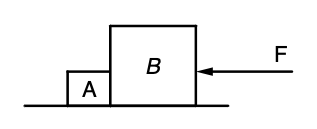
In the diagram shown, a \(20 \, \text{N}\) force is applied to block \(B\) (\(7 \, \text{kg}\)). Block \(A\) has a mass of \(3 \, \text{kg}\). Assume frictionless conditions.
A uniform ladder of length \(L\) and weight \(W = 50 \, \text{N}\) rests against a smooth vertical wall. If the coefficient of static friction between the ladder and the ground is \(\mu = 0.4\).
A circus cannon fires an acrobat into the air at an angle of \( 45^\circ \) above the horizontal, and the acrobat reaches a maximum height \( y \) above her original launch height. The cannon is now aimed so that it fires straight up, at an identical speed, into the air at an angle of \( 90^\circ \) to the horizontal. In terms of \( y \), what is the acrobat’s new maximum height?
An \( 80 \, \text{kg} \) block is placed \( 2 \, \text{m} \) away from the endpoint of a horizontal steel beam of length \( 6.6 \, \text{m} \) and mass \( 1,450 \, \text{kg} \). The plank makes contact with a vertical wall on one end (assume it does not slip). The other end of the beam is attached to a massless cable that makes an angle of \( 30^\circ \) with the horizontal and ties into the vertical wall as well. Calculate the (1) tension force in the cable and (2) the total force the wall exerts on the beam.
By continuing you (1) agree to our Terms of Use and Terms of Sale and (2) consent to sharing your IP and browser information used by this site’s security protocols as outlined in our Privacy Policy.
One price to unlock most advanced version of Phy across all our tools.
per month
Billed Monthly. Cancel Anytime.
Quick Start Guide
AP physics 1, AP C, honors and advanced physics students.
Quickly filter questions by units and more.
Here’s guide to using 5 UBQ filters.
GQ = general question, MCQ = multiple choice, FRQ = free response.
Click the check or bookmark button.
Now you’ll be able to see completed or bookmarked questions at a glance!
Answer keys, personalized for you.
Phy will be responsible for grading your FRQs and GQs.
No more copy and pasting. Just solve and snap.
Questions for Mastery
By continuing you agree to nerd-notes.com Terms of Service, Privacy Policy, and our usage of user data.