More Subjects, Faster Loading, Better Search, and So Much More
NewTry UBQ Quiz Lab. 40+ custom built quizzes to get a 5 on AP Physics 1.
for free to use all UBQ features
A rocket is sent to shoot down an invading spacecraft that is hovering at an altitude of \( 1500 \, \text{m} \). The rocket is launched with an initial velocity of \( 180 \, \text{m/s} \). Find the following:
Four systems are in rotational motion. Which of the following combinations of rotational inertia and angular speed for each of the systems corresponds to the greatest rotational kinetic energy?
| System | Rotational Inertia | Angular Speed |
|---|---|---|
| A | \( I_0 \) | \( \omega_0 \) |
| B | \( I_0 \) | \( 4\, \omega_0 \) |
| C | \( 2 I_0 \) | \( 2\, \omega_0 \) |
| D | \( 6 I_0 \) | \( \omega_0 \) |
A U-tube open to the atmosphere at both ends is partially filled with water of density \( \rho_w \). Oil of density \( \rho_o \) (where \( \rho_o < \rho_w \)) is poured into the left arm until it forms a column of height \( L \). The interface between the oil and water in the left arm is found to be a vertical distance \( d \) below the water surface in the right arm. Which of the following expressions correctly represents the density of the oil?
What force would have to be applied to start a \(12.3 \, \text{kg}\) wood block moving on a surface with a static coefficient of friction of \(0.438\)?
The launching mechanism of a toy gun consists of a spring with an unknown spring constant, \( k \). When the spring is compressed \( 0.120 \, \text{m} \) vertically, a \( 35.0 \, \text{g} \) projectile is able to be fired to a maximum height of \( 25 \, \text{m} \) above the position of the projectile when the spring is compressed. Assume that the barrel of the gun is frictionless.

In which of the following is the rate of change of the particle’s momentum zero?
The speed of a \(40 \, \text{N}\) hockey puck, sliding across a level ice surface, decreases at the rate of \(0.61 \, \text{m/s}^2\). The coefficient of kinetic friction between the puck and ice is
Which of the following best describes the implication of an ideal fluid being ‘incompressible’?

A uniform, rigid rod of length \( 2 \) \( \text{m} \) lies on a horizontal surface. One end of the rod can pivot about an axis that is perpendicular to the rod and along the plane of the page. A \( 10 \) \( \text{N} \) force is applied to the rod at its midpoint at an angle of \( 37^{\circ} \). A second force \( F \) is applied to the free end of the rod so that the rod remains at rest, as shown in the figure. The magnitude of the torque produced by force \( F \) is most nearly
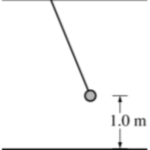
A 0.5 kg pendulum bob is raised to 1.0 m above the floor, as shown in the figure. The bob is then released from rest. When the bob is 0.8 m above the floor, its speed is most nearly
Which car controls directly allow the driver to cause acceleration?
An object undergoes constant acceleration. Starting from rest, the object travels \( 5 \, \text{m} \) in the first second. Then it travels \( 15 \, \text{m} \) in the next second. What total distance will be covered after the 3rd second?
In 2014, the European Space Agency placed a satellite in orbit around comet 67P/Churyumov-Gerasimenko and then landed a probe on the surface. The actual orbit was elliptical, but we can approximate it as a 50 km diameter circular orbit with a period of 11 days.
A driver has a reaction time of \( 0.50 \) \( \text{s} \), and the maximum deceleration of her car is \( 6.0 \) \( \text{m/s}^2 \). She is driving at \( 20 \) \( \text{m/s} \) when suddenly she sees an obstacle in the road \( 50 \) \( \text{m} \) in front of her. Can she stop the car to avoid the collision?
Find the escape speed from a planet of mass \(6.89 \times 10^{25} \, \text{kg}\) and radius \(6.2 \times 10^{6} \, \text{m}\).

A \(20 \, \text{g}\) piece of clay moving at a speed of \(50 \, \text{m/s}\) strikes a \(500 \, \text{g}\) pendulum bob at rest. The length of a string is \(0.8 \, \text{m}\). After the collision, the clay-bob system starts to oscillate as a simple pendulum.
The cart with mass \( M = 3 \, \text{kg} \) is pulled by a massless string and moving on a horizontal track. A weight with mass \( m = 1 \, \text{kg} \) is hung from the other end of the string through a pulley system. Due to the gravitational force acting on the weight of mass \( m \), the cart is accelerated to the left. Find the tension in the string.
Which launch angle gives the greatest horizontal range, assuming level ground and no air resistance?
A horizontal spring with spring constant 162 N/m is compressed 50 cm and used to launch a 3 kg box across a frictionless, horizontal surface. After the box travels some distance, the surface becomes rough. The coefficient of kinetic friction of the box on the rough surface is 0.2. Find the total distance the box travels before stopping.
Robin Hood, whose mass is \( 78.6 \) \( \text{kg} \), is holding a \( 6.28 \) \( \text{m} \) long rope that has been pulled back \( 42.35^{\circ} \) from the vertical. He will swing like a pendulum until reaching the lowest point of the arc, at which point he grabs a hanging bag of coins of mass \( 12.3 \) \( \text{kg} \). Immediately upon grabbing the coins, he releases the rope and continues forward as a projectile toward a lake surface below. The release point of the rope is \( 9.72 \) \( \text{m} \) above the water level. The local gravitational field strength is \( 6.90 \) \( \text{m/s}^2 \).
You kick a soccer ball with an initial velocity directed 53° above the horizontal. The ball lands on a roof 7.2 m high. The wall of the building is 25 m away, and it takes the ball 2.1 seconds to pass directly over the wall.
A circus cannon fires an acrobat into the air at an angle of \( 45^\circ \) above the horizontal, and the acrobat reaches a maximum height \( y \) above her original launch height. The cannon is now aimed so that it fires straight up, at an identical speed, into the air at an angle of \( 90^\circ \) to the horizontal. In terms of \( y \), what is the acrobat’s new maximum height?
Two identical metal balls are being held side by side at the top of a ramp. Alex lets one ball, \( A \), start rolling down the hill. A few seconds later, Alex’s partner, Bob, starts the second ball, \( B \), down the hill by giving it a push. Ball \( B \) rolls down an identical, parallel path to the first ball and passes it. At the instant ball \( B \) passes ball \( A \) (select all that apply):
Which of the following pairs of properties correctly describes an ideal fluid as defined in the AP Physics 1 curriculum?
By continuing you (1) agree to our Terms of Use and Terms of Sale and (2) consent to sharing your IP and browser information used by this site’s security protocols as outlined in our Privacy Policy.
One price to unlock most advanced version of Phy across all our tools.
per month
Billed Monthly. Cancel Anytime.
Quick Start Guide
AP physics 1, AP C, honors and advanced physics students.
Quickly filter questions by units and more.
Here’s guide to using 5 UBQ filters.
GQ = general question, MCQ = multiple choice, FRQ = free response.
Click the check or bookmark button.
Now you’ll be able to see completed or bookmarked questions at a glance!
Answer keys, personalized for you.
Phy will be responsible for grading your FRQs and GQs.
No more copy and pasting. Just solve and snap.
Questions for Mastery
By continuing you agree to nerd-notes.com Terms of Service, Privacy Policy, and our usage of user data.