for free to use all UBQ features
A liquid flows at a constant flow rate through a pipe with circular cross-sections of varying diameters. At one point in the pipe, the diameter is \(2\) \(\text{cm}\) and the flow speed is \(18\) \(\text{m/s}\). What is the flow speed at another point in this pipe, where the diameter is \(3\) \(\text{cm}\).
An airliner arrives at the terminal, and the engines are shut off. The rotor of one of the engines has an initial clockwise angular velocity of \( 2000 \) \( \text{rad/s} \). The engine’s rotation slows with an angular acceleration of magnitude \( 80.0 \) \( \text{rad/s}^2 \).

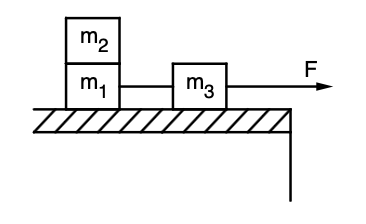
Block \(m_1\) is stacked on top of block \(m_2\). Block \(m_2\) is connected by a light cord to block \(m_3\), which is pulled along a frictionless surface with a force \(F\) as shown in the diagram above. Block \(m_1\) is accelerated at the same rate as block \(m_2\) because of the frictional forces between the two blocks. If all three blocks have the same mass \(m\), what is the minimum coefficient of static friction between block \(m_1\) and block \(m_2\)?
Can an object have a non-zero distance and zero average speed?
A \(2,000 \, \text{kg}\) car collides with a stationary \(1,000 \, \text{kg}\) car. Afterwards, they slide \(6 \, \text{m}\) before coming to a stop. The coefficient of friction between the tires and the road is \(0.7\). Find the initial velocity of the \(2,000 \, \text{kg}\) car before the collision?
A cannon fires projectiles on a flat range at a fixed speed but with variable angle. The maximum range of the cannon is \(L\). What is the range of the cannon when it fires at an angle of \(30^\circ\) above the horizontal? Ignore air resistance.

A helium-filled balloon is attached by a string of negligible mass to a small \(0.015 \ \text{kg}\) object that is just heavy enough to keep the balloon from rising. The total mass of the balloon, including the helium, is \(0.0050 \ \text{kg}\). The density of air is \(\rho_{\text{air}} = 1.29 \ \text{kg/m}^3\), and the density of helium is \(\rho_{\text{He}} = 0.179 \ \text{kg/m}^3\). The buoyant force on the \(0.015 \ \text{kg}\) object is small enough to be negligible.

Which statement is true about the distances the two objects have traveled at time \( t_f \)?
A \(4 \, \text{kg}\) mass is traveling at \(10 \, \text{m/s}\) to the right when it collides inelastically with a stationary \(7 \, \text{kg}\) mass. The \(7 \, \text{kg}\) mass then travels at \(2 \, \text{m/s}\) at an angle of \(22^\circ\) below the horizontal. What are the velocity and the angle of the \(4 \, \text{kg}\) mass?
A blue sphere and a red sphere with the same diameter are released from rest at the top of a ramp. The red sphere takes a longer time to reach the bottom of the ramp. The spheres are then rolled off a horizontal table at the same time with the same speed and fall freely to the floor. Which sphere reaches the floor first?
The launching mechanism of a toy gun consists of a spring with an unknown spring constant, \( k \). When the spring is compressed \( 0.120 \, \text{m} \) vertically, a \( 35.0 \, \text{g} \) projectile is able to be fired to a maximum height of \( 25 \, \text{m} \) above the position of the projectile when the spring is compressed. Assume that the barrel of the gun is frictionless.
A cannon fires a cannonball forward. The recoil of the cannon is backward. Why doesn’t the cannon move backward as fast as the cannonball moves forward?
Why do raindrops fall with constant speed during the later stages of their descent?

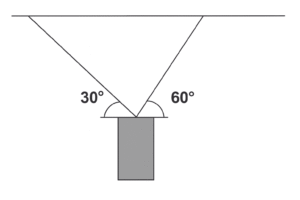
Two wires support an unknown mass as shown in the diagram. The tension in the left wire is measured to be \( 17.5 \) \( \text{N} \) and the tension in the right wire is \( 30.3 \) \( \text{N} \). The left wire makes an angle of \( 30^{\circ} \) with the horizontal, and the right wire makes an angle of \( 60^{\circ} \) with the horizontal. What is the mass of the object?
A communications satellite orbits the Earth at an altitude of \(35{,}000 \, \text{km}\) above the Earth’s surface. Take the mass of Earth to be \(6 \times 10^{24} \, \text{kg}\) and the radius of Earth to be \(6.4 \times 10^6 \, \text{m}\). What is the satellite’s velocity?
A uniform solid cylinder of mass [katex] M [/katex] and radius [katex] R [/katex] is initially at rest on a frictionless horizontal surface. A massless string is attached to the cylinder and is wrapped around it. The string is then pulled with a constant force [katex] F [/katex] , causing the cylinder to rotate about its center of mass. After the cylinder has rotated through an angle [katex] \theta [/katex], what is the kinetic energy of the cylinder in terms of [katex] F [/katex] and [katex] \theta [/katex]?
A ball is attached to the end of a string. It is swung in a vertical circle of radius \( 0.33 \) \( \text{m} \). What is the minimum velocity that the ball must have to make it around the circle?

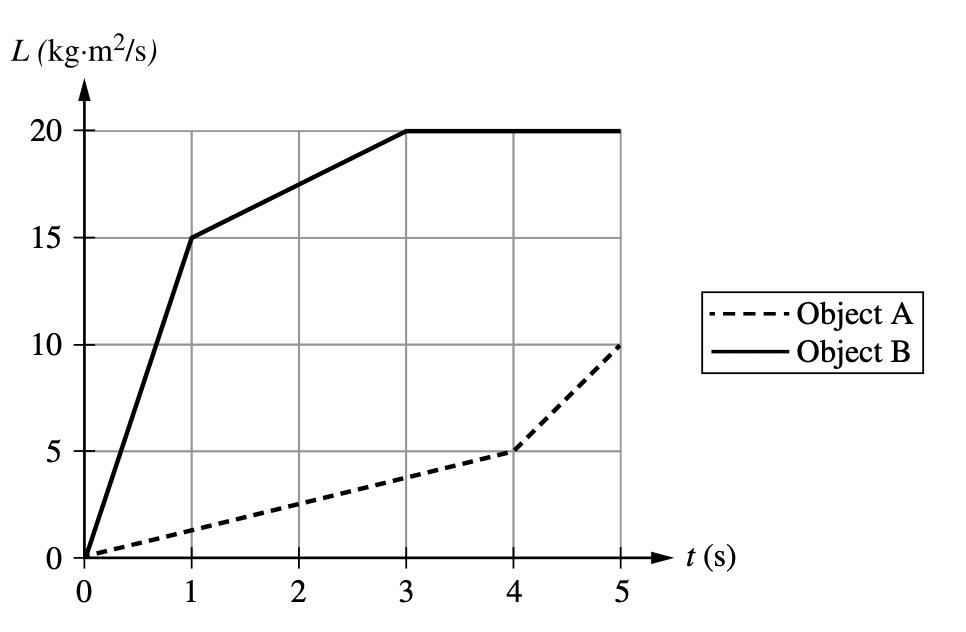
Two disks, A and B, each experience a net external torque that varies over an interval of \( 5 \) \( \text{s} \). Disk B has a rotational inertia that is twice that of Disk A. The graph shown represents the angular momentum of the two disks as functions of time between \( t = 0 \) \( \text{s} \) and \( t = 5 \) \( \text{s} \). The average magnitudes of the net torques exerted on disks A and B from \( t = 0 \) \( \text{s} \) to \( t = 5 \) \( \text{s} \) are \( \tau_A \) and \( \tau_B \), respectively. Which of the following expressions correctly relates the magnitudes of the average torques?
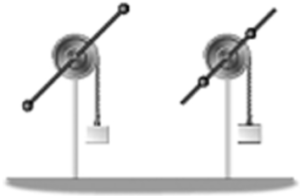
Two masses, \( m_1 \) and \( m_2 \), are suspended on either side of a pulley with a radius \( R \), as shown. The heavier mass, \( m_2 \), is initially held at rest above the ground by a distance \( h \) before being released. An student measures that it takes an amount of time \( t \) for the heavier mass to hit the ground after being released.
How long does it take for a rotating object to speed up from 15.0 rad/s to 33.3 rad/s if it has a uniform angular acceleration of 3.45 rad/s2?

The rotating systems, shown in the figure above, differ only in that the two identical movable masses are positioned a distance r from the axis of rotation (left), or a distance r/2 from the axis of rotation (right). What happens if you release the hanging blocks simultaneously from rest?
Two workers are holding a thin plate with length \(5 \, \text{m}\) and height \(2 \, \text{m}\) at rest by supporting the plate in the bottom corners. The workers are standing at rest on a slope of \(10^\circ\). Treat these supporting forces as vertical normal forces and calculate their magnitudes and state if both workers are sharing “the job” fairly.

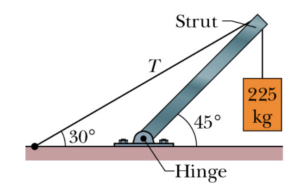
The system in the Figure is in equilibrium. A concrete block of mass 225 kg hangs from the end of a uniform strut whose mass is 45.0 kg.
By continuing you (1) agree to our Terms of Use and Terms of Sale and (2) consent to sharing your IP and browser information used by this site’s security protocols as outlined in our Privacy Policy.
Quick Start Guide
AP physics 1, AP C, honors and advanced physics students.
Quickly filter questions by units and more.
Here’s guide to using 5 UBQ filters.
GQ = general question, MCQ = multiple choice, FRQ = free response.
Click the check or bookmark button.
Now you’ll be able to see completed or bookmarked questions at a glance!
Answer keys, personalized for you.
Phy will be responsible for grading your FRQs and GQs.
No more copy and pasting. Just solve and snap.
Questions for Mastery
By continuing you agree to nerd-notes.com Terms of Service, Privacy Policy, and our usage of user data.