
- AP Physics 1 | Speed Review
- Fluids
AP Physics 1 Fluids Dynamics Speed Review

- 10 minutes
- 8 formulas
- 4 questions

The Ultimate Fluids Speed Review
This guide will get you up to speed with everything you need to know about fluids, pressure, buoyancy, and flow.
After you’re done take this 10 questions fluids quiz for mastery.
Check out the Youtube Fluids Speed Review if you prefer watching me derive equations fluid principles from scratch.
Let’s get into it.
First Things First: What Even is a Fluid?
Fluids are anything that flows. Think liquids, gases, and whatever weird in-between states physics hasn’t classified yet.
Unlike solids, fluids don’t hold their shape; they take the form of whatever container they’re in.
The key quantity to track? Density, which is just mass packed into a given volume:
\[ \rho = \frac{m}{V} \]
Think about it: oil floats on water because it’s less dense. Helium rises in air for the same reason. Simple.
Try applying it:
Pressure: The Invisible Force You Never Notice
Pressure is how much force a fluid applies over an area. Mathematically, that’s:
\[ P = \frac{F_{\perp}}{A} \]
More force? More pressure. Smaller area? Even more pressure.
A Note on Pascal’s Law
Normally, this is where we’d talk about Pascal’s Law which explains how a change in pressure is transmitted equally throughout a enclosed fluid.
It explains how hydraulic systems work, like the braking system in your car.
A small force applied at one end can create a much larger force at the other, making it possible to stop a car with just the pressure from your foot.
The equation for Pascal’s Law is:
\[ F_1 = \frac{A_1}{A_2} F_2 \]
It’s important to note that Pascal’s Law is not covered on the AP Physics 1 exam (but its simple and easy to understand).
Try it out:

The radius of the left piston is \(0.12\,\text{m}\) and the radius of the right piston is \(0.65\,\text{m}\). If \(f\) were raised by \(14\,\text{N}\), how much would \(F\) need to be increased to maintain equilibrium?
How Fluid Pressure Changes with Depth
Pressure increases with depth because more water weight presses down from above.
For a fluid column the pressure is still \(\dfrac{F}{A}\). But measuring force (of fluid weight) is impractical.
So we use density as a helper equation \(\rho = \dfrac{m}{V}\) and combine it with the previous equation to get:
\[ P = \dfrac{F}{A} = \dfrac{mg}{A} = \dfrac{\rho Vg}{A} = \boxed{\rho gh}\]
This formula is what we call gauge pressure, also known fluid pressure.
Absolute Pressure
A cup of water experiences gauge pressure from the water itself and atmospheric pressure from the air pushing down on its surface.
The sum of these two is known as total, or absolute, pressure.
The equation for absolute pressure is:
\[ P = P_0 + \rho gh \]
Where \(P_0\) is atmospheric pressure at the surface.
Try applying it here:
Buoyancy: Why Some Things Float and Others Sink
Ever tried to push a beach ball underwater? The harder you push, the stronger the water pushes back. That’s buoyancy in action.
Archimedes figured out that the buoyant force equals the weight of the displaced fluid \(DF\):
\[ F_b = m_{DF}g = \rho_{DF} V_{DF} g \]
So the further you push down the beach ball, the more water it will displace, creating a larger buoyant force.
Note: buoyant force does NOT come from the weight of the OBJECT itself.
If \(F_b\) is greater than the object’s weight, it floats. If not, down it goes.
This also explains why ships, despite being made of heavy metal, don’t sink: they displace enough water to generate a buoyant force greater than their own weight.
Problem Solving With Buoyant Forces
Follow the forces problem framework:
- Draw an FBD. Keep in mind fluids, including air, has weight!
- Sum up forces and use newton’s law \(F = ma\)
- Derive! If you need, plug in the formula for buoyancy and solve for the unknown.
Try it out this question:
Fluid Flow: Conservation Of Mass
Fluids follow a strict rule: what goes in must come out. That’s where the continuity equation comes in:
\[ A_1 v_1 = A_2 v_2 \]
Here’s what it really means: the volume of fluid flowing per second stays the same, no matter how the pipe’s shape changes. This is called the flow rate (\( Q \)), defined as:
\[ Q = A v \]
Where:
- \(Q\) = flow rate \(\frac{m^3}{s}\)
- \(A\) = cross-sectional area \(m^2\)
- \(v\) = velocity of the fluid \(\frac{m}{s}\)
If a pipe gets narrower, the velocity increases to maintain the same flow rate.
If it widens, the velocity decreases.
That’s why river rapids form when a wide river suddenly narrows—water speeds up to keep the same volume moving through.
The flow rate always stays constant for an incompressible fluid. If area changes, velocity adjusts to compensate.
Try it out:
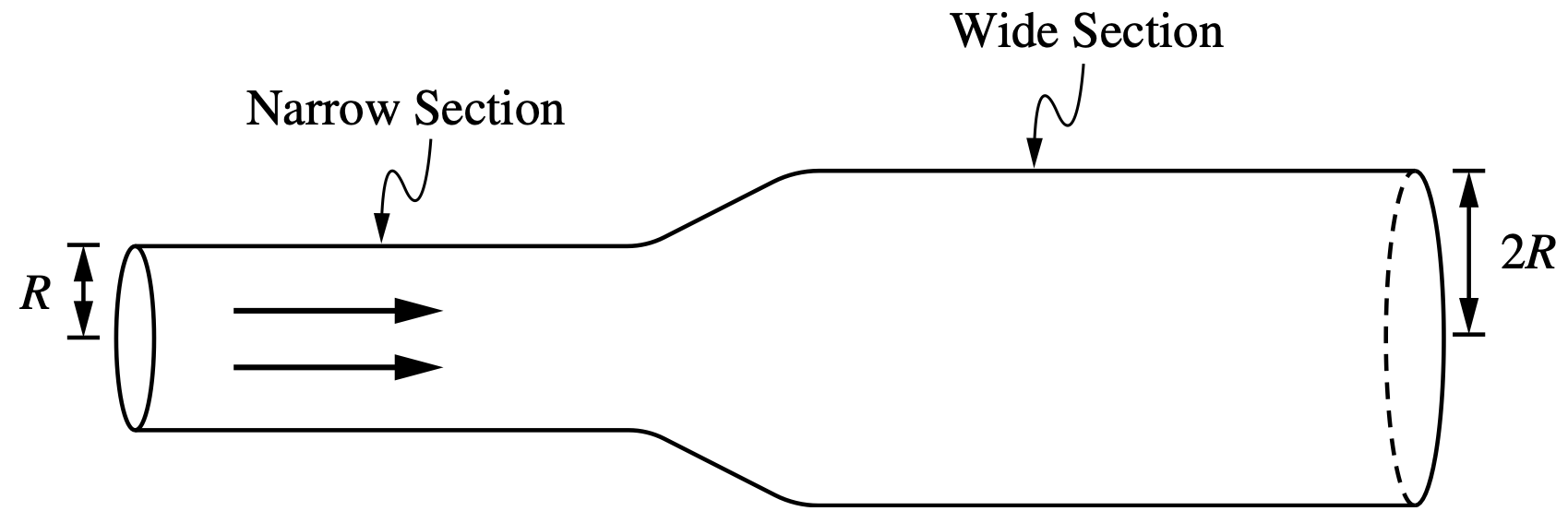
A fluid flows through the two sections of cylindrical pipe shown in the figure. The narrow section of the pipe has radius \(R\) and the wide section has radius \(2R\). What is the ratio of the fluid’s speed in the wide section of pipe to its speed in the narrow section of pipe, \(\dfrac{v_{\text{wide}}}{v_{\text{narrow}}}\)?
Bernoulli’s Equation: Conservation of Energy (Revisited)
Bernoulli’s principle is just conservation of energy applied to fluids. It states that a fluid’s total energy (pressure, gravitational potential, and kinetic) stays constant:
\[ P_1 + \rho g y_1 + \frac{1}{2} \rho v_1^2 = P_2 + \rho g y_2 + \frac{1}{2} \rho v_2^2 \]
In short, a gain in one form of energy must come from a decrease in another.
For example, consider what happens when a pipe narrows: the fluid speeds up (according to continuity). But that increase in kinetic energy has to come from somewhere — and it comes from pressure.
This explains:
- How airplanes generate lift (faster air over top of wing = lower pressure at top compared to bottom)
- Why a shower curtain gets sucked inward when you turn on the water
- How a perfume atomizer sprays liquid
Try it out:
Torricelli’s Theorem: Fluid Speed Without the Drama
When a fluid drains out of a hole, it acts like it’s in free fall. Torricelli’s equation gives its speed:
\[ v = \sqrt{2g\Delta y} \]
The greater the height difference, the faster the fluid moves. That’s why water from a tall tower shoots out faster than from a short one.
Final Takeaways (a.k.a. Your Cheat Sheet)
- Fluid pressure increases with depth: \( P = \rho gh \)
- Buoyant force = weight of displaced fluid: \( F_b = \rho V g \)
- Fluid flow speeds up in narrow spaces: \( A_1 v_1 = A_2 v_2 \)
- Fast-moving fluids have low pressure: Bernoulli’s equation
- Fluid draining from a hole follows \( v = \sqrt{2g\Delta y} \)
Master these, and you’ll crush any fluids question the AP throws at you.
If you’re looking for free fluid practice questions in AP style, check out UBQ, our collection of over 1000+ Physics questions, with explanations, AI powered assistance, and automatic FRQ grading. Over 200,000 students use it daily to accelerate this success! Try it here.
If you need questions already organized into quizzes try Quiz Labs.
More Practice Questions for Mastery
Take the density of helium and air to be \(0.18\,\text{kg/m}^3\) and \(1.24\,\text{kg/m}^3\), respectively.
Video Review
This article was written by Jason