NewTry UBQ Quiz Lab. 40+ custom built quizzes to get a 5 on AP Physics 1.
for free to use all UBQ features

A crane’s trolley at point \( P \) moves for a few seconds to the right with constant acceleration, and the \( 870 \, \text{kg} \) load hangs on a light cable at a \( 5^\circ \) angle to the vertical as shown. What is the acceleration of the trolley and load?
An airplane is traveling \( 900. \) \( \text{km/h} \) in a direction \( 38.5^\circ \) west of north.
An object is moving to the west at a constant speed. Three forces are exerted on the object. One force is \( 10 \) \( \text{N} \) directed due north, and another is \( 10 \) \( \text{N} \) directed due west. What is the magnitude and direction of the third force if the object is to continue moving to the west at a constant speed?
When a horizontal force of \( 4.5 \, \text{N} \) acts on a block on a resistance-free surface, it produces an acceleration of \( 2.5 \, \text{m/s}^2 \). Suppose a second \( 4.0 \, \text{kg} \) block is dropped onto the first. What is the magnitude of the acceleration of the combination if the same force continues to act? Assume that the second block does not slide on the first block.
In a \(4.0\)-kilometer race, a runner completes the first kilometer in \(5.9\) minutes, the second kilometer in \(6.2\) minutes, the third kilometer in \(6.3\) minutes, and the final kilometer in \(6.0\) minutes. What is the average speed of the runner? Use standard units: \(\text{m/s}\).
A satellite in circular orbit around the Earth moves at constant speed. This orbit is maintained by the force of gravity between the Earth and the satellite, yet no work is done on the satellite. How is this possible?

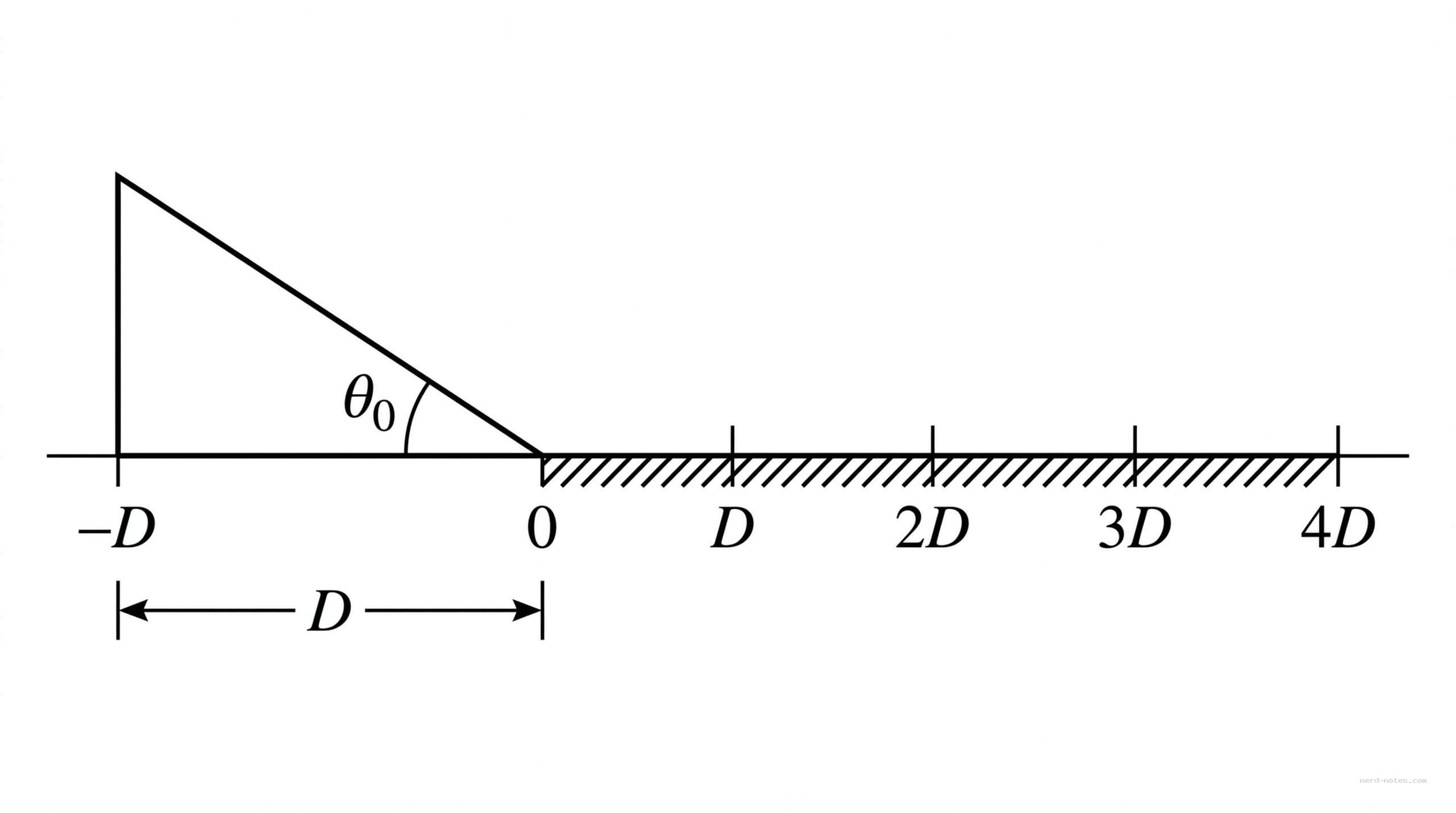
A block is initially at rest on top of an inclined ramp that makes an angle \( \theta_0 \) with the horizontal. The distance measured along the base of the ramp is \( D \). After the block is released from rest, it slides down the frictionless ramp and then continues onto a rough horizontal surface until it finally comes to rest at the position \( x = 4D \) measured from the base of the ramp. The coefficient of kinetic friction between the block and the rough horizontal surface is \( \mu_k \).
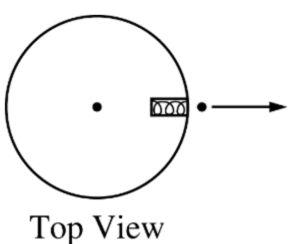
A compressed spring mounted on a disk can project a small ball. When the disk is not rotating, as shown in the top view above, the ball moves radially outward. The disk then rotates in a counterclockwise direction as seen from above, and the ball is projected outward at the instant the disk is in the position shown above. Which of the following best shows the subsequent path of the ball relative to the ground?
| Wagon | Wheel Structure | Moment of Inertia | Wheel Mass | Wheel Radius |
|---|---|---|---|---|
| Wagon \(A\) | Solid disk | \[\frac{1}{2} M R^2\] | \[ 0.5 \, \text{kg} \] | \[ 0.1 \, \text{m} \] |
| Wagon \(B\) | Solid disk | \[\frac{1}{2} M R^2\] | \[ 0.2 \, \text{kg} \] | \[ 0.1 \, \text{m} \] |
| Wagon \(C\) | Hollow hoop | \[M R^2\] | \[ 0.1 \, \text{kg} \] | \[ 0.1 \, \text{m} \] |
Three wagons have identical total mass (including their wheels) and each has four wheels. However, the wheels on each wagon have different designs with varying mass distributions and radii as shown in a reference chart. When accelerating each wagon from a standstill to \( 10 \) \( \text{m/s} \), which wagon requires the most energy input?
A comet of mass \( m_c = 3.2 \times 10^{14} \) \( \text{kg} \) is orbiting a star with mass \( m_s = 1.8 \times 10^{30} \) \( \text{kg} \). The comet’s orbit is elliptical. At its closest point, the comet is a distance \( r_1 = 8.3 \times 10^{10} \) \( \text{m} \) from the star, and at its farthest point, the comet is a distance \( r_2 = 4.9 \times 10^{11} \) \( \text{m} \) from the star. What is the change in the kinetic energy of the comet as it moves along its orbit from distance \( r_2 \) to distance \( r_1 \) from the star?

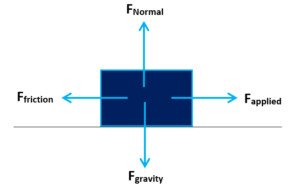
The box in the diagram is sliding to the right across a horizontal table, under the influence of the forces shown. Which force(s) is doing negative work on the box?
A \(6 \, \text{kg}\) cube rests against a compressed spring with a force constant of \(1{,}800 \, \text{N/m}\), initially compressed by \(0.3 \, \text{m}\). Upon release, the cube slides on a horizontal surface with a kinetic friction coefficient of \(\mu_k = 0.12\) for \(3 \, \text{m}\), then ascends a \(12^\circ\) slope, stopping after \(4.5 \, \text{m}\). Determine the coefficient of kinetic friction on the slope.
A 2.0 kg wood box slides down a vertical wood wall while you push on it at a 45 ° angle. The coefficient of kinetic friction of wood µk = 0.200. What magnitude of force should you apply to cause the box to slide down at a constant speed?
A officer fires a pistol horizontally toward a target \(120 \,\text{m}\) at a velocity of \(200 \, \text{m/s}\). If the officer aimed directly at the bull’s eye
What condition(s) are necessary for static equilibrium?

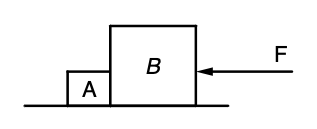
In the diagram shown, a \(20 \, \text{N}\) force is applied to block \(B\) (\(7 \, \text{kg}\)). Block \(A\) has a mass of \(3 \, \text{kg}\). Assume frictionless conditions.
The radius of the aorta is about \( 1 \) \( \text{cm} \) and the blood flowing through it has a speed of about \( 30 \) \( \frac{\text{cm}}{\text{s}} \). Calculate the average speed of the blood in the capillaries given the total cross section of all the capillaries is about \( 2000 \) \( \text{cm}^2 \).
A drinking fountain projects water at an initial angle of \( 50^ \circ \) above the horizontal, and the water reaches a maximum height of \( 0.150 \) \( \text{m} \) above the point of exit. Assume air resistance is negligible.

A \( 0.20 \) \( \text{kg} \) object moves along a straight line. The net force acting on the object varies with the object’s displacement as shown in the graph above. The object starts from rest at displacement \( x = 0 \) and time \( t = 0 \) and is displaced a distance of \( 20 \) \( \text{m} \). Determine each of the following.
A skydiver reaches a terminal velocity of \(55.0\, \mathrm{m/s}\). At terminal velocity, the skydiver no longer accelerates. The mass of the skydiver and her equipment is \(87.0\, \mathrm{kg}\). What is the force of friction acting on her?

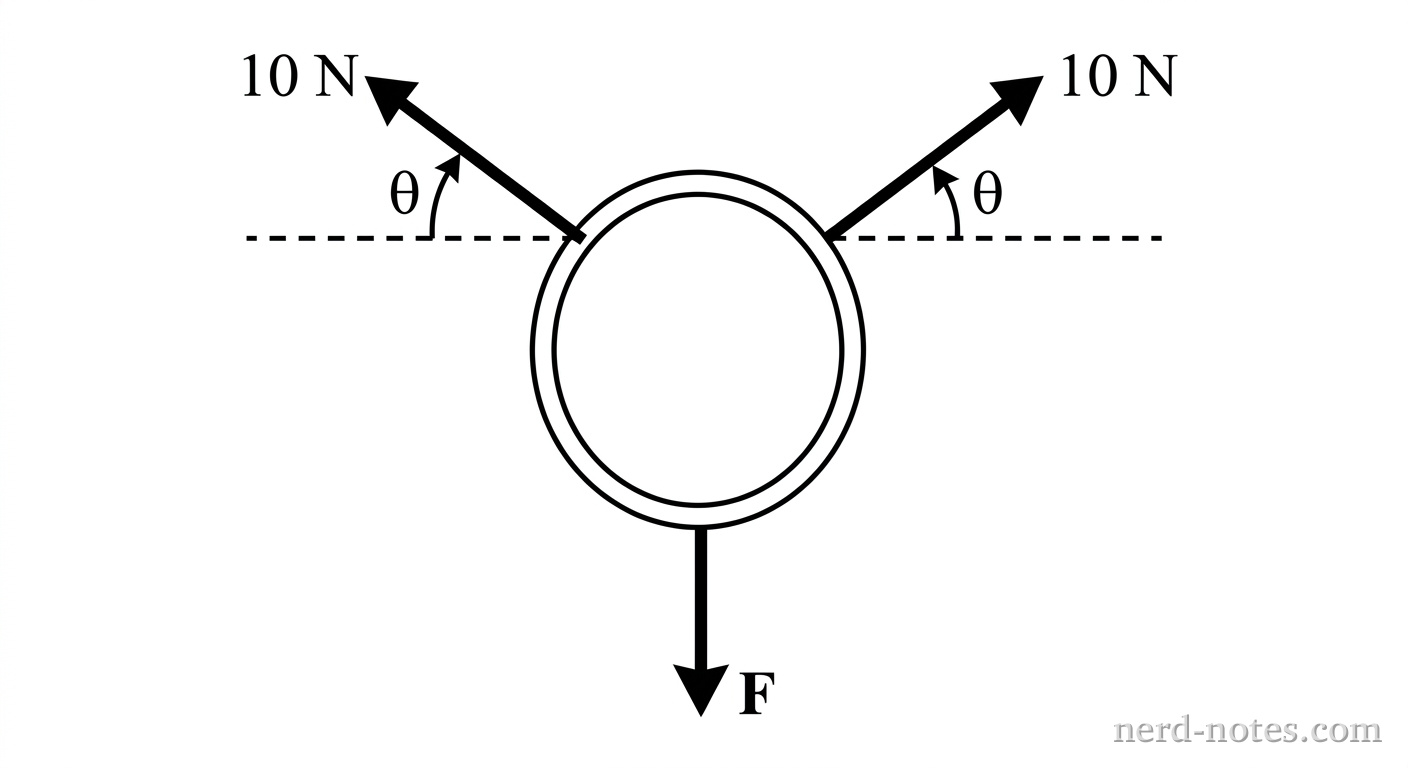
A ring of negligible mass remains in static equilibrium under the influence of three coplanar forces, as shown in the accompanying diagram. Two forces, each with a magnitude of \(10 \, \text{N}\), act on the ring at an angle \(\theta\) above the horizontal—one directed to the right and the other to the left. A third force, \(F\), acts vertically downward. Determine the magnitude of force \(F\).
Barry Bonds hits a \(125 \,\text{m}\) home run. Assuming that the ball left the bat at an angle of \(45^\circ\) from the horizontal, calculate how long the ball was in the air.
According to Newton’s third law, each team in a tug of war pulls with equal force on the other team. What, then, determines which team will win?
A spring stretches \( 8.0 \) \( \text{cm} \) when a \( 13 \) \( \text{N} \) force is applied. How far does it stretch when a \( 26 \) \( \text{N} \) force is applied?
By continuing you (1) agree to our Terms of Use and Terms of Sale and (2) consent to sharing your IP and browser information used by this site’s security protocols as outlined in our Privacy Policy.
One price to unlock most advanced version of Phy across all our tools.
per month
Billed Monthly. Cancel Anytime.
Quick Start Guide
AP physics 1, AP C, honors and advanced physics students.
Quickly filter questions by units and more.
Here’s guide to using 5 UBQ filters.
GQ = general question, MCQ = multiple choice, FRQ = free response.
Click the check or bookmark button.
Now you’ll be able to see completed or bookmarked questions at a glance!
Answer keys, personalized for you.
Phy will be responsible for grading your FRQs and GQs.
No more copy and pasting. Just solve and snap.
Questions for Mastery
By continuing you agree to nerd-notes.com Terms of Service, Privacy Policy, and our usage of user data.