More Subjects, Faster Loading, Better Search, and So Much More
NewTry UBQ Quiz Lab. 40+ custom built quizzes to get a 5 on AP Physics 1.
for free to use all UBQ features
You are standing on a bathroom scale in an elevator. The elevator starts from rest on the first floor and accelerates up to the third floor, \(12 \, \text{m}\) above, in a time of \(6 \, \text{s}\). The scale reads \(800 \, \text{N}\). What is the mass of the person?
In a controlled experiment, engineers test a firecracker. The firecracker has mass \( m \) and is placed at rest on a horizontal surface. When the firecracker is lit, it explodes and breaks apart into two pieces. In the first trial, one piece with mass \( \frac{m}{2} \) moves to the left with speed \( v_L \) and the other piece moves to the right with speed \( v_R \). A second trial is performed with an identical firecracker, and one piece with mass \( \frac{3m}{4} \) moves to the left, again with speed \( v_L \). What will the speed of the other piece be in this second trial?
A \(25 \, \text{g}\) steel ball is attached to the top of a \(24 \, \text{cm}\)-diameter vertical wheel of negligible mass. Starting from rest, the wheel accelerates at \(470 \, \text{rad/s}^2\). The ball is released after \(\frac{3}{4}\) of a revolution. How high does it go above the center of the wheel?
A projectile is launched at an upward angle of \(30^\circ\) to the horizontal with a speed of \(30 \, \text{m/s}\). How does the horizontal component of its velocity \(1.0 \, \text{s}\) after launch compare with its horizontal component of velocity \(2.0 \, \text{s}\) after launch, ignoring air resistance?
Two identical open containers are filled with water to the same height \( H \). Container \( A \) has a small hole at a depth \( h \) below the surface, and Container \( B \) has a small hole at a depth \( 2h \) below the surface. If \( v_A \) and \( v_B \) are the exit speeds of the water, what is the ratio \( v_B / v_A \)?
A ball is attached to the end of a string. It is swung in a vertical circle of radius \( 2.5 \) \( \text{m} \). What is the minimum velocity that the ball must have at the top to make it around the circle?
A student uses a mercury barometer to measure atmospheric pressure. If the student replaces the original tube with one that has \( 2 \) times the cross-sectional area, how will the height \( h \) of the mercury column change?
Which of the following do not affect the maximum speed that a car can drive in a circle? Choose all correct answers.
Ben’s favorite ride at the Barrel-O-Fun Amusement Park is the Flying Umbrella, which is lifted by a hydraulic jack. The operator activates the ride by applying a force of \( 72 \) \( \text{N} \) to a \( 3.0 \) \( \text{cm} \) wide cylindrical piston, which holds the \( 20,000 \) \( \text{N} \) ride off the ground. What is the diameter of the piston that holds the ride?
A uniform ladder with mass \( m_2 \) and length \( L \) rests against a smooth wall. A do-it-yourself enthusiast of mass \( m_1 \) stands on the ladder a distance \( d \) from the bottom (measured along the ladder). The ladder makes an angle \( \theta \) with the ground. There is no friction between the wall and the ladder, but there is a frictional force of magnitude \( f \) between the floor and the ladder. \( N_1 \) is the magnitude of the normal force exerted by the wall on the ladder, and \( N_2 \) is the magnitude of the normal force exerted by the ground on the ladder. Throughout the problem, consider counterclockwise torques to be positive.
A bird, traveling at \(50 \, \text{m/s}\) wants to hit a man \(100 \, \text{m}\) below with a dropping. How far in distance before flying directly over the man should the bird release it?
In a town’s water system, pressure gauges in still water at street level read \( 150 \) \( \text{kPa} \). If a pipeline connected to the system breaks and shoots water straight up, how high above the street does the water shoot?
Two identical springs are suspended from the ceiling and blocks with masses \( m_0 \) and \( 3 m_0 \) are attached to the bottoms of springs A and B, respectively. How does the spring potential energy of the spring–block B system, \( U_{sp,B} \), compare to the spring potential energy of the spring–block A system, \( U_{sp,A} \)?
A box of mass \(m\) is initially at rest at the top of a ramp that is at an angle \(\theta\) with the horizontal. The block is at a height \(h\) and length \(L\) from the bottom of the ramp. The coefficient of kinetic friction between the block and the ramp is \(\mu\). What is the kinetic energy of the box at the bottom of the ramp?
A car is driving to the right at \( 20 \) \( \text{m/s} \). A motorcycle starts \( 30 \) \( \text{m} \) behind the car and is moving at \( 30 \) \( \text{m/s} \) in the same direction.
A baseball is hit high and far across a field. Which of the following statements is true? At the highest point:
Explain how a roof might “blow off” during heavy winds.
A car rounds a curve at a steady \( 50 \) \( \text{km/h} \). If it rounds the same curve at a steady \( 70 \) \( \text{km/h} \), will its acceleration be any different?
A horizontal \( 300 \) \( \text{N} \) force pushes a \( 40 \) \( \text{kg} \) object across a horizontal \( 10 \) \( \text{meter} \) frictionless surface. After this, the block slides up a \( 20^\circ \) incline. Assuming the incline has a coefficient of kinetic friction of \( 0.4 \), how far along the incline will the object slide?
Determine the force needed to push a \( 150 \) \( \text{kg} \) body up a smooth \( 30^\circ \) incline with an acceleration of \( 6 \) \( \text{m/s}^2 \).
A stone hangs by a fine thread from the ceiling, and a section of the same thread dangles from the bottom of the stone. If a person gives a sharp pull on the dangling thread, where is the thread likely to break: below the stone or above it? What if the person gives a slow and steady pull?
Water balloons are tossed from the roof of a building, all with the same speed but with different launch angles. Which one has the highest speed when it hits the ground? Ignore air resistance. Without using equations, explain your answer.

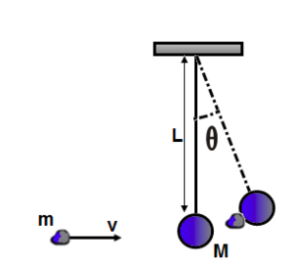
A \(20 \, \text{g}\) piece of clay moving at a speed of \(50 \, \text{m/s}\) strikes a \(500 \, \text{g}\) pendulum bob at rest. The length of a string is \(0.8 \, \text{m}\). After the collision, the clay-bob system starts to oscillate as a simple pendulum.
A \(2 \, \text{kg}\) object slides east at \(4 \, \text{m/s}\) and collides with a stationary \(3 \, \text{kg}\) object. After the collision, the \(2 \, \text{kg}\) object is traveling at an unknown velocity at \(15^\circ\) north of east and the \(3 \, \text{kg}\) object is traveling at \(38^\circ\) south of east. What is each object’s final velocity?
By continuing you (1) agree to our Terms of Use and Terms of Sale and (2) consent to sharing your IP and browser information used by this site’s security protocols as outlined in our Privacy Policy.
One price to unlock most advanced version of Phy across all our tools.
per month
Billed Monthly. Cancel Anytime.
Quick Start Guide
AP physics 1, AP C, honors and advanced physics students.
Quickly filter questions by units and more.
Here’s guide to using 5 UBQ filters.
GQ = general question, MCQ = multiple choice, FRQ = free response.
Click the check or bookmark button.
Now you’ll be able to see completed or bookmarked questions at a glance!
Answer keys, personalized for you.
Phy will be responsible for grading your FRQs and GQs.
No more copy and pasting. Just solve and snap.
Questions for Mastery
By continuing you agree to nerd-notes.com Terms of Service, Privacy Policy, and our usage of user data.