Phy UBQ Count Message Here
Intermediate
Mathematical
FRQ

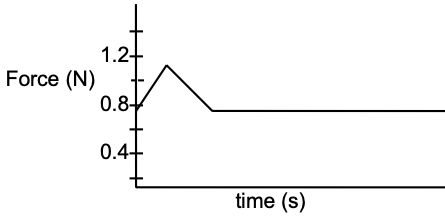
A \(1509 \, \text{g}\) wood block is being pulled by the force meter at a constant velocity. Using the graph above, find:

Beginner
Mathematical
GQ

A \( 6.00 \, \text{m} \) long, \( 500 \, \text{kg} \) steel uniform beam extends horizontally from the point where it has been bolted to the framework of a new building under construction. A \( 70 \, \text{kg} \) construction worker stands at the far end of the beam. What is the magnitude of the torque about the bolt due to the worker and the weight of the beam?

Intermediate
Mathematical
MCQ

A constant force of 8.0 N is exerted on a 16 kg object initially at rest. How much speed will the object gain after 4 seconds?

Intermediate
Mathematical
FRQ

A 6.0-cm-diameter gear rotates with angular velocity \( \omega = \left(20-\frac {1}{2} t^2 \right) \, \text {rad/s} \), where \(t\) is in seconds. At \(t = 4.0 \, \text{s}\), what are

Intermediate
Mathematical
FRQ

A train consists of \(50\) cars, each of which has a mass of \(6.1 \times 10^{3} \, \text{kg}\). The train has an acceleration of \(8.0 \times 10^{-2} \, \text{m/s}^2\). Ignore friction and determine the tension in the coupling at the following places:

Intermediate
Mathematical
FRQ

The occupants of a car traveling at a speed of \( 30 \) \( \text{m/s} \) note that on a particular part of a road their apparent weight is \( 15\% \) higher than their weight when driving on a flat road.

Intermediate
Mathematical
MCQ

A mass is attached to a spring of spring constant 60 N/m along a horizontal, frictionless surface. The spring is initially stretched by a force of 5.0 N and let go. It takes the mass 0.50 s to go back to its equilibrium position when it is oscillating. What is the amplitude?

Intermediate
Mathematical
GQ

A \(5.0 \, \text{g}\) coin is placed \(15 \, \text{cm}\) from the center of a turntable. The coin has coefficients of static and kinetic friction of \(\mu_s = 0.80\) and \(\mu_k = 0.50\). The turntable slowly speeds up to \(60 \, \text{rpm}\). Does the coin slide off the turntable?

Intermediate
Mathematical
FRQ

The launching mechanism of a toy gun consists of a spring with an unknown spring constant, \( k \). When the spring is compressed \( 0.120 \, \text{m} \) vertically, a \( 35.0 \, \text{g} \) projectile is able to be fired to a maximum height of \( 25 \, \text{m} \) above the position of the projectile when the spring is compressed. Assume that the barrel of the gun is frictionless.

Intermediate
Mathematical
MCQ

What is the net torque acting on the pivot supporting a \(10 \, \text{kilogram}\) beam \(2 \, \text{meters}\) long as shown above? Assume that the positive direction is clockwise.
Advanced
Mathematical
GQ

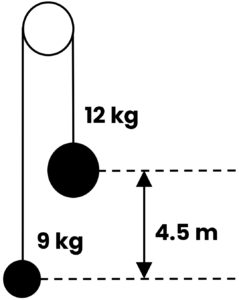
pulley system of 12 and 9 kg mass. The 12kg mass is 4.5 m above the floor.

Using only work and energy, find the velocity of the masses after they have traveled \(0.8 \, \text{m}\). Refer to the image above.
Advanced
Conceptual
MCQ

When the speed of a rear-wheel-drive car is increasing on a horizontal road, what is the direction of the frictional force on the tires?

Intermediate
Proportional Analysis
MCQ

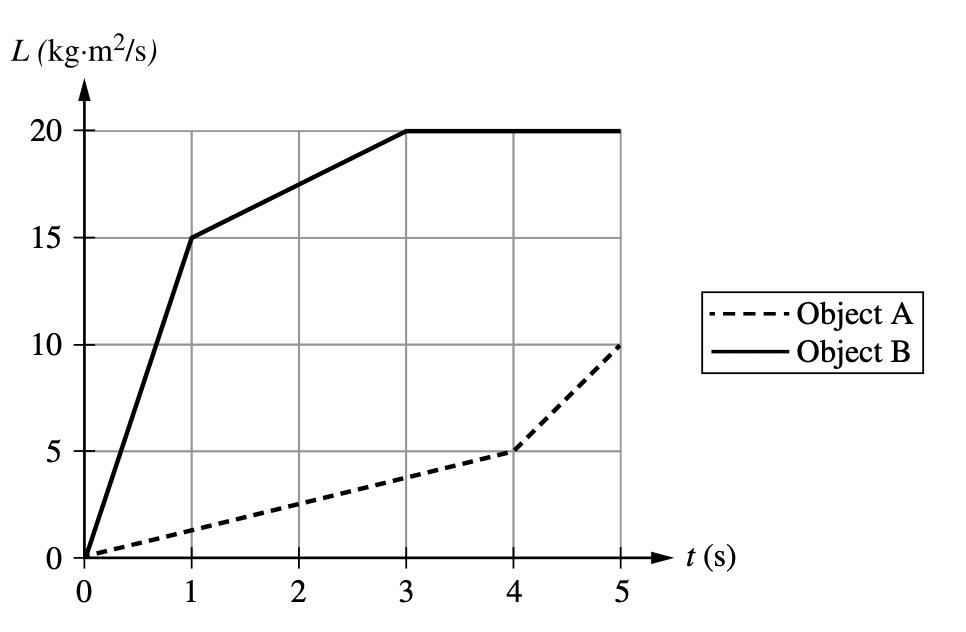
Two disks, A and B, each experience a net external torque that varies over an interval of \( 5 \) \( \text{s} \). Disk B has a rotational inertia that is twice that of Disk A. The graph shown represents the angular momentum of the two disks as functions of time between \( t = 0 \) \( \text{s} \) and \( t = 5 \) \( \text{s} \). The average magnitudes of the net torques exerted on disks A and B from \( t = 0 \) \( \text{s} \) to \( t = 5 \) \( \text{s} \) are \( \tau_A \) and \( \tau_B \), respectively. Which of the following expressions correctly relates the magnitudes of the average torques?
Advanced
Mathematical
FRQ

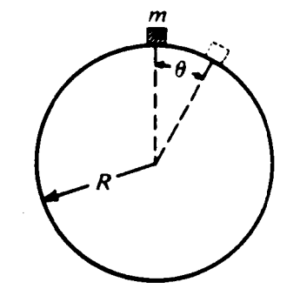
A particle of mass \(m\) slides down a fixed, frictionless sphere of radius \(R\), starting from rest at the top.

In terms of \(m\), \(g\), \(R\), and \(\theta\), determine each of the following for the particle while it is sliding on the sphere.
Intermediate
Mathematical
FRQ

A seagull first flies \( 160 \, \text{m} \) North, then heads \( 120.65 \, \text{m} \) at \( 18.43^\circ \) North of West. After it lands:

Beginner
Conceptual
MCQ

When we refer to an object’s speed, we’re talking about:

Advanced
Conceptual
FRQ

Two cannonballs, A and B, are fired from the ground with identical initial speeds, but with \( \theta_A \) larger than \( \theta_B \).

Advanced
Mathematical
FRQ

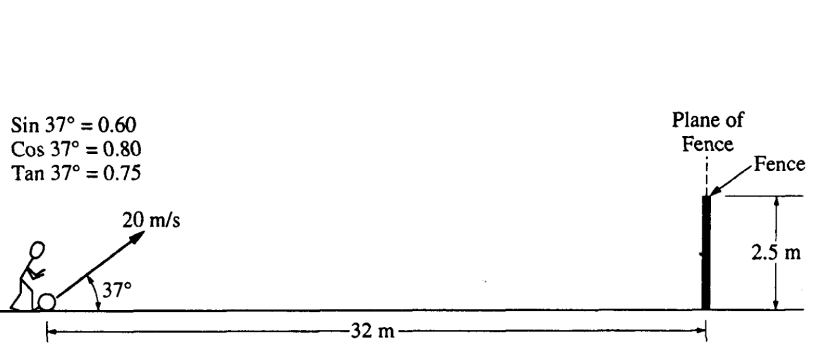
A ball of mass \( 0.5 \, \text{kg} \), initially at rest, is kicked directly toward a fence from a point \( 32 \, \text{m} \) away, as shown above. The velocity of the ball as it leaves the kicker’s foot is \( 20 \, \text{m/s} \) at an angle of \( 37^\circ \) above the horizontal. The top of the fence is \( 2.5 \, \text{m} \) high. The ball hits nothing while in flight and air resistance is negligible.
Intermediate
Conceptual
MCQ

Which of the following must be zero if an object is spinning at a constant rate? There may be more than one right answer.

Intermediate
Mathematical
MCQ

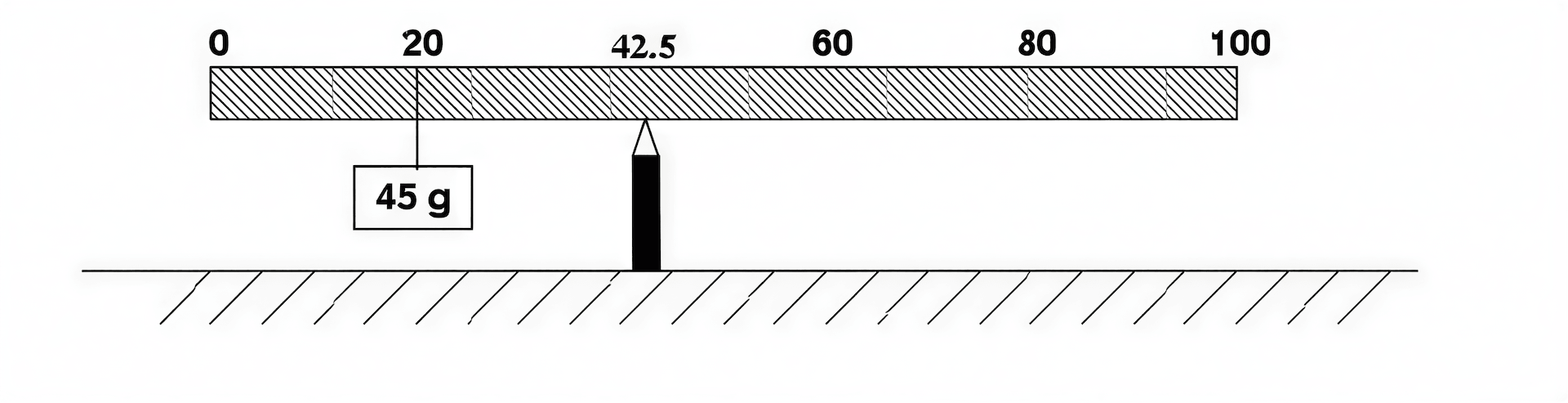
A uniform meter stick has a mass of \( 45.0 \) \( \text{g} \) placed at the \( 20 \) \( \text{cm} \) mark. If a pivot is placed at the \( 42.5 \) \( \text{cm} \) mark and the meter stick remains horizontal in static equilibrium, what is the mass of the meter stick?


Advanced
Mathematical
FRQ

The International Space Station has a mass of \(4.2 \times 10^{5} \, \text{kg}\) and orbits Earth at a distance of \(4.0 \times 10^{2} \, \text{km}\) above the surface. Earth has a radius of \(6.37 \times 10^{6} \, \text{m}\) and a mass of \(5.97 \times 10^{24} \, \text{kg}\). Calculate the following:

Intermediate
Conceptual
MCQ

A stone is falling at a constant velocity vertically down a tube filled with oil. Which of the following statements about the energy changes of the stone during its motion are correct?

I. The gain in kinetic energy is less than the loss in gravitational potential energy.

II. The sum of kinetic and gravitational potential energy of the stone is constant.

III. The work done by the force of gravity has the same magnitude as the work done by friction.

Advanced
Mathematical
FRQ

A box of mass \( 20 \) \( \text{kg} \) moves to the right on a horizontal frictionless surface with a speed of \( 4.0 \) \( \text{m/s} \). The box collides with and remains attached to one end of a spring of negligible mass whose other end is fixed to a wall. After the collision, the spring compresses a maximum distance of \( 0.50 \) \( \text{m} \), and the box then oscillates back and forth.

Beginner
Conceptual
GQ

If an object rotating, must there be a net torque acting on it?

Nerd Notes

Discover the world's best Physics resources

Continue with

By continuing you (1) agree to our Terms of Use and Terms of Sale and (2) consent to sharing your IP and browser information used by this site’s security protocols as outlined in our Privacy Policy.

We use cookies to improve your experience. By continuing to browse on Nerd Notes, you accept the use of cookies as outlined in our privacy policy.

Sign In to View Your Questions

PRO TIER

One price to unlock most advanced version of Phy across all our tools.

$20

per month

Billed Monthly. Cancel Anytime.