for free to use all UBQ features

In which of the following is the rate of change of the particle’s momentum zero?
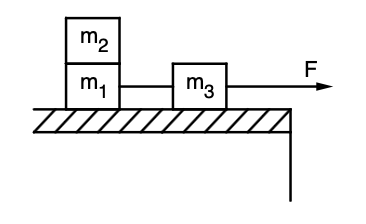
Block \(m_1\) is stacked on top of block \(m_2\). Block \(m_2\) is connected by a light cord to block \(m_3\), which is pulled along a frictionless surface with a force \(F\) as shown in the diagram above. Block \(m_1\) is accelerated at the same rate as block \(m_2\) because of the frictional forces between the two blocks. If all three blocks have the same mass \(m\), what is the minimum coefficient of static friction between block \(m_1\) and block \(m_2\)?
A golf ball is hit with a golf club. While the ball flies through the air, which forces act on the ball? Neglect air resistance.
A truck going \(15 \, \text{km/h}\) has a head-on collision with a small car going \(30 \, \text{km/h}\). Which statement best describes the situation?
An airplane accelerates down a runway at \( 10 \, \text{m/s}^2 \). It reaches a final velocity of \( 200 \, \text{m/s} \) until it finally lifts off the ground. Determine the distance traveled before takeoff.
A car accelerates from \( 0 \) to \( 25 \) \( \text{m/s} \) in \( 5 \) \( \text{s} \). If the car’s tires have a diameter of \( 70 \) \( \text{cm} \), how many revolutions does a tire make while accelerating?
Find the net gravitational force on a \(2.0 \, \text{kg}\) sphere midway between a \(4.0 \, \text{kg}\) sphere and a \(7.0 \, \text{kg}\) sphere that are \(1.2 \, \text{m}\) apart.

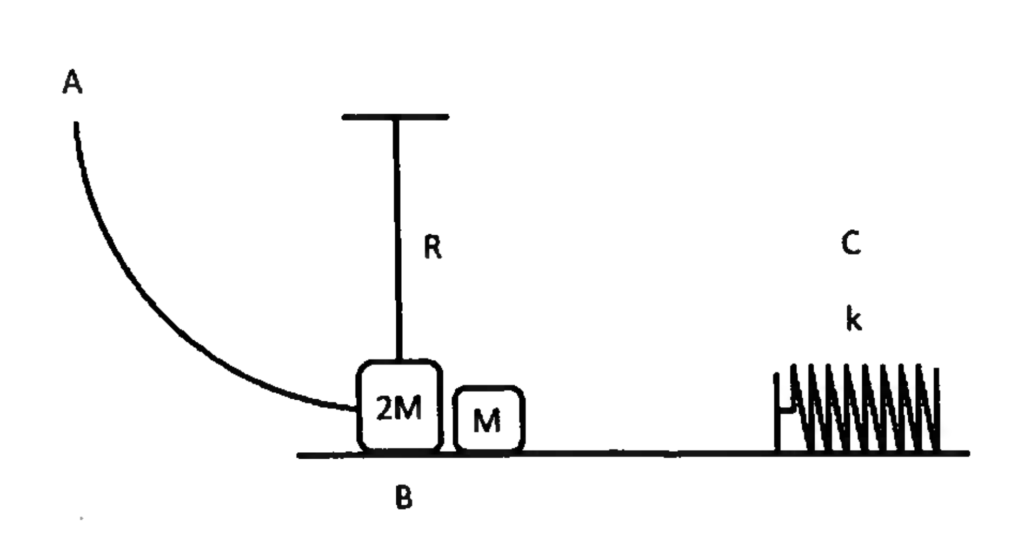
Refer to the diagram above and solve all equations in terms of \(R\), \(M\), \(k\), and constants.
A satellite in circular orbit around the Earth moves at constant speed. This orbit is maintained by the force of gravity between the Earth and the satellite, yet no work is done on the satellite. How is this possible?
A cart with a mass of \( 20 \) \( \text{kg} \) is pressed against a wall by a horizontal spring with spring constant \( k = 244 \) \( \text{N/m} \) placed between the cart and the wall. The spring is compressed by \( 0.1 \) \( \text{m} \). While the spring is compressed, an additional constant horizontal force of \( 20 \) \( \text{N} \) continues to push the cart toward the wall. What is the resulting acceleration of the cart?
Why do raindrops fall with constant speed during the later stages of their descent?
Two people, one of mass \( 88 \) \( \text{kg} \) and the other of mass \( 55 \) \( \text{kg} \), sit in a rowboat of mass \( 70 \) \( \text{kg} \). With the boat initially at rest, the two people, who have been sitting at opposite ends of the boat \( 3.1 \) \( \text{m} \) apart from each other, now exchange seats.
A baseball rolls off a 0.70 m high desk and strikes the floor 0.25 m away from the base of the desk. How fast was the ball rolling?
Find the approximate minimum mass needed for a spherical ball with a \(40\) \(\text{cm}\) radius to sink in a liquid of density \(1.4 \times 10^3\) \(\text{kg/m}^3\). Use \(9.8 \text{m/s}^2\) for \(g\).
The two blocks of masses \( M \) and \( 2M \) travel at the same speed \( v \) but in opposite directions. They collide and stick together. How much mechanical energy is lost to other forms of energy during the collision?
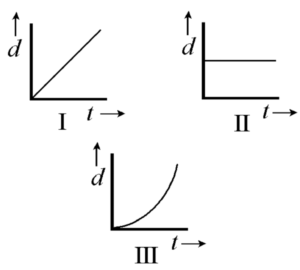
Which of the following graphs shows runners moving at the same speed? Assume the \(y\)-axis is measured in meters and the \(x\)-axis is measured in seconds.
A \( 240 \) \( \text{kg} \) block is dropped from \( 3.0 \) meters onto a spring, compresses the spring and comes to rest.
A constant force of strength \( 20 \) \( \text{N} \) acts on an object of mass \( 3 \) \( \text{kg} \) as it moves a distance of \( 4 \) \( \text{m} \). If this force is applied perpendicular to the \( 4 \) \( \text{m} \) displacement, the work done by the force is equal to:

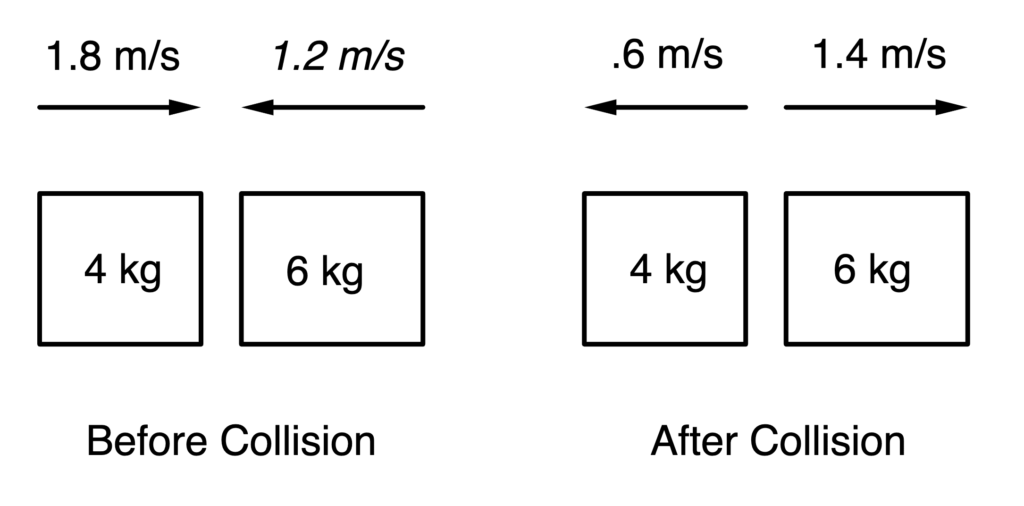
From the figure above, determine which characteristic fits this collision best.

The graph above shows the angular velocity of a spinning wheel (radius = \( 25 \) \( \text{cm} \)) as a function of time.
A ball is launched horizontally from a height. At the same time, another ball is dropped vertically from the same height. Which hits the ground first?
You are adding vectors of length \( 20 \) and \( 40 \) units. Which of the following choices is a possible resultant magnitude?
Which of these scenarios involve accelerated motion? (Select all that apply)
A body moving in the positive \( x \) direction passes the origin at time \( t = 0 \). Between \( t = 0 \) and \( t = 1 \, \text{second} \), the body has a constant speed of \( 24 \, \text{m/s} \). At \( t = 1 \, \text{second} \), the body is given a constant acceleration of \( 6 \, \text{m/s}^2 \) in the negative \( x \) direction. The position \( x \) of the body at \( t = 11 \, \text{seconds} \) is
By continuing you (1) agree to our Terms of Use and Terms of Sale and (2) consent to sharing your IP and browser information used by this site’s security protocols as outlined in our Privacy Policy.
Quick Start Guide
AP physics 1, AP C, honors and advanced physics students.
Quickly filter questions by units and more.
Here’s guide to using 5 UBQ filters.
GQ = general question, MCQ = multiple choice, FRQ = free response.
Click the check or bookmark button.
Now you’ll be able to see completed or bookmarked questions at a glance!
Answer keys, personalized for you.
Phy will be responsible for grading your FRQs and GQs.
No more copy and pasting. Just solve and snap.
Questions for Mastery
By continuing you agree to nerd-notes.com Terms of Service, Privacy Policy, and our usage of user data.