New Tool FRQ Atlas - Find, Solve, and Grade Any AP FRQ In Seconds.

Phy UBQ Count Message Here

for free to use all UBQ features

Advanced
Conceptual
MCQ

A child of mass \( 3 \) \( \text{kg} \) rotates on a platform of \( 10 \) \( \text{kg} \). They start walking towards the center while the platform is rotating. Which of the following could possibly decrease the total angular momentum of the child-platform system?

Intermediate
Mathematical
GQ

Person A throws a ball horizontally from a cliff \( 20 \) \( \text{m} \) tall at \( 12 \) \( \text{m/s} \). Person B is running to the right on the ground and catches the ball at the same height it would’ve landed after running \( 15 \) \( \text{m} \). How fast was Person B running?

Advanced
Mathematical
GQ

A uniform solid sphere of mass M and radius R is placed on a frictionless horizontal surface. A massless string is wrapped around the sphere and is pulled with a force F. The string makes an angle of θ with the horizontal. What is the minimum value of the coefficient of static friction between the sphere and the surface required for the sphere to start rolling without slipping?

Advanced
Mathematical
GQ

A baseball rolls off a 0.70 m high desk and strikes the floor 0.25 m away from the base of the desk. How fast was the ball rolling?

Advanced
Conceptual
MCQ

Two uniform solid balls, one of radius \( R \) and mass \( M \), the other of radius \( 2R \) and mass \( 8M \), roll down a high incline. They start together from rest at the top of the incline. Which one will reach the bottom of the incline first?

Beginner
Conceptual
MCQ

A car’s velocity increases as follows each second: \( 2 \) \( \text{m/s} \), \( 4 \) \( \text{m/s} \), \( 6 \) \( \text{m/s} \), \( 8 \) \( \text{m/s} \). This pattern shows that the car is:

Beginner
Proportional Analysis
MCQ

Jill does twice as much work as Jack does and in half the time. Jill’s power output is

Intermediate
Mathematical
FRQ

Will Clark throws a baseball with a horizontal component of velocity of \(25 \, \text{m/s}\). It takes \(3 \, \text{s}\) to come back to its original height. Calculate the baseball’s:

Advanced
Mathematical
FRQ

A hungry bear weighing 700 N walks out on a beam in an attempt to retrieve a basket of goodies hanging at the end of the beam. The beam is uniform, weighs 200 N, and is 6.00 m long. The goodies weigh 80 N.

Beginner
Mathematical
MCQ

A vertical rope of negligible mass supports a block that weighs \(30 N\). The breaking strength of the rope is \( 50 N\). The largest acceleration that can be given to the block by pulling up on it with the rope without breaking the rope is most nearly

Advanced
Mathematical
MCQ

The elliptical orbit of a comet is shown above. Positions \(1\) and \(2\) are, respectively, the farthest and nearest positions to the Sun, and at position \(1\) the distance from the comet to the Sun is \(10\) times that at position \(2\). What is the ratio \(\dfrac{F_1}{F_2}\), the force on the comet at position \(1\) to the force on the comet at position \(2\)?

Advanced
Mathematical
GQ

Three blocks of masses \(5 \, \text{kg}\), \(4 \, \text{kg}\), and \(3 \, \text{kg}\) are placed side by side in that order. A \(25 \, \text{N}\) force applied on the \(5 \, \text{kg}\) block accelerates all three blocks together to the right. Find the acceleration of the blocks and the normal force the \(4 \, \text{kg}\) block exerts on the \(3 \, \text{kg}\) block.

Advanced
Mathematical
FRQ

The experimental diving rig is lowered from rest at the ocean’s surface and reaches a maximum depth of \(80\) \(\text{m}\). Initially it accelerates downward at a rate of \(0.10\) \(\text{m/s}^2\) until it reaches a speed of \(2.0\) \(\text{m/s}\), which then remains constant. During the descent, the pressure inside the bell remains constant at \(1\) atmosphere. The top of the bell has a cross-sectional area \(A = 9.0\) \(\text{m}^2\). The density of seawater is \(1025\) \(\text{kg/m}^3\).

Intermediate
Mathematical
MCQ

A comet of mass \( m_c = 3.2 \times 10^{14} \) \( \text{kg} \) is orbiting a star with mass \( m_s = 1.8 \times 10^{30} \) \( \text{kg} \). The comet’s orbit is elliptical. At its closest point, the comet is a distance \( r_1 = 8.3 \times 10^{10} \) \( \text{m} \) from the star, and at its farthest point, the comet is a distance \( r_2 = 4.9 \times 10^{11} \) \( \text{m} \) from the star. What is the change in the kinetic energy of the comet as it moves along its orbit from distance \( r_2 \) to distance \( r_1 \) from the star?

Intermediate
Mathematical
GQ

A \( 0.72 \) \( \text{m} \)-diameter solid sphere can be rotated about an axis through its center by a torque of \( 10.8 \) \( \text{Nm} \) which accelerates it uniformly from rest through a total of \( 160 \) revolutions in \( 15.0 \) \( \text{s} \). What is the mass of the sphere?

Intermediate
Mathematical
MCQ

A small sphere hangs from a string attached to the ceiling of a uniformly accelerating train car. It is observed that the string makes an angle of \(37^\circ\) with respect to the vertical. The magnitude of the acceleration \(a\) of the train car is most nearly:

Intermediate
Conceptual
MCQ

Which statement is true about the distances the two objects have traveled at time \( t_f \)?

Intermediate
Mathematical
GQ

When a horizontal force of \( 4.5 \, \text{N} \) acts on a block on a resistance-free surface, it produces an acceleration of \( 2.5 \, \text{m/s}^2 \). Suppose a second \( 4.0 \, \text{kg} \) block is dropped onto the first. What is the magnitude of the acceleration of the combination if the same force continues to act? Assume that the second block does not slide on the first block.

Beginner
Conceptual
MCQ

One ball is dropped vertically from a window. At the same instant, a second ball is thrown horizontally from the same window. Which ball has the greater speed at ground level?

Advanced
Mathematical
FRQ

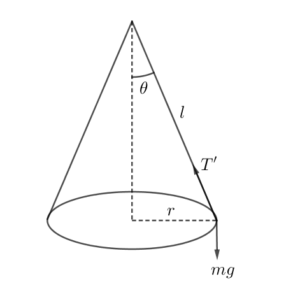
A conical pendulum is formed by attaching a ball of mass \( m \) to a string of length \( L \), then allowing the ball to move in a horizontal circle of radius \( R \).

Intermediate
Mathematical
GQ

A big bird has a mass of about 0.021 kg. Suppose it does 0.36 J of work against gravity, so that it ascends straight up with a net acceleration of 0.625 m/s2. How far up does it move?

Intermediate
Proportional Analysis
MCQ

A car with speed \( v \) and an identical car with speed \( 3v \) both travel the same circular section of an unbanked (flat) road. If the frictional force required to keep the faster car on the road without skidding is \( F \), then the frictional force required to keep the slower car on the road without skidding is

Beginner
Mathematical
GQ

A 2.0 kg ball on the end of a 0.65 m long string is moving in a vertical circle. At the bottom of the circle, its speed is 4.0 m/s. Find the tension in the string.

Intermediate
Conceptual
GQ

A rollercoaster leaves the station at rest. Its speed increases steadily for \( 6 \) \( \text{s} \) as it heads down the first drop. The ride then levels out and it moves at a constant speed for \( 4 \) \( \text{s} \) before hitting the brakes and stopping in \( 3 \) \( \text{s} \). Draw the velocity vs. time graph or explain it in terms of functions.

Nerd Notes

Discover the world's best Physics resources

Continue with

By continuing you (1) agree to our Terms of Use and Terms of Sale and (2) consent to sharing your IP and browser information used by this site’s security protocols as outlined in our Privacy Policy.

Sign In to View Your Questions

We use cookies to improve your experience. By continuing to browse on Nerd Notes, you accept the use of cookies as outlined in our privacy policy.