NewTry UBQ Quiz Lab. 40+ custom built quizzes to get a 5 on AP Physics 1.
for free to use all UBQ features
A small boat coasts at constant speed under a bridge. A heavy sack of sand is dropped from the bridge onto the boat. The speed of the boat
A string is wound tightly around a fixed pulley having a radius of 5.0 cm. As the string is pulled, the pulley rotates without any slipping of the string. What is the angular speed of the pulley when the string is moving at 5.0 m/s?
A pendulum bob of mass m on a cord of length L is pulled sideways until the cord makes an angle [katex] \theta [/katex] with the vertical. The change in potential energy of the bob during the displacement is:
Two masses, \( m_y = 32 \) \( \text{kg} \) and \( m_z = 38 \) \( \text{kg} \), are connected by a rope that hangs over a pulley. The pulley is a uniform cylinder of radius \( R = 0.311 \) \( \text{m} \) and mass \( 3.1 \) \( \text{kg} \). Initially, \( m_y \) is on the ground and \( m_z \) rests \( 2.5 \) \( \text{m} \) above the ground.

A student sets an object attached to a spring into oscillatory motion and uses a motion detector to record the velocity of the object as a function of time. The total change in the object’s speed between \(1.0 \, \text{s}\) and \(1.1 \, \text{s}\) is most nearly
A car accelerates from rest with an acceleration of \( 3.5 \, \text{m/s}^2 \) for \( 10 \, \text{s} \). After this, it continues at a constant speed for an unknown amount of time. The driver notices a ramp \( 50 \, \text{m} \) ahead and takes \( 0.6 \, \text{s} \) to react. After reacting, the driver hits the brakes, which slow the car with an acceleration of \( 7.2 \, \text{m/s}^2 \). Unfortunately, the driver does not stop in time and goes off the \( 3 \, \text{m} \) high ramp that is angled at \( 27^\circ \).
Suppose we wish to make a neutrally buoyant hollow sphere out of titanium (\(\rho = 4500 \text{kg/m}^3\)). If the sphere has an outer radius of \( 1.5 \) \( \text{m} \), what must be its inner radius?
Determine the sum of the three vectors given below. Calculate the resultant \( \vec{R} \) expressed as:
(a) Vector components
(b) Resultant vector (its total magnitude and direction)
\[\vec{A} = 26.5 \, \text{m} \ @ \ 56^\circ \, \text{NW}\]
\[\vec{B} = 44 \, \text{m} \ @ \ 28^\circ \, \text{NE}\]
\[\vec{C} = 31 \, \text{m} \, \text{South}\]
A car rounds a curve at a steady \( 50 \) \( \text{km/h} \). If it rounds the same curve at a steady \( 70 \) \( \text{km/h} \), will its acceleration be any different?
Can an object have \( 0 \) velocity and nonzero acceleration at the same time? Give two examples.
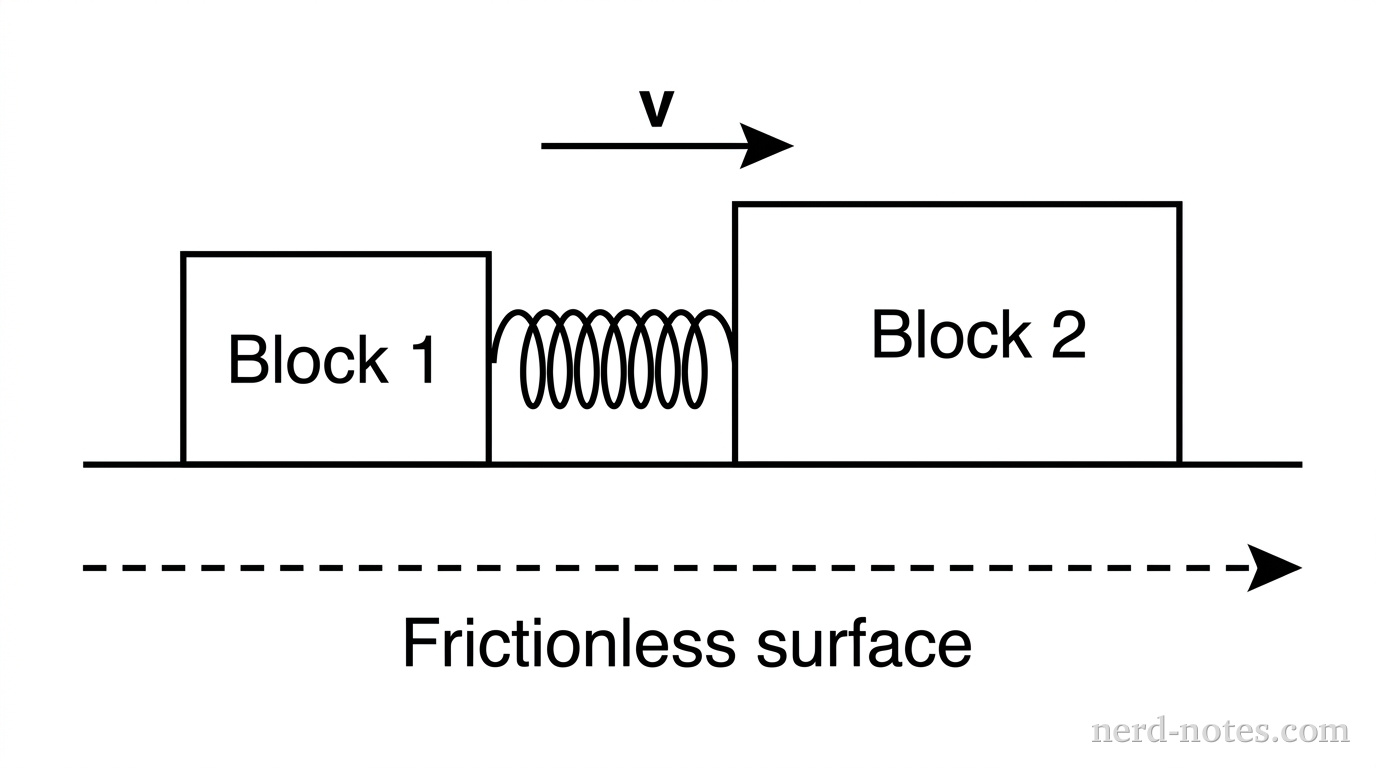
A \( 0.0350 \) \( \text{kg} \) bullet moving horizontally at \( 425 \) \( \text{m/s} \) embeds itself into an initially stationary \( 0.550 \) \( \text{kg} \) block.
A ladder at rest is leaning against a wall at an angle. Which of the following forces must have the same magnitude as the frictional force exerted on the ladder by the floor?
A point P is at a distance \( R \) from the axis of rotation of a rigid body whose angular velocity and angular acceleration are \( \omega \) and \( \alpha \) respectively. The linear speed, centripetal acceleration, and tangential acceleration of the point can be expressed as:
| Linear speed | Centripetal acceleration | Tangential acceleration | |
|---|---|---|---|
| \( (a) \) | \( R\omega \) | \( R\omega^{2} \) | \( R\alpha \) |
| \( (b) \) | \( R\omega \) | \( R\alpha \) | \( R\omega^{2} \) |
| \( (c) \) | \( R\omega^{2} \) | \( R\alpha \) | \( R\omega \) |
| \( (d) \) | \( R\omega \) | \( R\omega^{2} \) | \( R\omega \) |
| \( (e) \) | \( R\omega^{2} \) | \( R\alpha \) | \( R\omega^{2} \) |
A cube of unknown material and uniform density floats in a container of water with \(60\%\) of its volume submerged. If this same cube were placed in a container of oil with density \(800\) \(\text{kg/m}^3\), what portion of the cube’s volume would be submerged while floating?
A person’s back is against the inner wall of a spinning cylinder with no support under their feet. If the radius is \(R\), find an expression for the minimum angular speed so the person does not slide down the wall. The coefficient of static friction is \(\mu_s\).
If you haven’t studied angular velocity \(\omega\) yet, just find the minumum linear velocity \(v\).
Which of the following graphs represent an object at rest?
Two satellites of equal mass, \( S_1 \) and \( S_2 \), orbit the Earth. \( S_1 \) is orbiting at a distance \( r \) from the Earth’s center at speed \( v \). \( S_2 \) orbits at a distance \( 2r \) from the Earth’s centre at speed \( \dfrac{v}{\sqrt{2}} \). The ratio of the centripetal force on \( S_1 \) to the centripetal force on \( S_2 \) is
A horizontal, uniform board of weight \( 125 \, \text{N} \) and length \( 4 \, \text{m} \) is supported by vertical chains at each end. A person weighing \( 500 \, \text{N} \) is hanging from the board. The tension in the right chain is \( 250 \, \text{N} \).

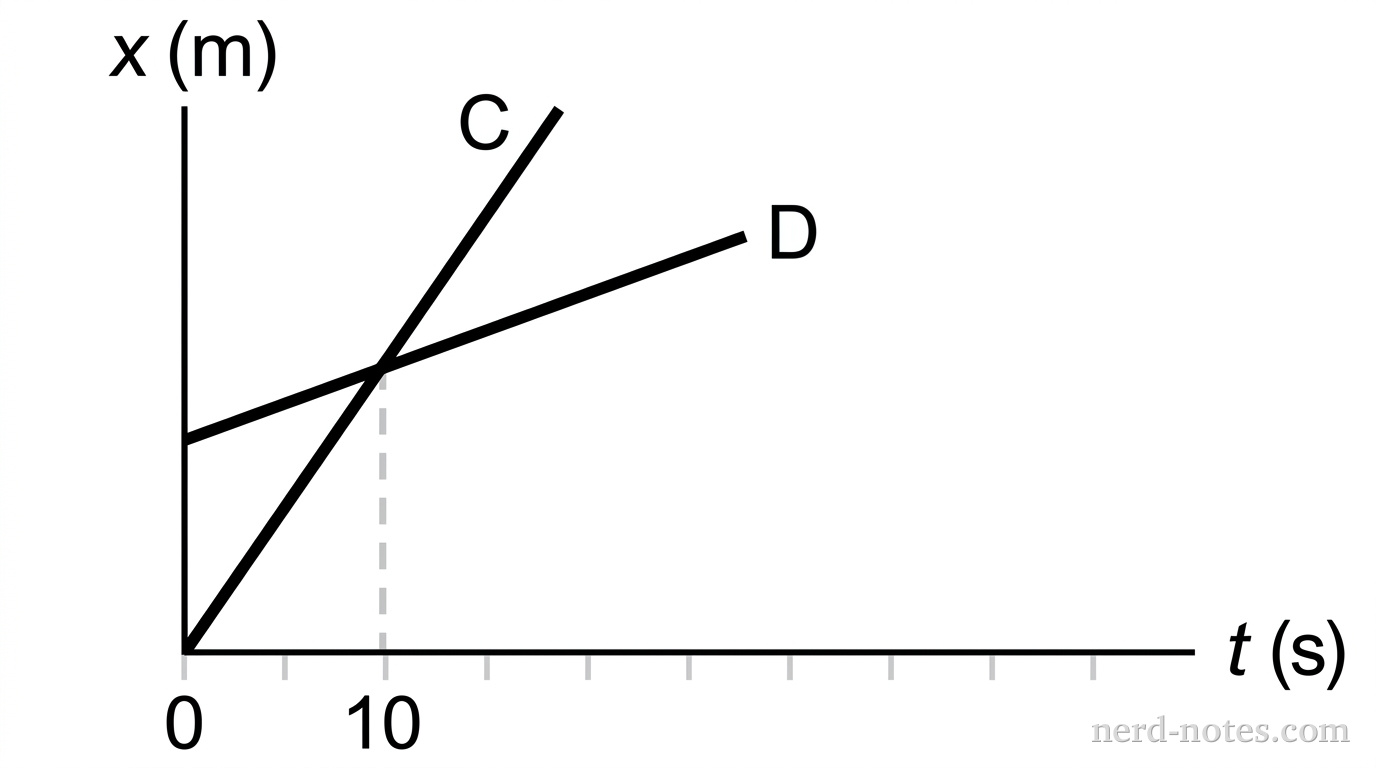
Which statement is true about the distances the two objects have traveled at time \( t_f \)?
A \(4 \, \text{kg}\) mass is traveling at \(10 \, \text{m/s}\) to the right when it collides inelastically with a stationary \(7 \, \text{kg}\) mass. The \(7 \, \text{kg}\) mass then travels at \(2 \, \text{m/s}\) at an angle of \(22^\circ\) below the horizontal. What are the velocity and the angle of the \(4 \, \text{kg}\) mass?
Water flowing in a horizontal pipe speeds up as it goes from a section with a large diameter to a section with a small diameter. Which of the following can explain why the speed of the water increases?
How large must a heating duct be if air moving \( 3 \ \frac{\text{m}}{\text{s}} \) along it can replenish the air in a room of \( 300 \ \text{m}^3 \) volume every \( 15 \) minutes? Assume the air’s density remains constant.
Two closed containers look the same, but one is packed with lead and the other with a few feathers. How could you determine which has more mass if you and the containers were orbiting in a weightless condition in outer space?
A child slides down a slide with a \( 34^\circ \) incline, and at the bottom her speed is precisely half what it would have been if the slide had been frictionless. Calculate the coefficient of kinetic friction between the slide and the child.
By continuing you (1) agree to our Terms of Use and Terms of Sale and (2) consent to sharing your IP and browser information used by this site’s security protocols as outlined in our Privacy Policy.
One price to unlock most advanced version of Phy across all our tools.
per month
Billed Monthly. Cancel Anytime.
Quick Start Guide
AP physics 1, AP C, honors and advanced physics students.
Quickly filter questions by units and more.
Here’s guide to using 5 UBQ filters.
GQ = general question, MCQ = multiple choice, FRQ = free response.
Click the check or bookmark button.
Now you’ll be able to see completed or bookmarked questions at a glance!
Answer keys, personalized for you.
Phy will be responsible for grading your FRQs and GQs.
No more copy and pasting. Just solve and snap.
Questions for Mastery
By continuing you agree to nerd-notes.com Terms of Service, Privacy Policy, and our usage of user data.